|
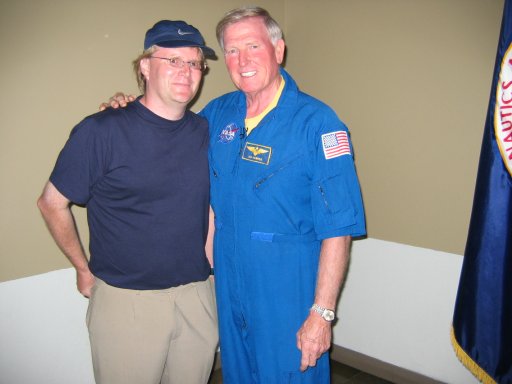
Me and Jon McBride.
McBride bio:
McBride was born August 14, 1943, in Charleston, West Virginia, but considers Beckley, West Virginia, to be his hometown. He graduated from Woodrow High School, Beckley, West Virginia in 1960, then attended West Virginia University 1960-1964 and received a Bachelor of Science degree in Aeronautical Engineering from the U.S. Naval Postgraduate School in 1971. He did graduate work in Human Resource Management at Pepperdine University.
McBride's naval service began in 1965 with flight training at Pensacola, Florida. After winning his wings as a naval aviator, he was assigned to Fighter Squadron 101 based at Naval Air Station Oceana, Virginia, for training in the F-4 "Phantom II" aircraft. He was subsequently assigned to Fighter Squadron 41 where he served 3 years as a fighter pilot and division officer. He has also served tours with Fighter Squadrons 11 and 103. While deployed to Southeast Asia, McBride flew 64 combat missions.
He attended the U.S. Air Force Test Pilot School at Edwards Air Force Base prior to reporting to Air Test and Development Squadron Four at Point Mugu, California, where he served as maintenance officer and Sidewinder project officer. He has flown over 40 different types of military and civilian aircraft and piloted the Navy "Spirit of '76" bicentennial-painted F-4J "Phantom in various air shows during 1976, 1977, and 1978. He holds current FAA ratings which include commercial pilot (multi-engine), instrument, and glider; and he previously served as a Certified Flight Instructor (CFI).
He has logged more than 8,800 hours flying time--including 4,700 hours in jet aircraft.
Selected as an astronaut candidate by NASA in January 1978, McBride became an astronaut in August 1979. His NASA assignments have included lead chase pilot for the maiden voyage of Columbia, software verification in the Shuttle Avionics Integration Laboratory (SAIL), capsule communicator (CAPCOM) for STS-5, STS-6, and STS-7, Flight Data File (FDF) Manager, and orbital rendezvous procedures development.
McBride was pilot of STS 41-G, which launched from Kennedy Space Center, Florida, on October 5, 1984, aboard the Orbiter Challenger. This was the first crew of seven. During their eight day mission, crew members deployed the Earth Radiation Budget Satellite, conducted scientific observations of the earth with the OSTA-3 pallet and Large Format Camera, and demonstrated potential satellite refueling with an EVA and associated hydrazine transfer. Mission duration was 197 hours and concluded with a landing at Kennedy Space Center, Florida, on October 13, 1984.