Raptor Aborts.
December 2020.
Still trying to get to Mars...
See: December 8th. Raptor aborts.
December 9th. Starship: Second launch attempt.
Indeed, the whole Starship adventure took me back
to my own visit
to the Kennedy Space Center, back in 2006.
See: here.
Before that, on december 2nd, Richard Bartle asked us all
to consider how we treat other (moral) beings.
More precisely, moral beings who live in coming virtual worlds...
See: here.
And after Richard Bartle's presentation you might be wondering...
But what about ourselves? Are we also living in a simulation?
See: The Simulation Argument.
Certainly, Virtual Reality is getting better all the time!
See: Virtual Reality.
Raptor Aborts.
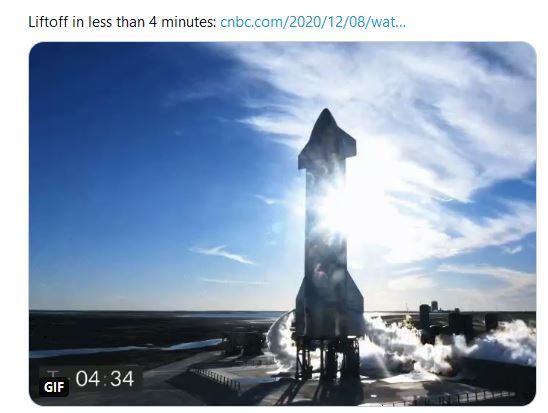
December 8th:
SpaceX counted down toward the first high-altitude launch of its Starship vehicle on Tuesday, but its main engines aborted the attempt at T-1.3 seconds. It is not clear whether there was an issue with one or more of the Raptor engines or if a sensor detected some problem elsewhere in the rocket to automatically trigger the abort.
Engine abort at T-1.3 seconds.
Still, quite a day:





-Simon
Simon Laub (Let me Google that for you).
www.simonlaub.net
December 9th. Starship: Second launch attempt.
SpaceX high-altitude Starship debut go for a second launch attempt.












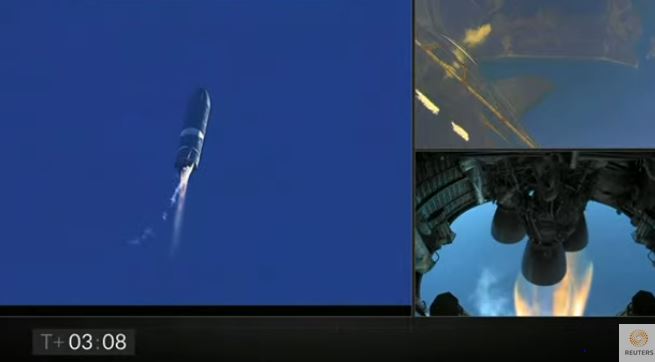














Indeed, it is all about going to Mars... See more here.
Or just to the ISS, see here.
-Simon
Simon Laub (Let me Google that for you).
www.simonlaub.net
Florida 2006.
Indeed, the whole Starship adventure
took me back to my own visit
to the Kennedy Space Center, back in 2006,
where I saw
the Shuttle Atlantis getting ready for launch.

Indeed, there is no business like the
space business...
Can't wait to get back and see it all live...
-Simon
Simon Laub (Let me Google that for you).
www.simonlaub.net
Webinar: AI, Games and Ethics. Edinburgh livefeed.
December 2nd - joined a webinar (livefeed from Edinburgh)

Here Richard Bartle talked about designing virtual worlds.
According to earlier work by Bartle,
it is a virtual world designer's role to know,
what will provide players with a positive game experience,
based on player classification.
That is, their preferred actions within the game:
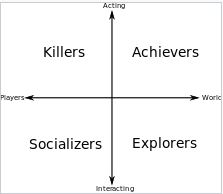
Indeed:
The designers of computer games are the gods of the realities they create.
But what happens, in future versions of such virtual worlds, where we
might have non-player
characters in our virtual worlds, who are as smart as, or smarter than, we are?
What are the moral concerns here?
How should (moral) beings in such virtual worlds be treated?
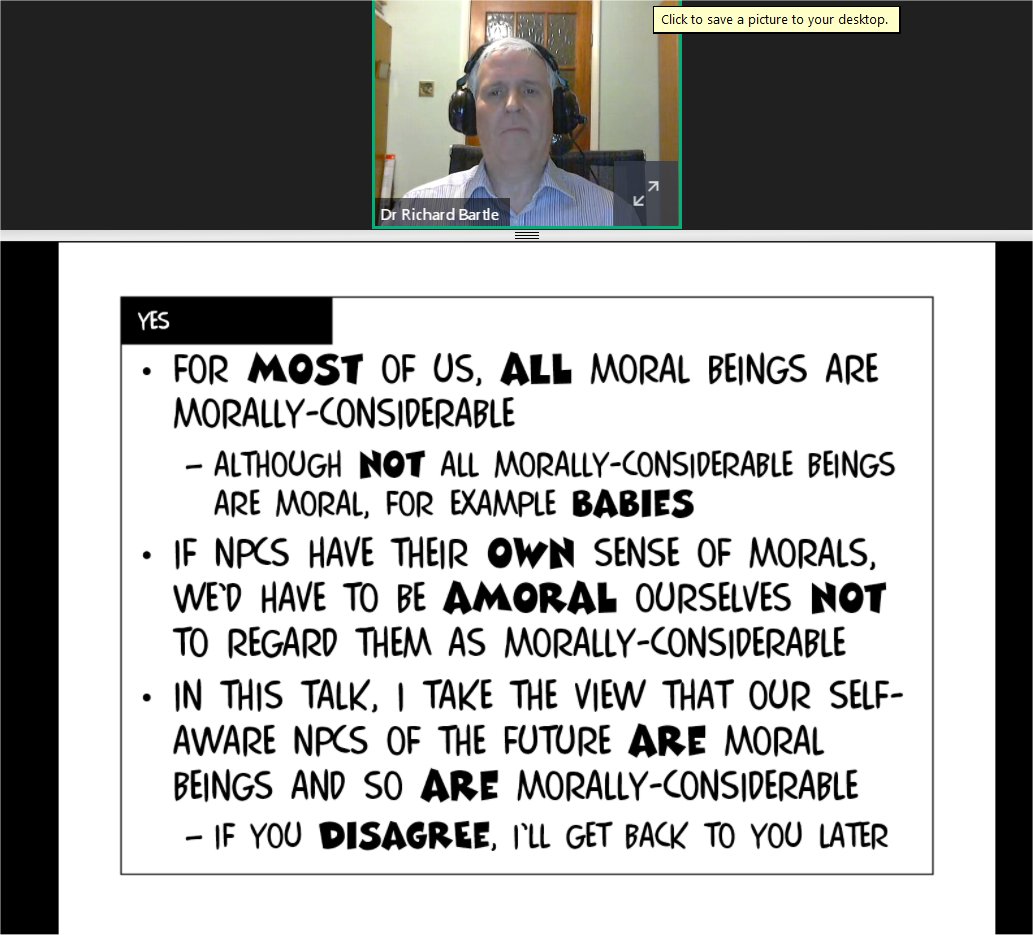
Can we just switch off the simulation if we feel like it?
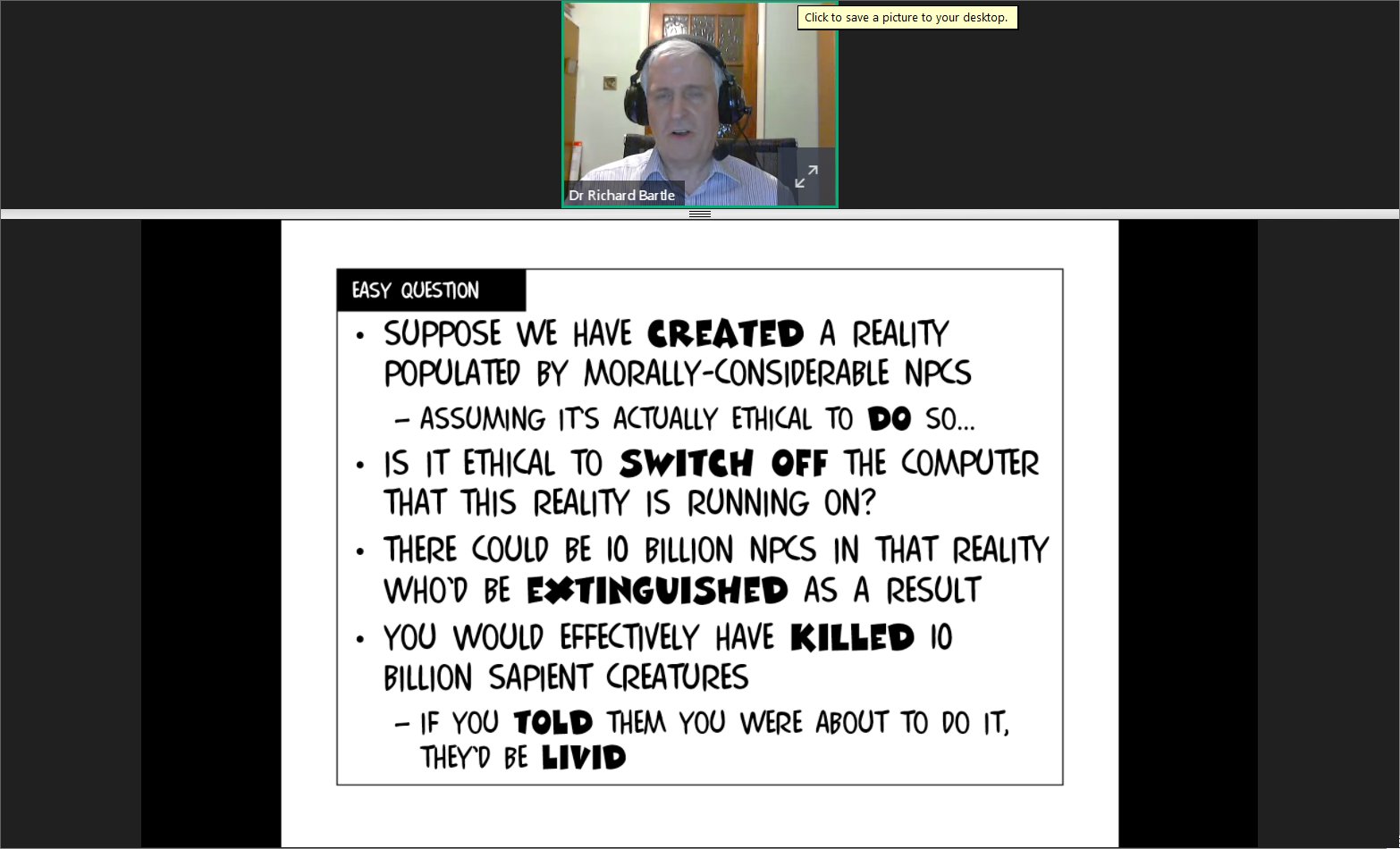
Do we have any duty of care towards the individuals whom we create?
Are they morally-considerable beings or mere bits in a database?
Is it indeed ethical to create them in the first place?
Well, well - see more here.
-Simon
Simon Laub (Let me Google that for you).
www.simonlaub.net
The Simulation Argument.
And after Richard Bartle's presentation you might be wondering...
But what about ourselves?
Are we also living in a simulation that someone else ''runs''?
In the words of Nick Bostrom:
Will future civilisations have enough computing power and programming skills to be able to create ''ancestor simulations''?
See Bostroms ''Simulation Hypothesis'':

And read on about the Simulation Argument on this site...

-Simon
Simon Laub (Let me Google that for you).
www.simonlaub.net
Virtual Reality.
Certainly, virtual reality is getting better all the time!
Indeed, a plank of wood and current VR technology might be more than enough
to mess up our understanding of where we are, and what the world is really like.
For more, see the Richie Plank Experience.

Just as 3d graphics is getting better all the time...
For more, see my 2010 Avatar post ''How I learned to stop worrying and love the eye candy'',
here.

-Simon
Simon Laub (Let me Google that for you).
www.simonlaub.net