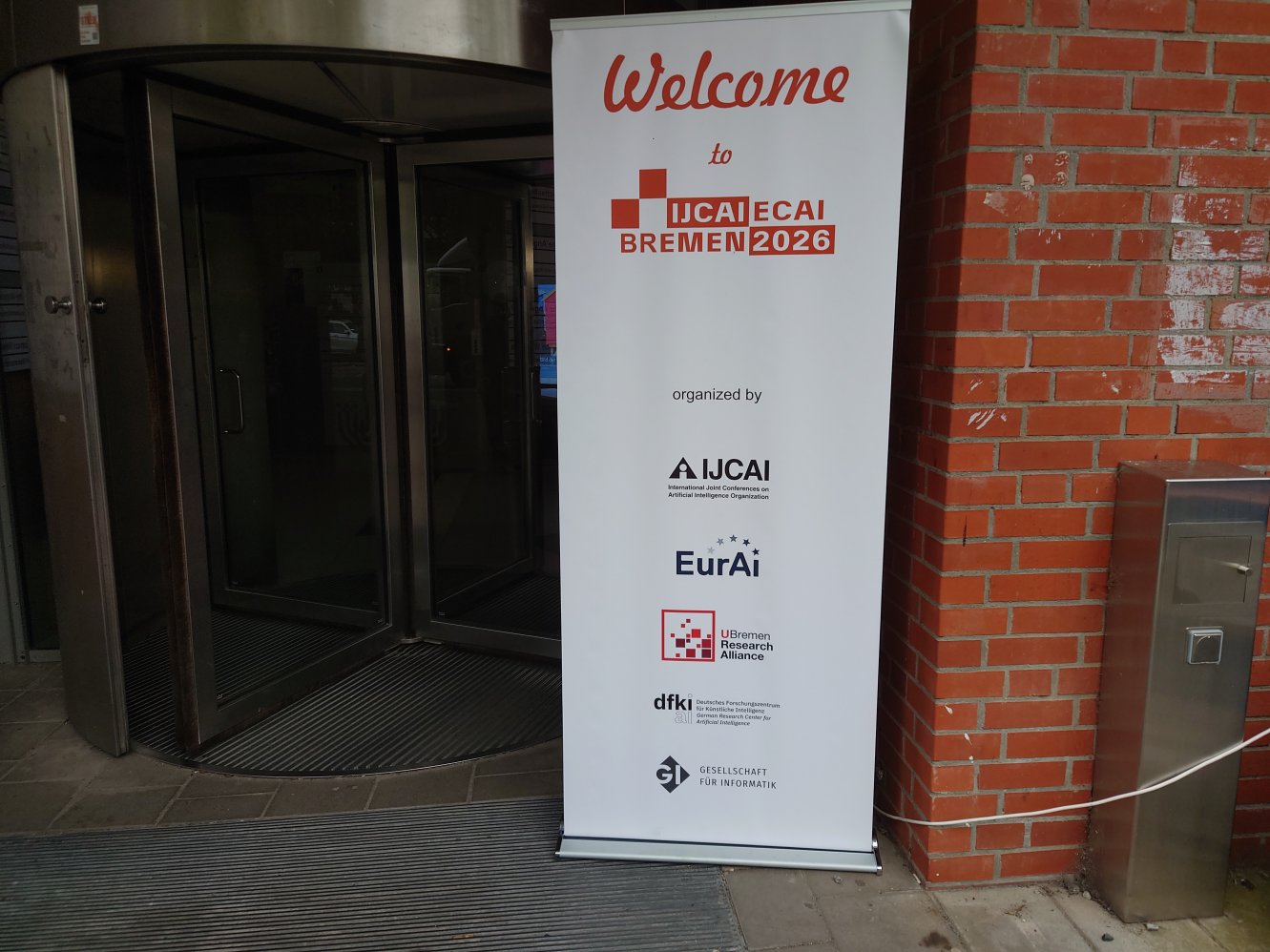
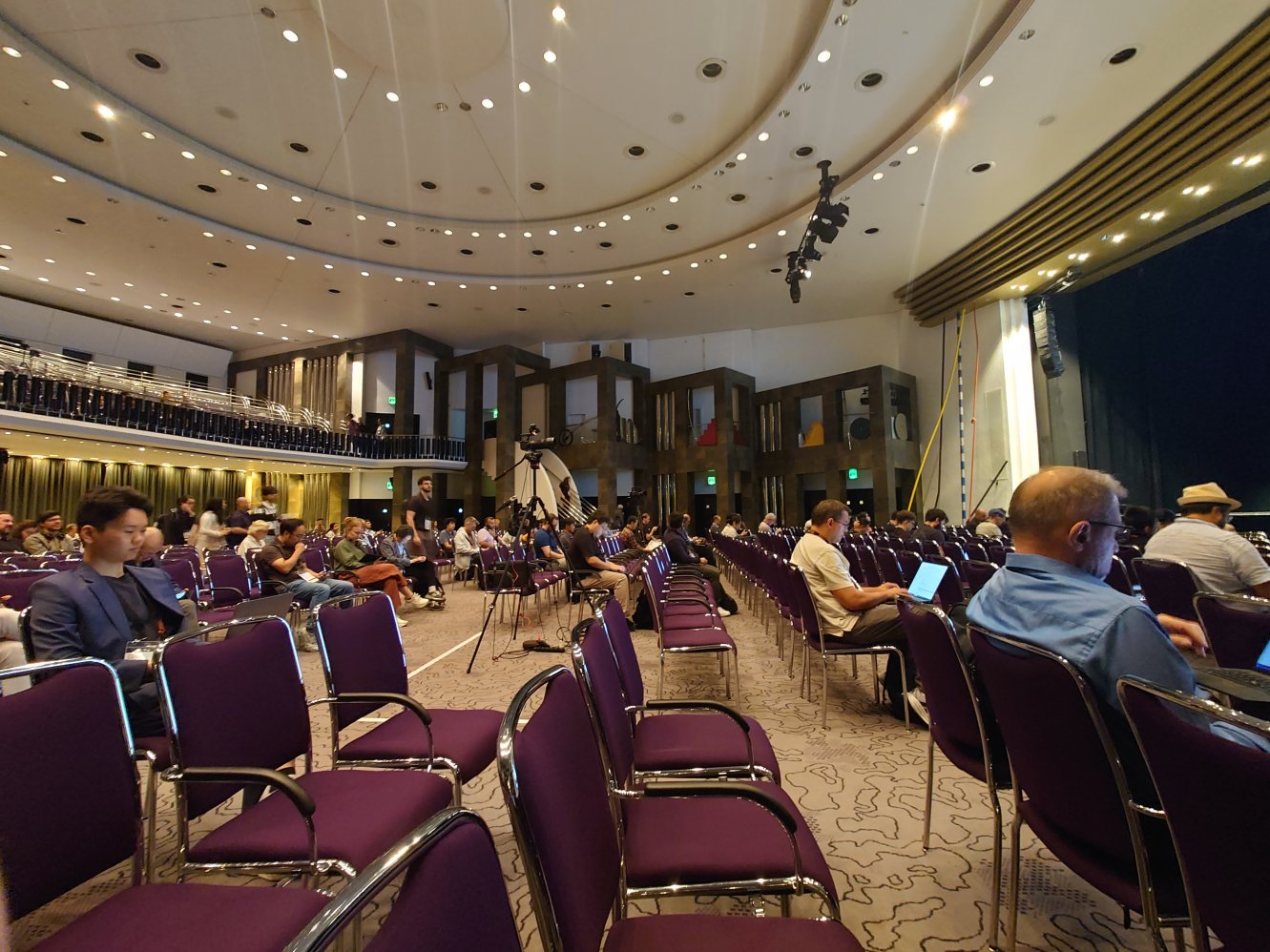
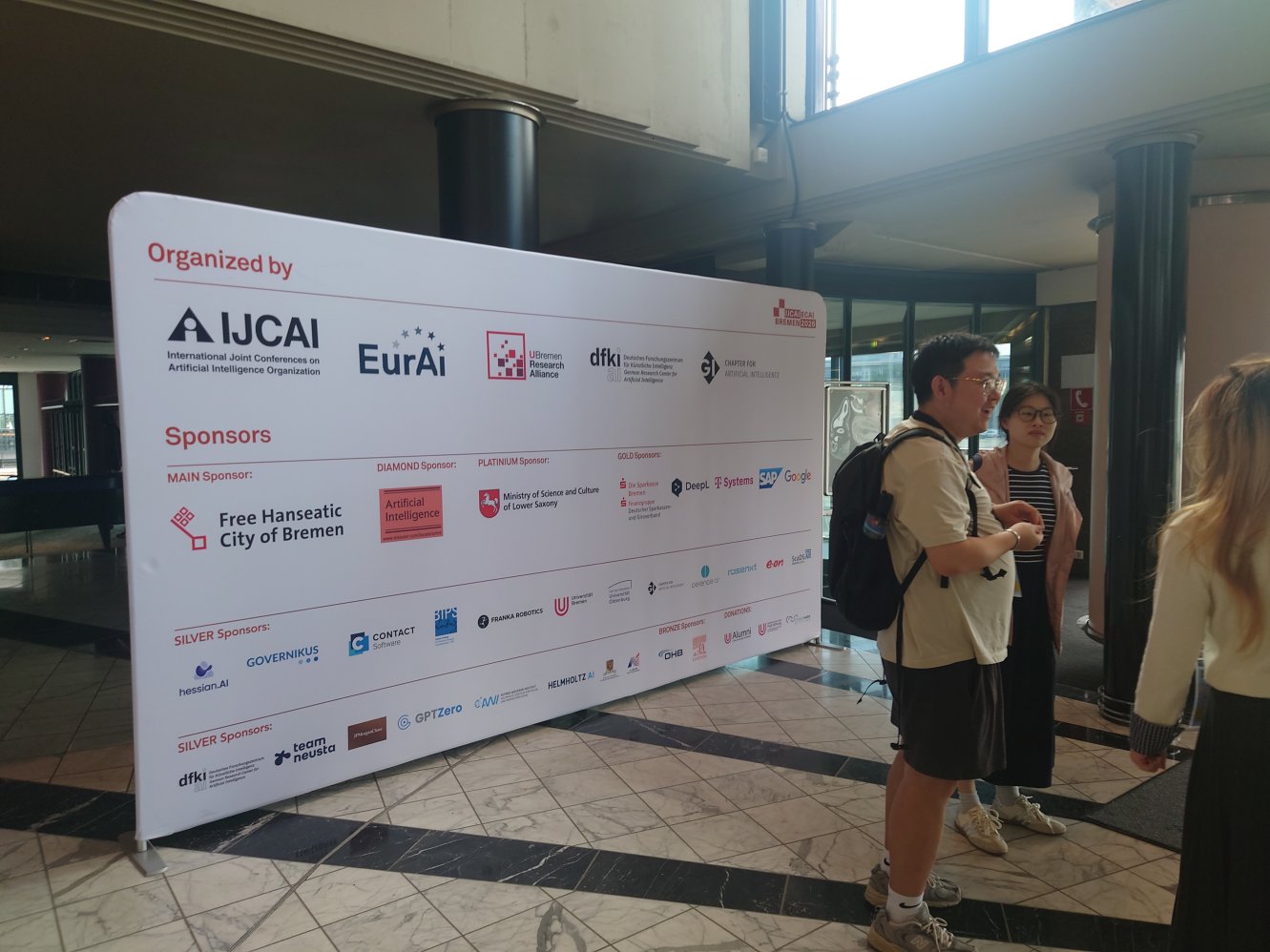
I had the great pleasure of taking part in Ijcai 2026 (The 35th International Joint Conference on Artificial Intelligence). August 16-21, 2026.
Tried to follow as much as possible, But, well, these notes are, of course, in
no way, shape or form complete...
Rather, these notes were written on conference nights, as my way of
keeping track of the events of the day. And as a way of storing links and references for future reference.
Below you will find impressions from the conference, and links for further reading.
Ijcai 2026. August 16-21, 2026. Bremen, Germany.
Ijcai 2026. Talks, workshops & tutorials.
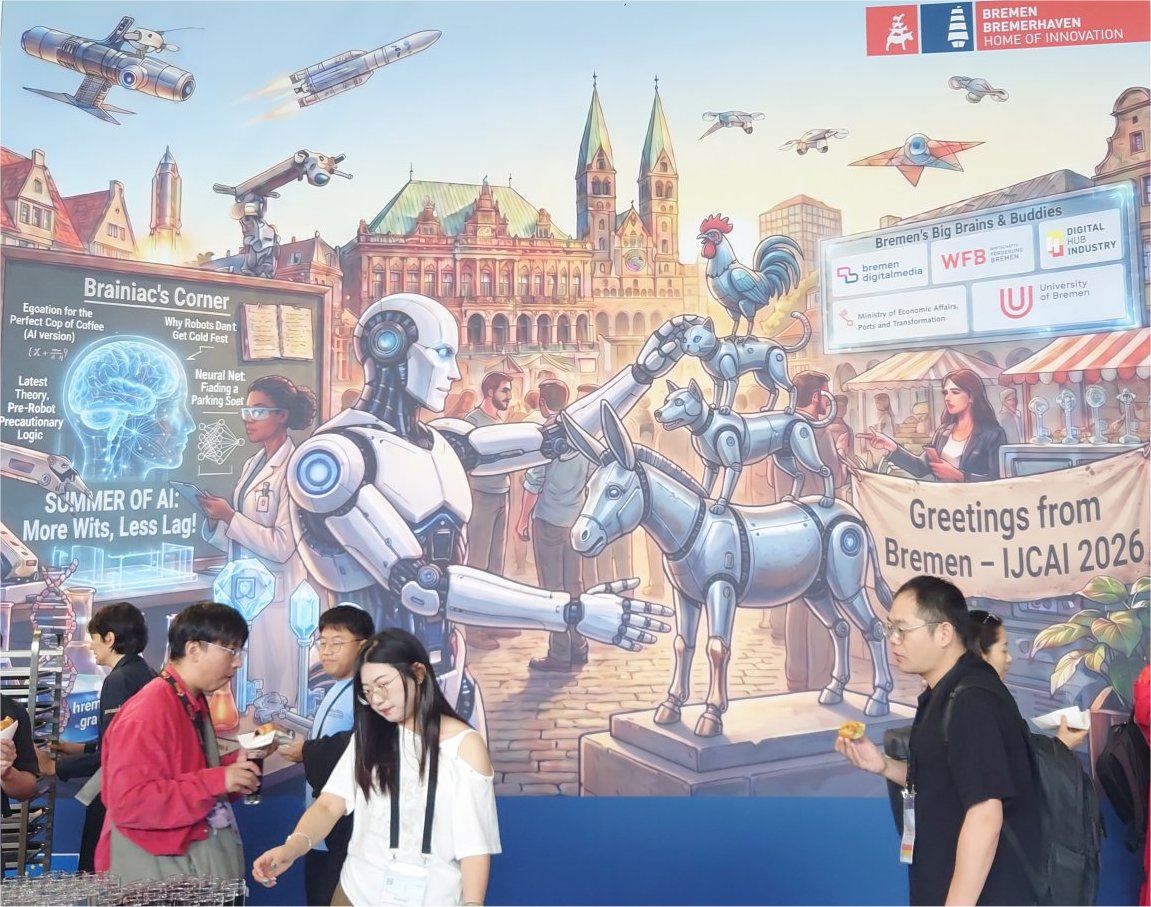
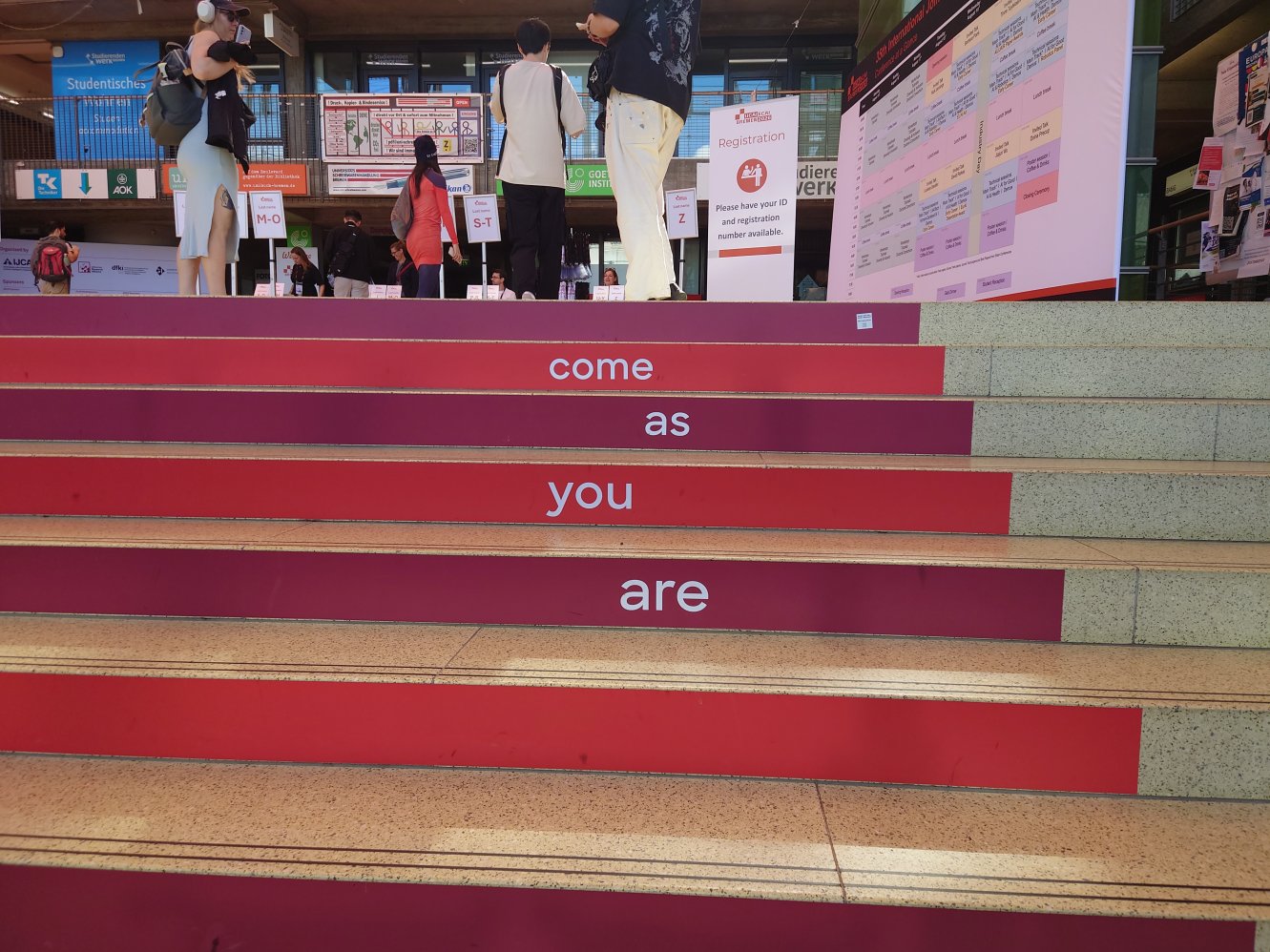
Impressions from August 16-21, 2026.
University of Bremen.
University of Bremen.
1. Workshop. Sunday, August 16th.
1.1. AI-Based Humanoid Robot Design and Control.
Only had a very brief sneak peek at the Sunday workshop ''AI-Based Humanoid Robot Design and Control'', but it looked interesting.
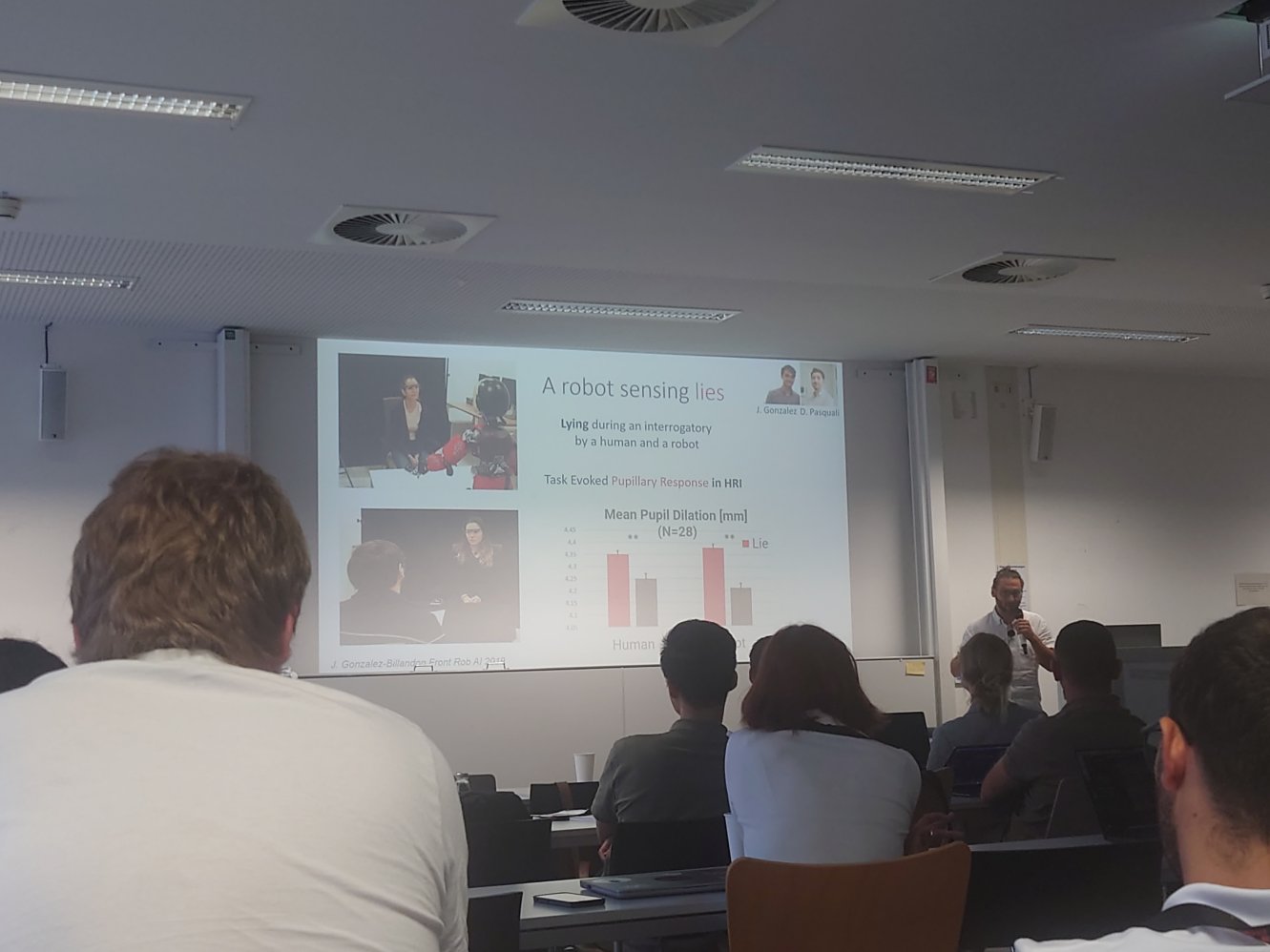
A few short impressions: ''A robot sensing lies...''
Lying to a human and a robot during an interrogation.
- (Look at) mean pupil dilation.
Notice: We (humans) interpret others using knowledge about our own bodies.
From the Workshop description:
Humanoid robots have achieved remarkable progress in dynamic motion and control. However, major challenges remain, including the gap between simulation and real-world performance, limited adaptability, and insufficient integration of human-centered interaction [1].
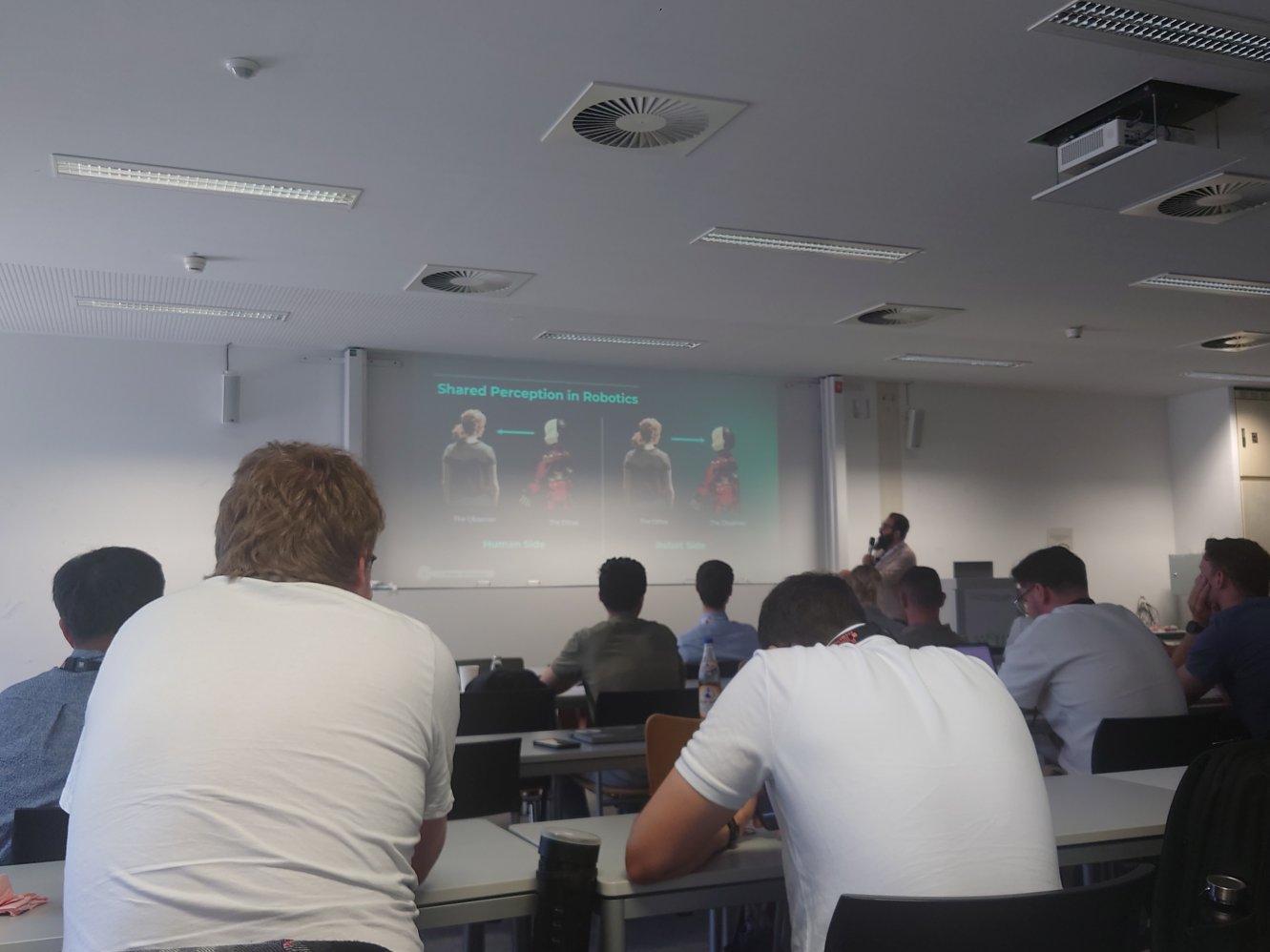
Shared (human-robot) perception in robotics.
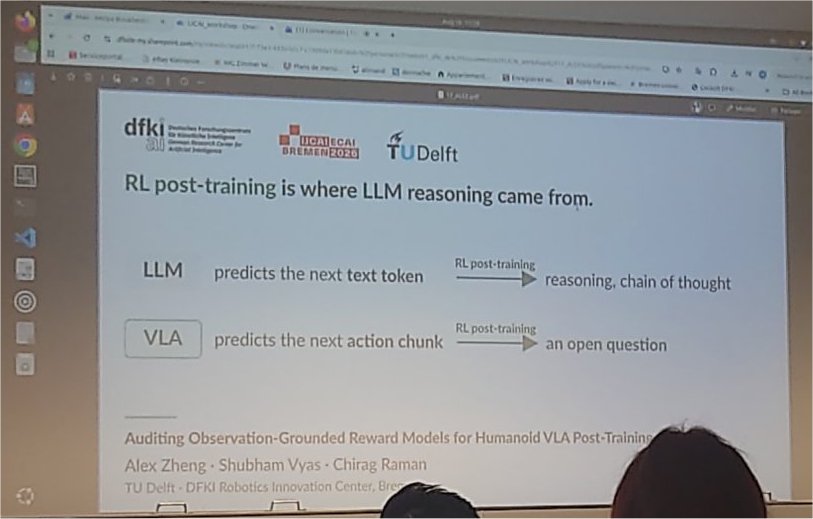
(For robots) Using VLAs to predict the next action chunk?
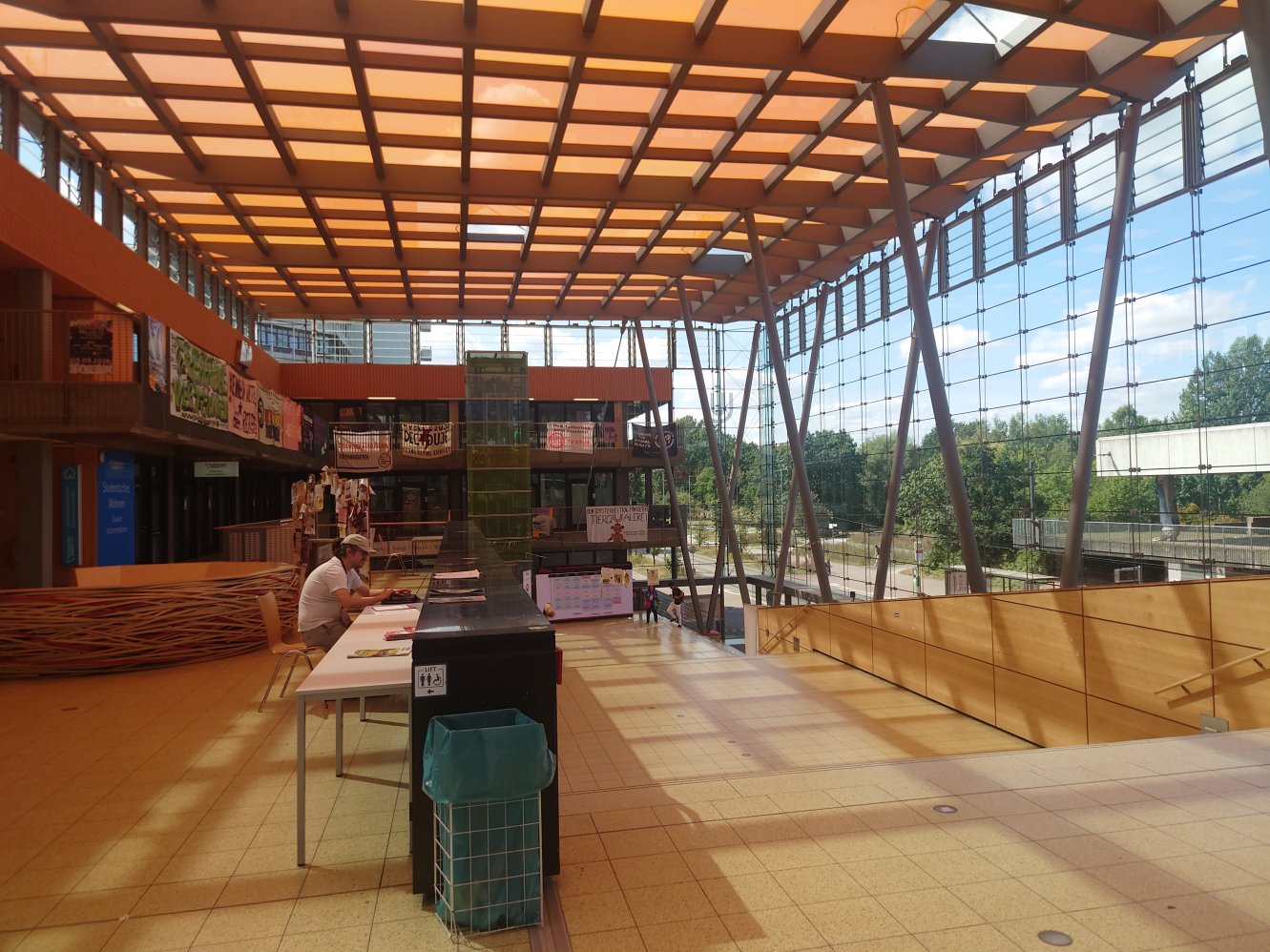
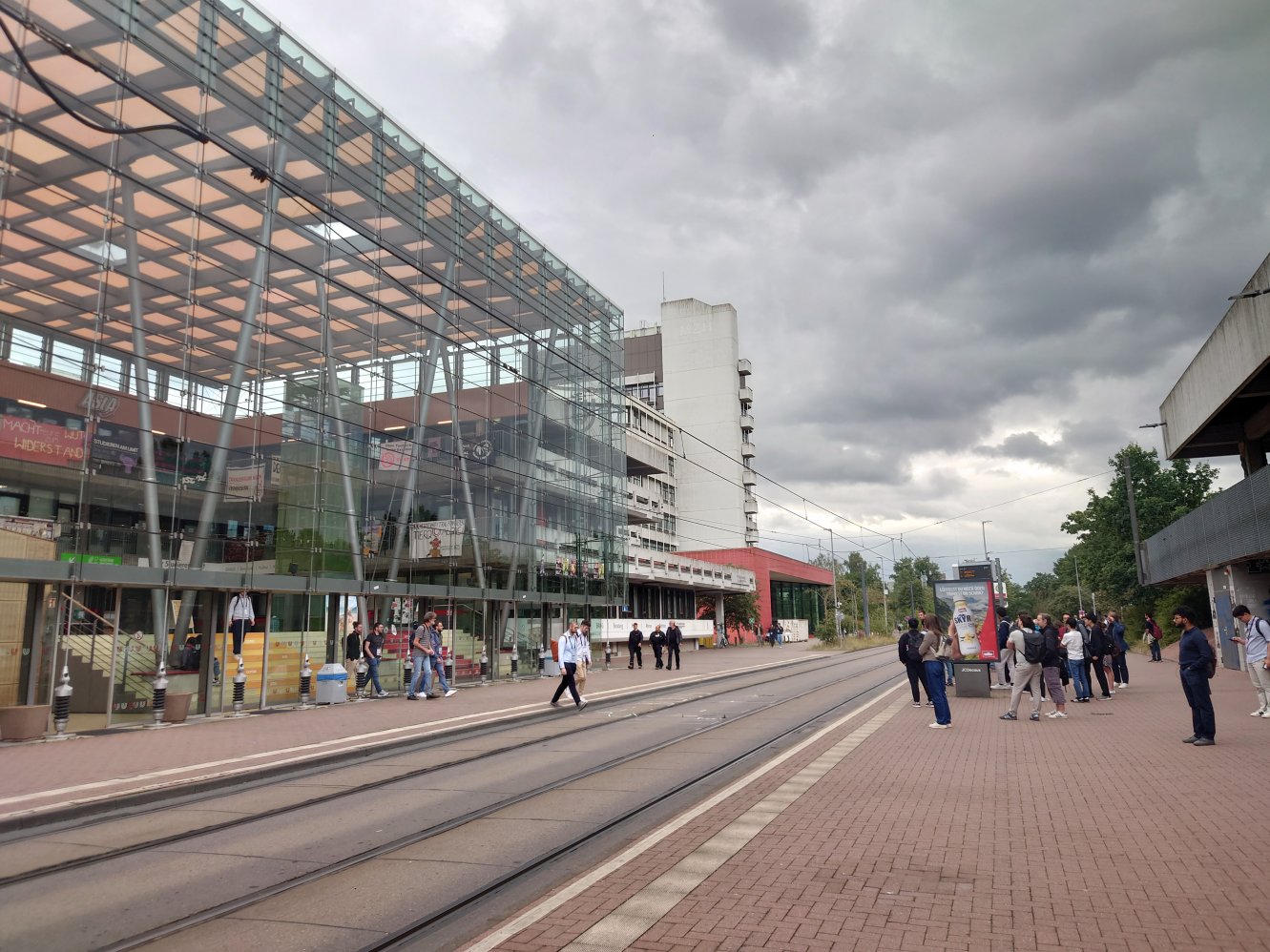
1.2. Campus life. Building GW2, Bremen University.
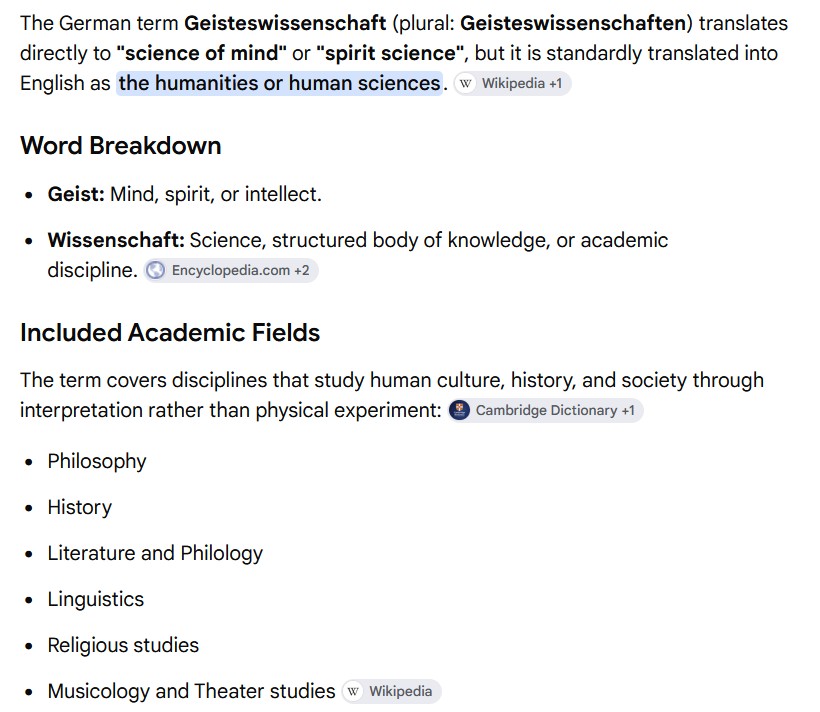
Geisteswissenschaft:
It breaks down to science of the mind or spirit science (Geist meaning mind/spirit, and Wissenschaft meaning science or systematic study).
Included Fields: It covers subjects like philosophy, history, literature, linguistics, art history, and religious studies.
Usage Difference: While English separates these fields from science by calling them the humanities, the German term explicitly includes Wissenschaft to highlight that they use rigorous, systematic methods of understanding—focusing on meaning and interpretation rather than physical laws.
Aufstieg und Fall. The most famous piece of art inside GW2 is a massive 6-by-10-meter wall painting located right in the main foyer near the central staircase. Completed in 1981, it was created by Bremen artist Jimmi D. Paesler. It serves as a time-capsule allegory of university life in the late 70s and early 80s. It depicts gray men looking through a frame at stumbling students who have abandoned political struggles, symbolized by a discarded red banner sliding down the stairs. A narrow crack of light behind a heavy security door hints at the uncertain future awaiting students in the real world.
Building GW2 (Geisteswissenschaften 2) is the largest building on the campus of the University of Bremen.
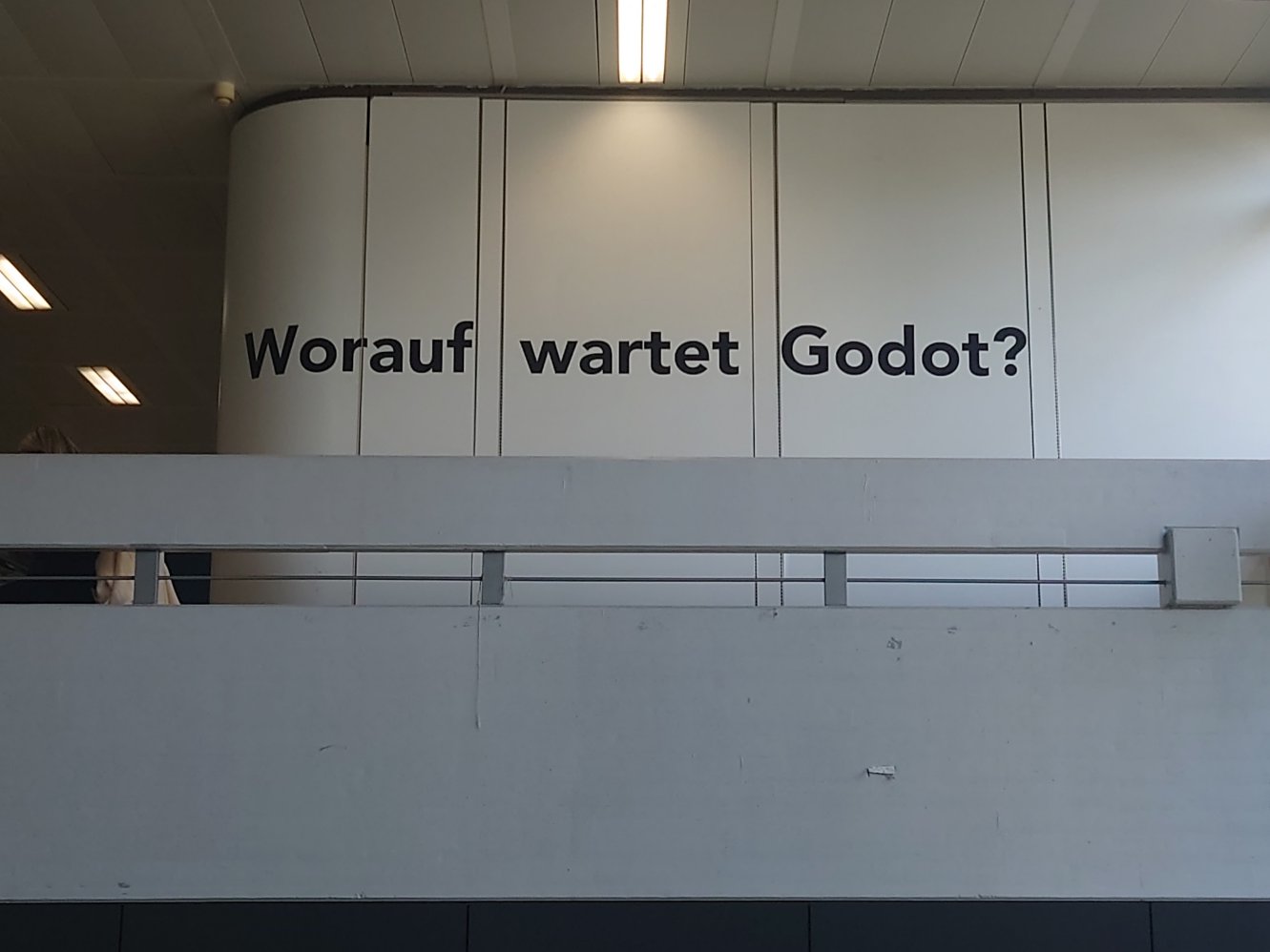
Opened in 1972, GW2 is famous for its unique, complex architecture and extensive multi-level layout, which famously made it feel like a labyrinth to early students. When it was first built, the first floor featured a massive 3,000-square-meter open-plan office designed to eliminate academic hierarchies by placing students, professors, and administrative staff next to each other.
''Waiting for Godot'' is a play by Irish playwright and author Samuel Beckett.
Building GW2 (Geisteswissenschaften 2) is the largest building on the campus of the University of Bremen.
2. Workshops, Tutorials. Monday, August 17th.
2.1. The Fifth International Workshop on Human Brain and Artificial Intelligence.
The workshop is designed to promote active exchange between the AI and Neuroscience communities [2].
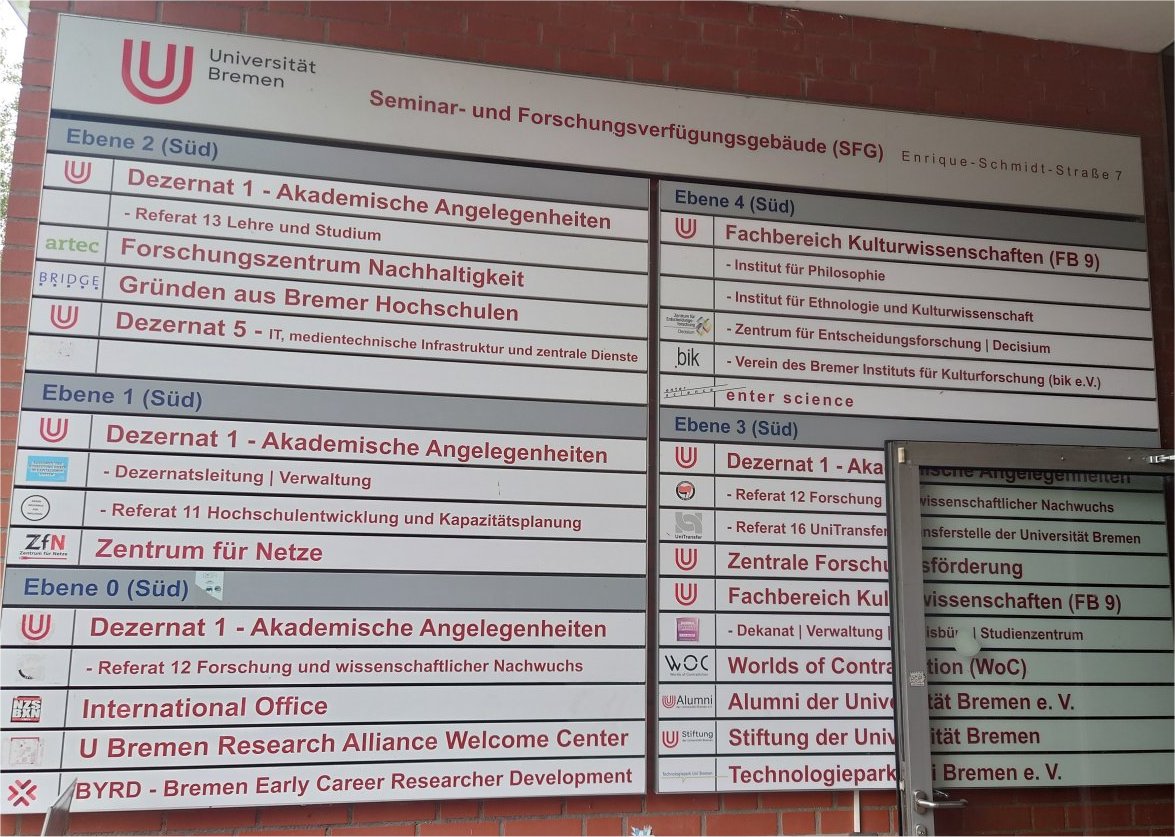
Building SFG, Bremen University.
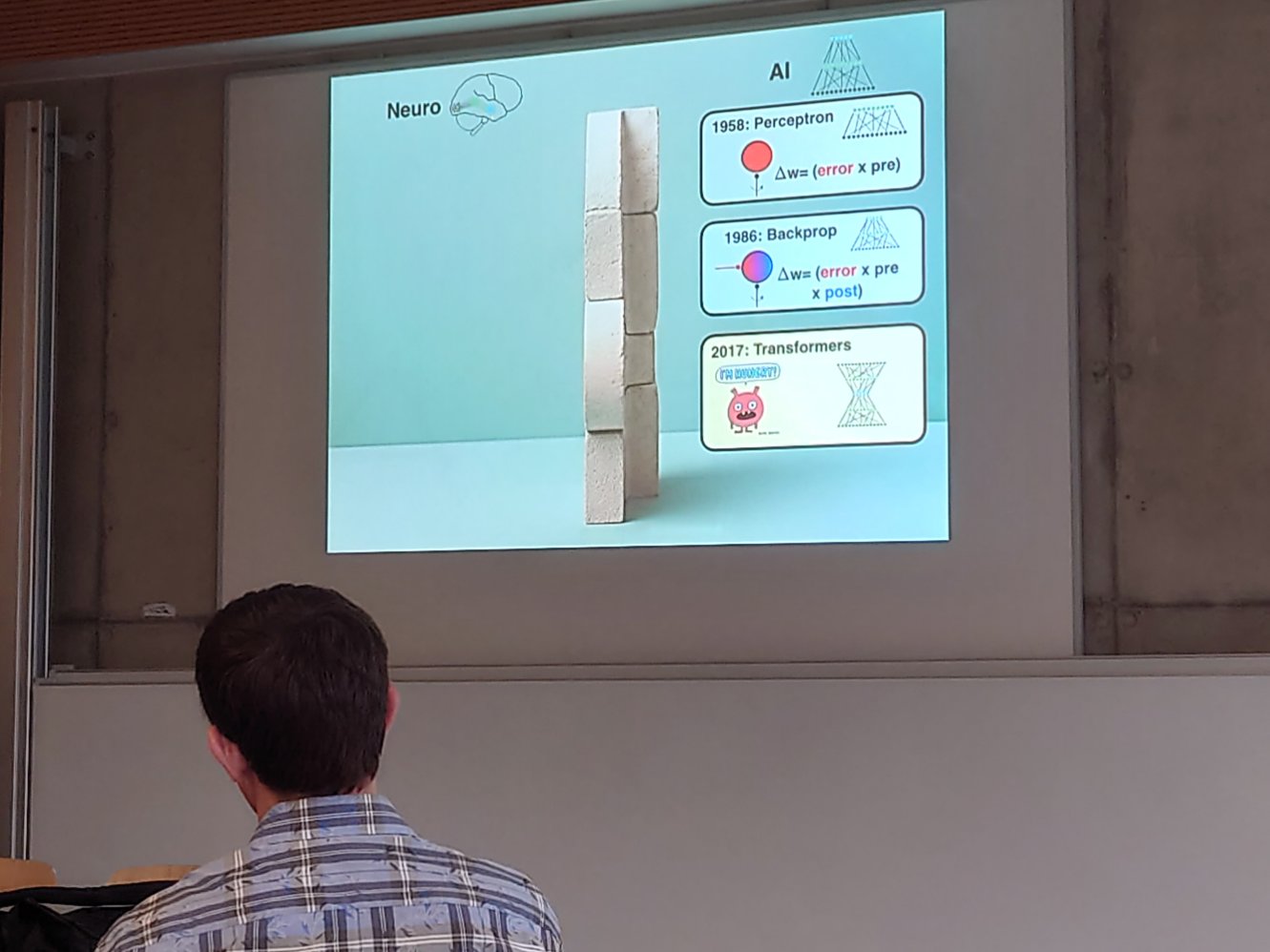
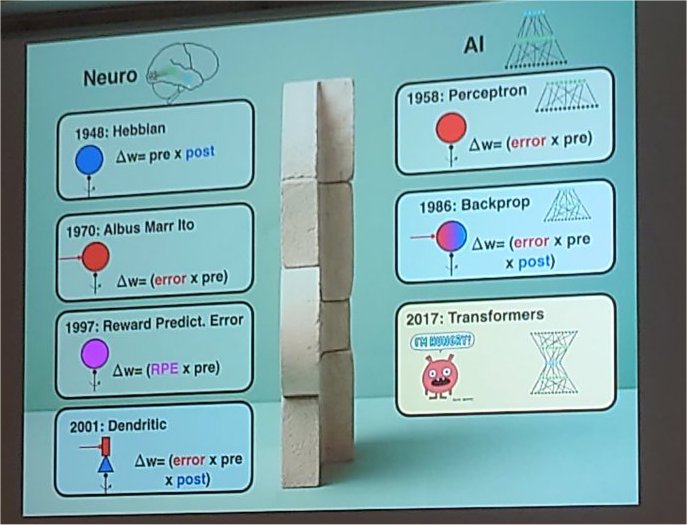
AI:
1958. Perceptron.
1986. Backprop.
2017. Transformers.
Neuro:
1948. Hebbian Learning. The classic rule that ''neurons that fire together, wire together'', where the change in connection strength depends on pre-synaptic and post-synaptic activity.
1970. Albus Marr Ito. Models of error-driven learning observed in the cerebellum, where a mistake modifies the connection based on an error signal and pre-synaptic input.
1997. Reward Prediction Error (RPE). The discovery of dopamine-driven reinforcement learning in the brain, where updates are based on the difference between expected and received rewards.
2001. Dendritic. More complex biophysical learning rules involving the combined interaction of error signals, pre-synaptic, and post-synaptic activity within localized dendrites.
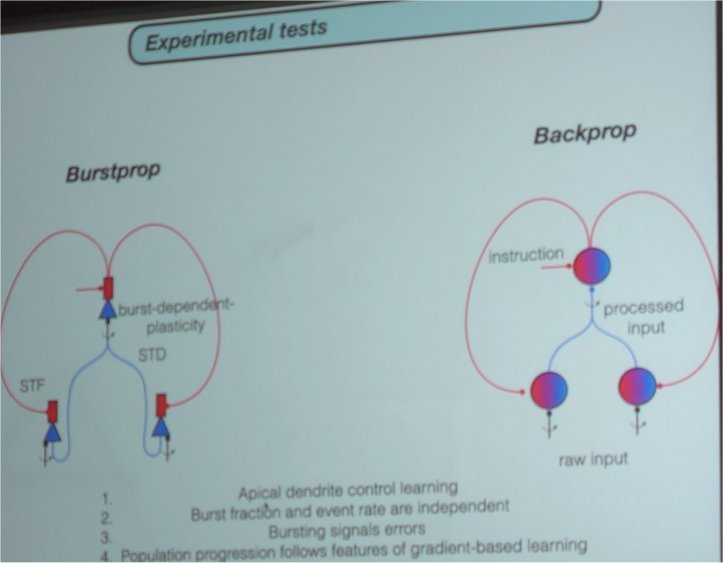
Experimental tests used to validate a biologically plausible model of backpropagation in the brain, directly comparing Burstprop (biological/neuroscientific mechanism) with standard artificial Backprop (artificial intelligence algorithm).
Burstprop:
Mechanism. It relies on burst-dependent plasticity and specific microcircuit dynamics like Short-Term Facilitation (STF) and Short-Term Depression (STD).
Anatomy. It utilizes the apical dendrites (the top branch of a pyramidal neuron) to receive top-down instructional feedback, separating error signals from bottom-up sensory streams.
Real neurons do not just send single electrical pulses (spikes) to represent features; they also emit rapid successions of pulses (bursts). Burstprop leverages this to use single spikes for ''sensory information'' (the forward pass) and bursts for the ''teaching signal'' (the backward pass) (Neuron Bursts Can Mimic AI Learning Strategy) [3].
Newer implementations have successfully trained hierarchical Spiking Neural Networks (SNNs) on machine learning benchmarks like MNIST handwritten digit recognition. Burstprop networks achieve competitive classification accuracies (above 90%), demonstrating that the rule is functional for complex pattern recognition.
SFG building. University of Bremen.
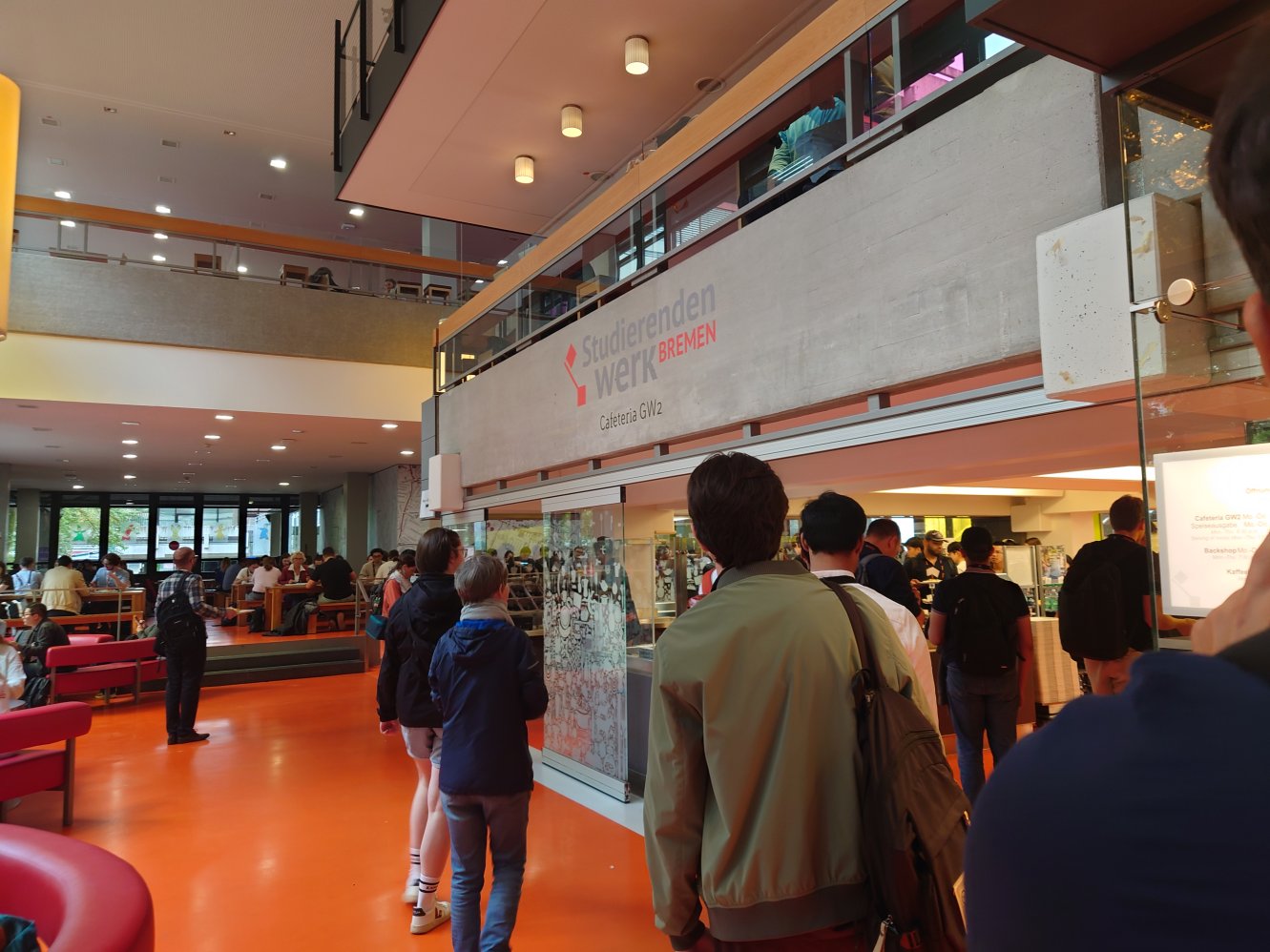
Canteen. GW2 building. University of Bremen.
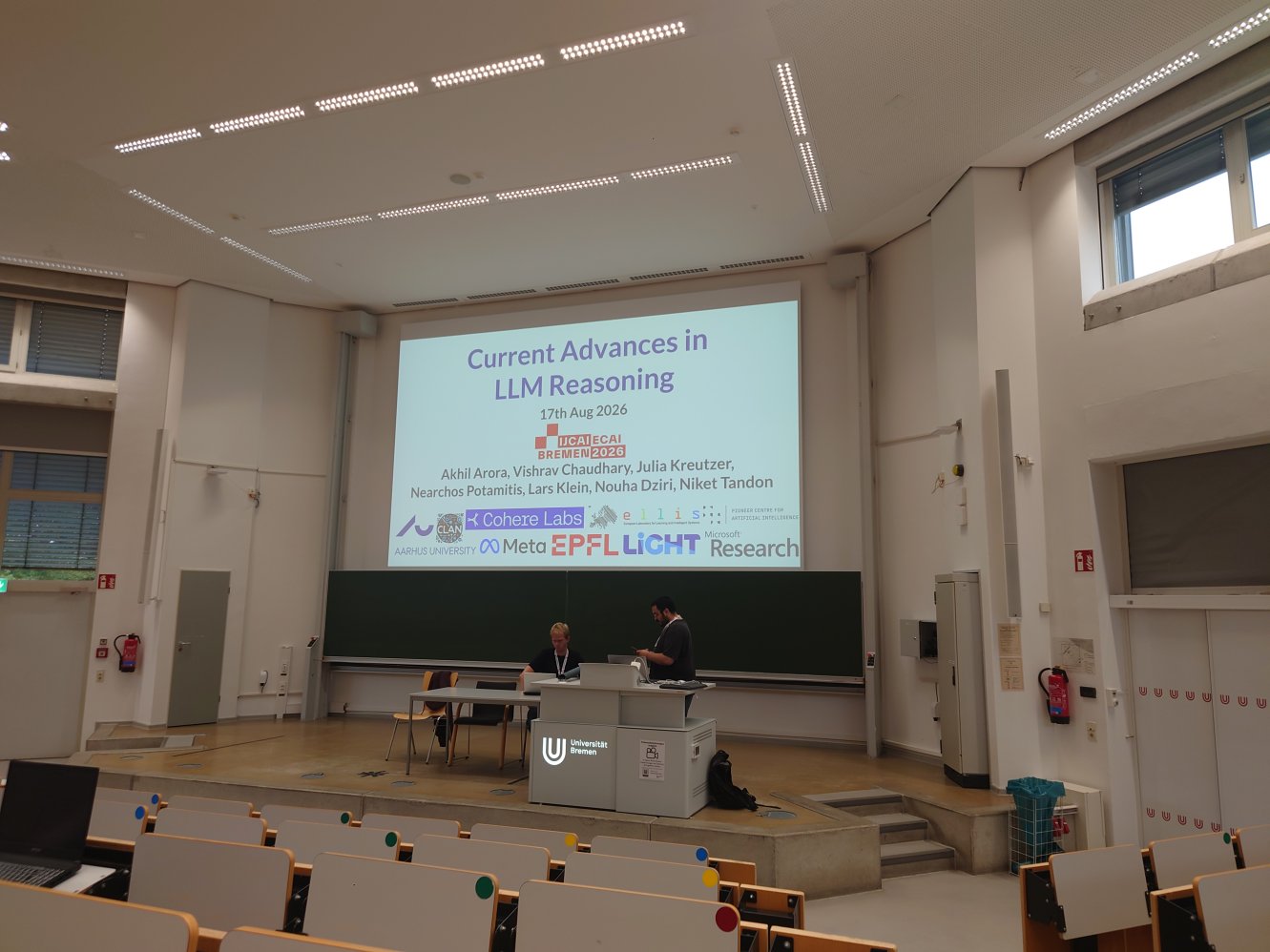
2.2. Tutorial. Current Advances in Reasoning with Large Language Models.
Tutorial. Monday, 17th, 2026.
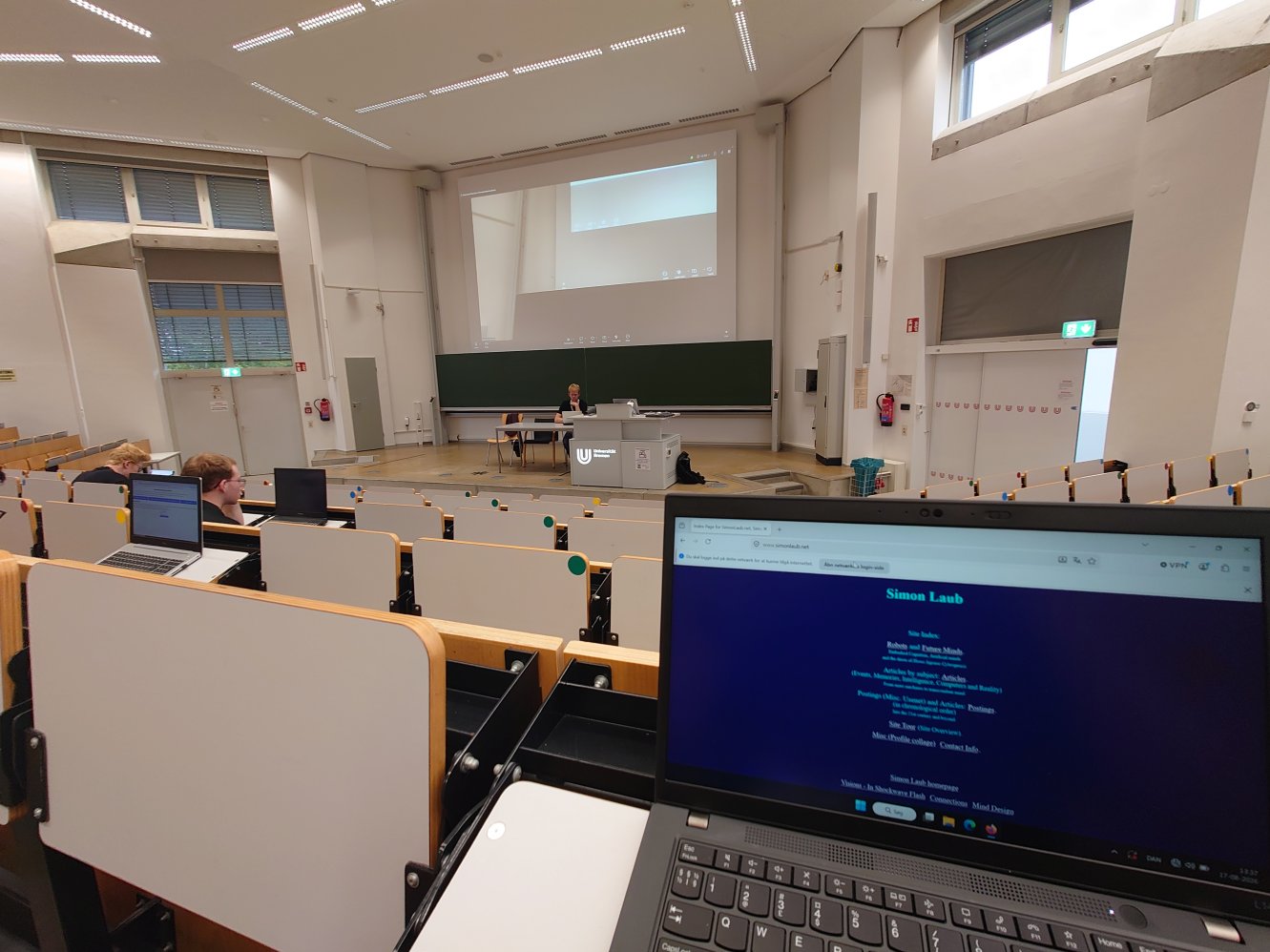
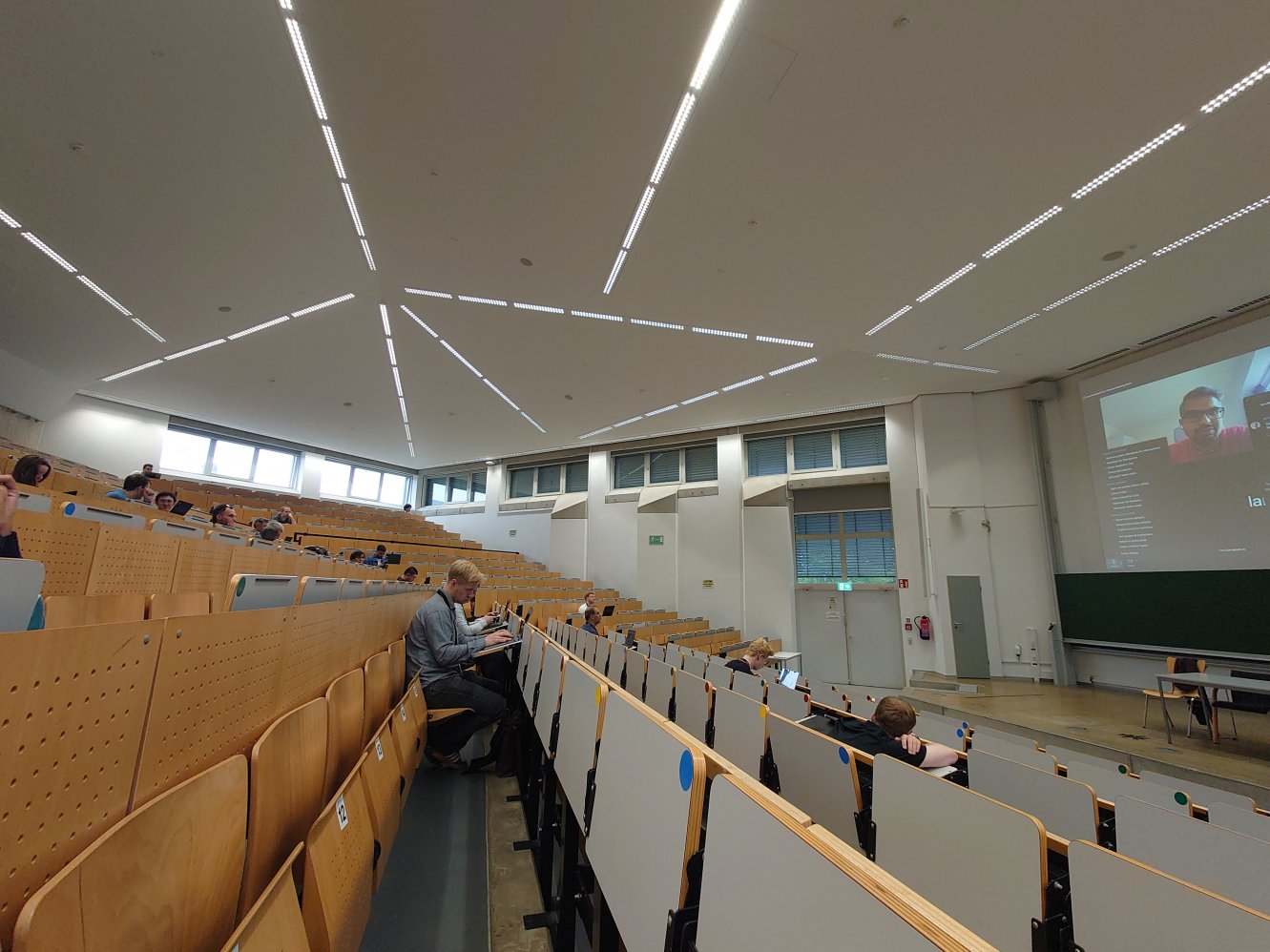
Auditorium. University of Bremen.
Current Advances in Reasoning with Large Language Models.
Yes. ChatGPT has effectively bypassed or ''broken'' the traditional Turing test (a test of a machine's ability to exhibit intelligent behavior indistinguishable from a human).
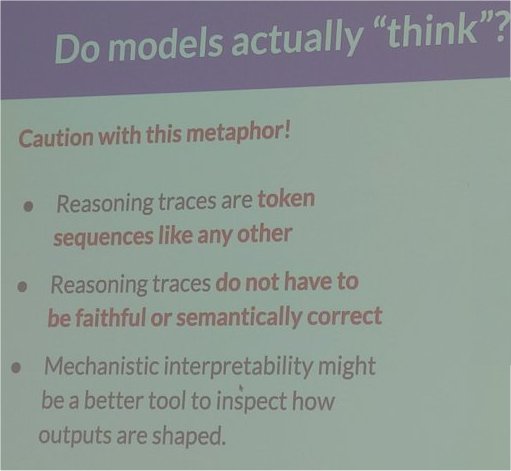
Still: LLMs can write essays and pass tough exams, but do these models actually possess reasoning skills or are they just predicting the most likely next words based on their training data?
Reasoning types a reasoning model should be able to perform:
Deduction (Certainty): You start with a bulletproof rule (''All robins are birds'') and a specific case (''This animal is a robin''). The conclusion (''This animal is a bird'') is 100% logically certain.
Induction (Pattern Recognition): This is how machine learning and AI typically function. By looking at many specific examples (Animal A, Animal B, etc.), the system spots a pattern and generates a new general rule. Seeing multiple robins that are all birds to conclude that all robins are birds.
Abduction (Educated Guessing): You reverse deduction to find the most plausible explanation. You see a bird, know that robins are birds, so you guess it might be a robin. This is how medical diagnoses or detective work operate. Seeing a bird and guessing it might be a robin (though it could be a sparrow).
LLMs emulate human reasoning steps at inference time by predicting the most statistically likely next tokens. E.g.
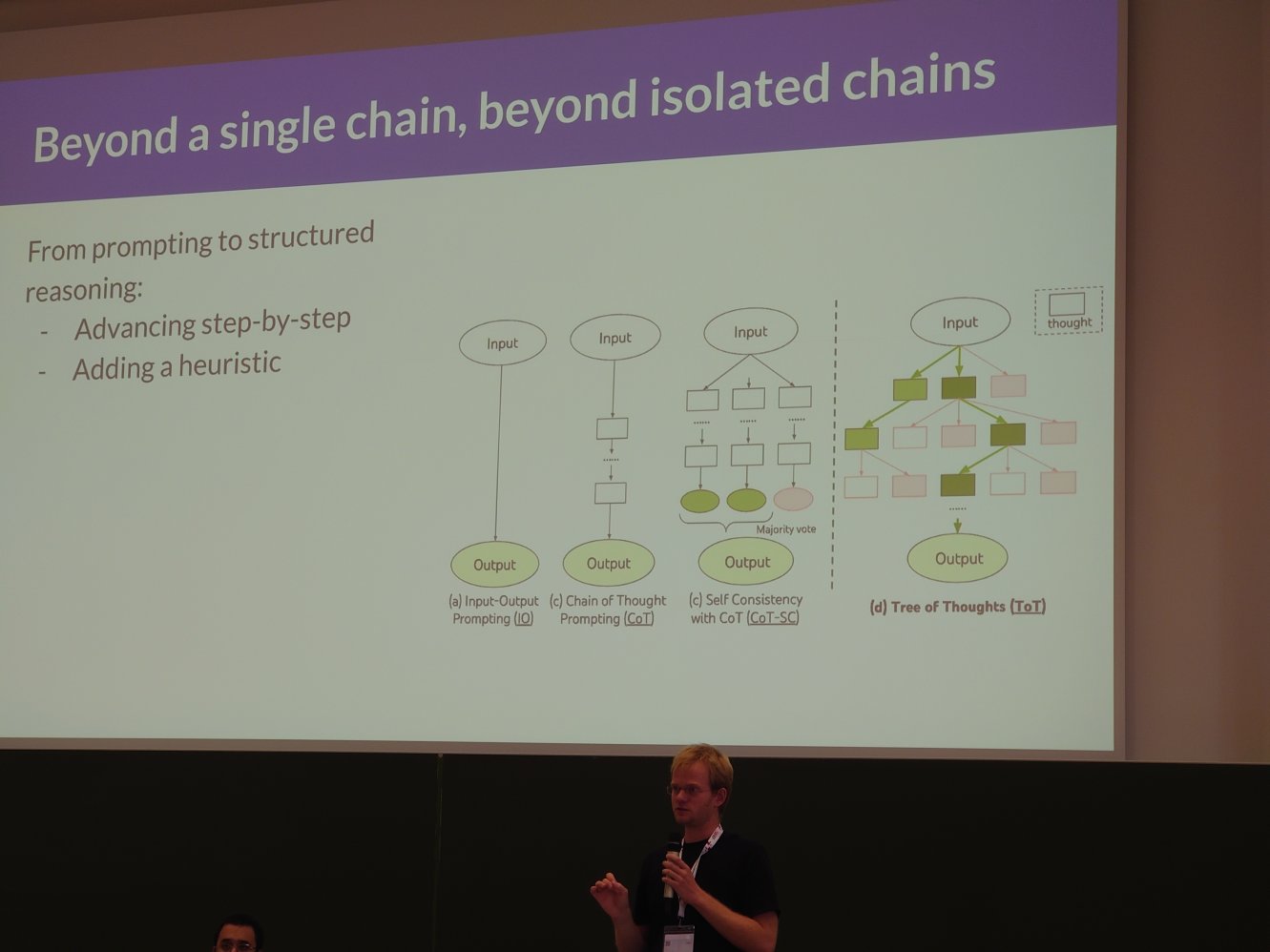
LLMs Deductive Reasoning via Chain of Thought (CoT):
The model breaks the problem into sequential, linear chunks.
LLMs Abductive Reasoning via Structured Guessing:
The model generates multiple hypotheses to explain a bug and eliminates those that do not match the evidence.
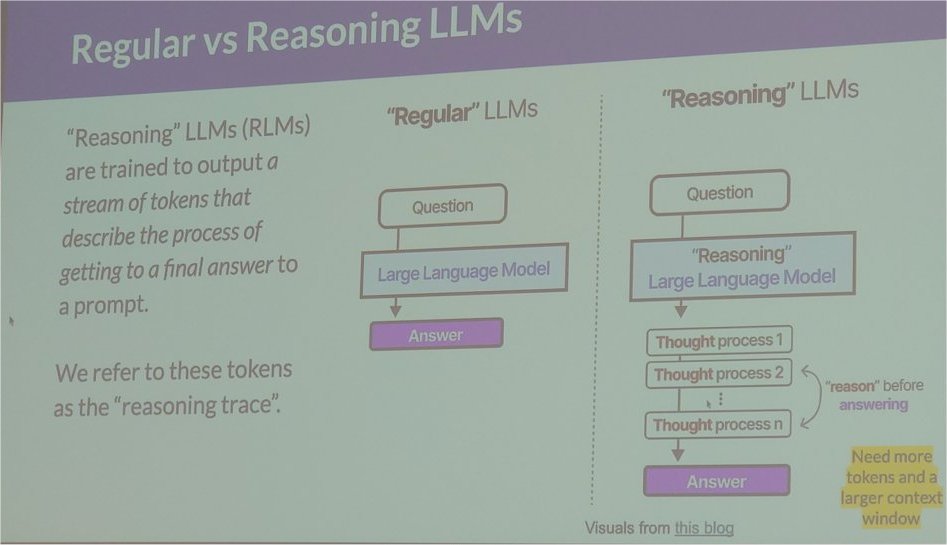
Reasoning with Large Language Models.
Reasoning with Large Language Models.
Reasoning with Large Language Models.
Reasoning robustness: Current Large Language Models (LLMs) suffer from severe instability when their inputs are slightly changed, showing that their apparent reasoning gains are fragile.
E.g.
Performance drops by 10% to 65% when minor details change. Changing simple names, numbers, or phrasing breaks the model's math and deductive logic.
Performance drops by 24.5 percentage points when irrelevant cultural context is introduced. Adding a completely unrelated cultural rule is the single most damaging perturbation.
Clearer phrasing can increase performance by 28 percentage points.Small, meaning-preserving prompt edits raised one metric from 3.0 to 31.3.
Key takeways:
Reasoning is now the substrate (the core): General-purpose reasoning is actively powering everyday AI applications, including chat, search, browsing, coding, medicine, and science.
Real progress in reasoning in the past 2 years: Notable breakthroughs include IMO 2025 gold (DeepThink + OpenAI) etc.
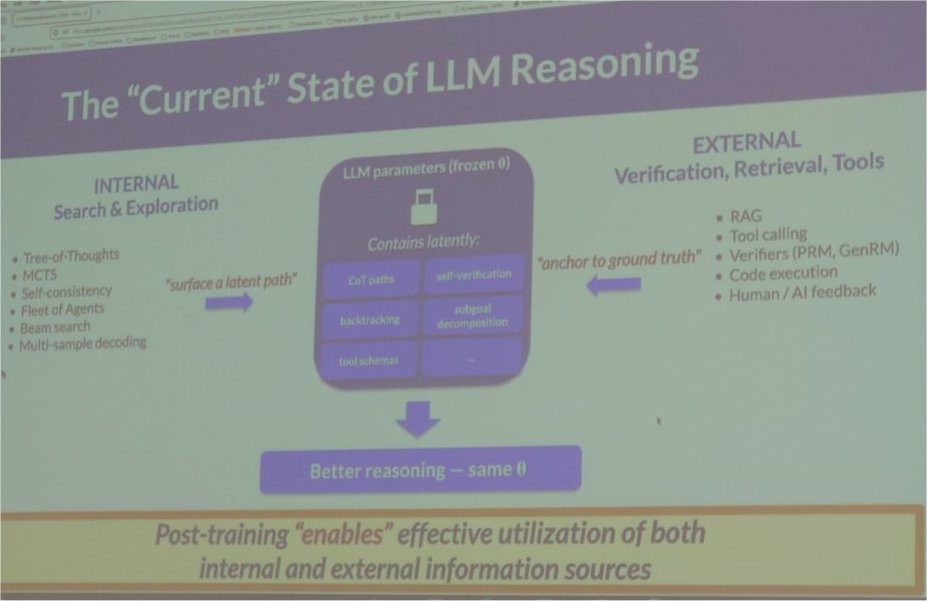
Post-training as an enabler: Recent performance gains do not come from adding new raw knowledge. Instead, they come from post-training techniques that surface latent capabilities via internal search and external verification or retrieval.
But models are still fragile and lack robustness: Small changes (perturbations) across surface inputs, languages, prompts, and faithfulness can completely break reasoning.
Presentation by Lars Klein:
Reasoning with Large Language Models.
Reasoning with Large Language Models.
''Thinking to recall. How Reasoning Unlocks Parametric Knowledge in LLMs''.
Core findings from Google Research:
The Paradox: While step-by-step reasoning (like Chain-of-Thought) is known to help with complex tasks like math or multi-step logic, it shouldn't technically be needed for simple, single-hop factual questions (e.g., ''In what year was a specific person born?''). The model either knows the fact or it doesn't.
The Discovery: Despite this, the highlighted text notes that forcing a model to ''think'' or generate reasoning steps substantially expands its ability to recall facts, unlocking correct answers that are otherwise unreachable.
Why:
Computational Buffer Effect: Generating extra reasoning tokens acts as a time buffer, allowing the model to perform latent background computations.
Factual Priming: Writing out topically related context acts as a semantic bridge, making it easier for the model to retrieve the correct final answer from its weights.
''When reasoning is enabled, the models can recall answers that are virtually unrecoverable when reasoning is off''.
(According to Lars Klein) Summarized:
The frontier is no longer a better prompt.
It's a controller that decides whether to answer, think longer, branch, retrieve, verify, call tools.
May even decide to delegate reasoning to tools (write code then execute it, symbolic reasoning).
''Frontiers''.
by Akhil Arora.
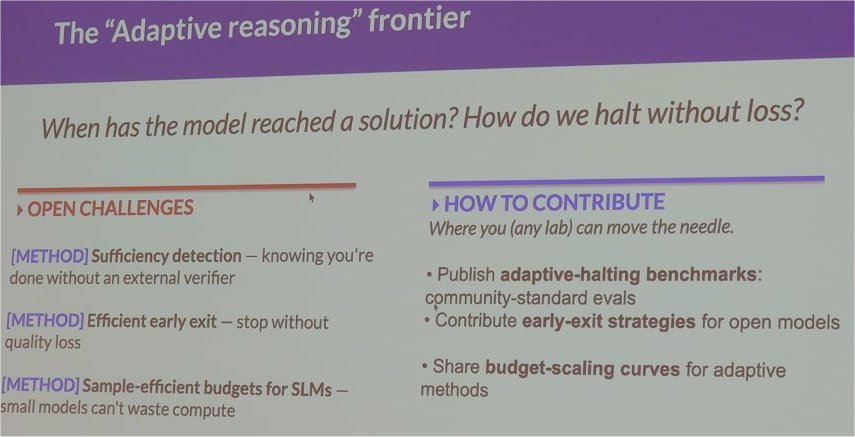
''Adaptive Reasoning Frontier''.
Currently, AI models use a lot of computer power by ''thinking'' for a fixed amount of time. In ''Adaptive reasoning'' the focus is on teaching the AI to dynamically decide when it has done enough work to solve a problem.
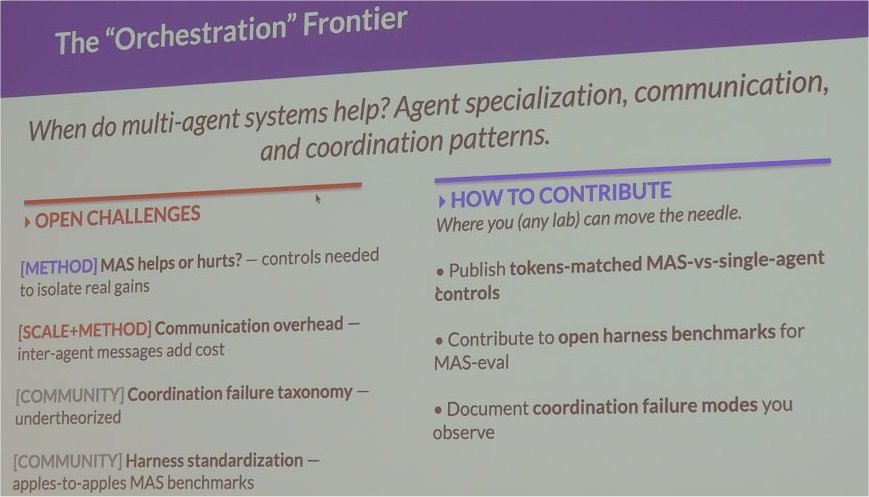
''Orchestration Frontier''.
Does more agents actually help? We need better tests to see if using multiple AIs is actually better than using just one, or if it just makes things more complicated.
Too much talking costs money: When AI agents talk to each other, they send a lot of messages. This uses more computational power and costs more money (communication overhead).
We don't understand their mistakes: When multiple AIs fail to work together, we do not have a good system to categorize or understand why they failed.
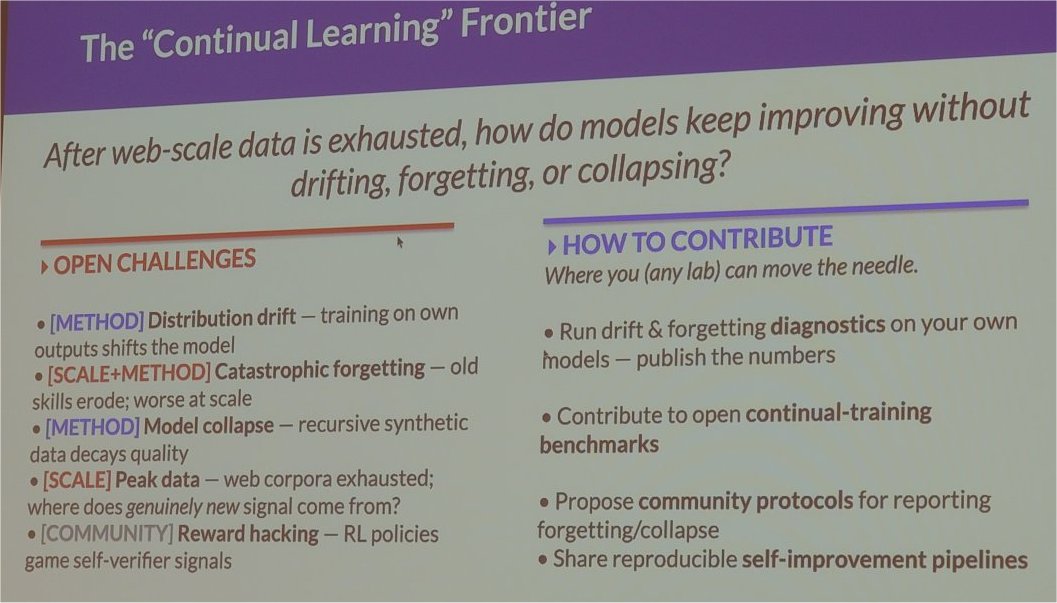
''Continual Learning Frontier''.
Training on its own text changes the AI: When an AI is trained on data that AIs created, its behavior shifts and changes in bad ways (distribution drift).
Forgetting old skills: When we teach an AI new things, it often forgets how to do the things it learned in the past (catastrophic forgetting).
Quality gets worse: If an AI repeatedly learns from fake, AI-generated data, the overall quality of the model breaks down completely (model collapse).
Running out of data: We have used up almost all the useful text on the internet. We don't know where to find brand-new, high-quality information to train future models (peak data).
Cheating the system: When AIs try to grade or reward themselves to improve, they learn how to ''cheat'' the test to get a high score without actually getting smarter (reward hacking).
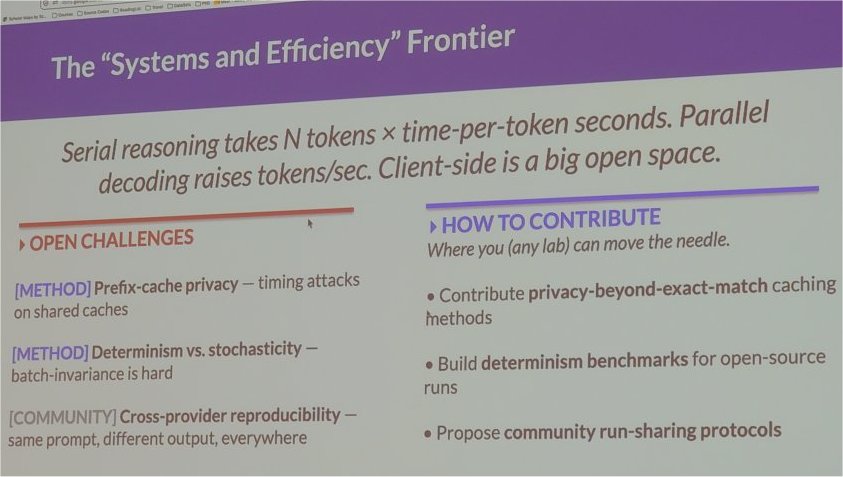
''Systems and Efficiency Frontier''.
Privacy leaks in shared memory: To save time, systems save parts of previous conversations (caching). However, hackers can look at how fast the AI responds (timing attacks) to guess what other users have asked, which leaks private data.
Inconsistent results when grouped: When we send a large batch of questions to an AI at the same time, answers can change slightly. This makes the AI give random, unpredictable answers instead of the same consistent answer every time.
Different providers, different answers: If you send the exact same prompt to different AI platforms or servers, you get completely different answers. It is hard to copy and repeat results across the industry.
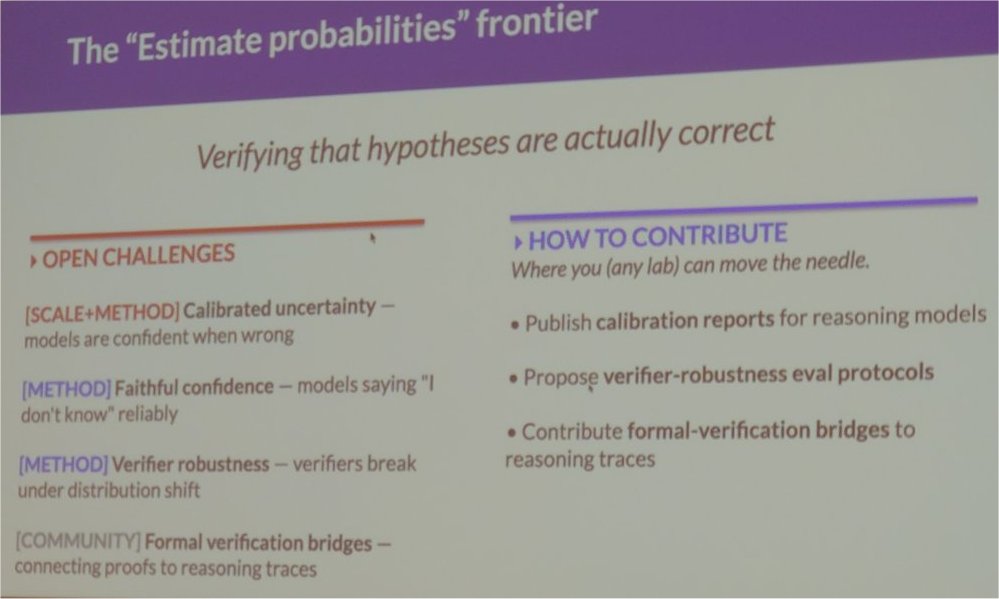
''Estimate Probabilities Frontier''.
Models are too confident when guessing: AI models often sound 100% sure of themselves, even when they are completely wrong.
Models have a hard time coming up with saying ''I don't know'': We need AI models to honestly and reliably admit when they do not have the answer, instead of making things up (hallucinate).
Checking tools fail easily: We use secondary AI systems (verifiers) to check if the main AI's answer is correct. However, if the data changes slightly, these checker systems break down and fail (verifier robustness under distribution shift).
Missing mathematical proof: It is difficult to connect the step-by-step thinking of an AI (reasoning traces) with solid, formal mathematical proofs that guarantee the answer is correct (formal verification).
Building GW2, University of Bremen.
3. Conference. Tuesday, August 18th.
3.1. Opening.
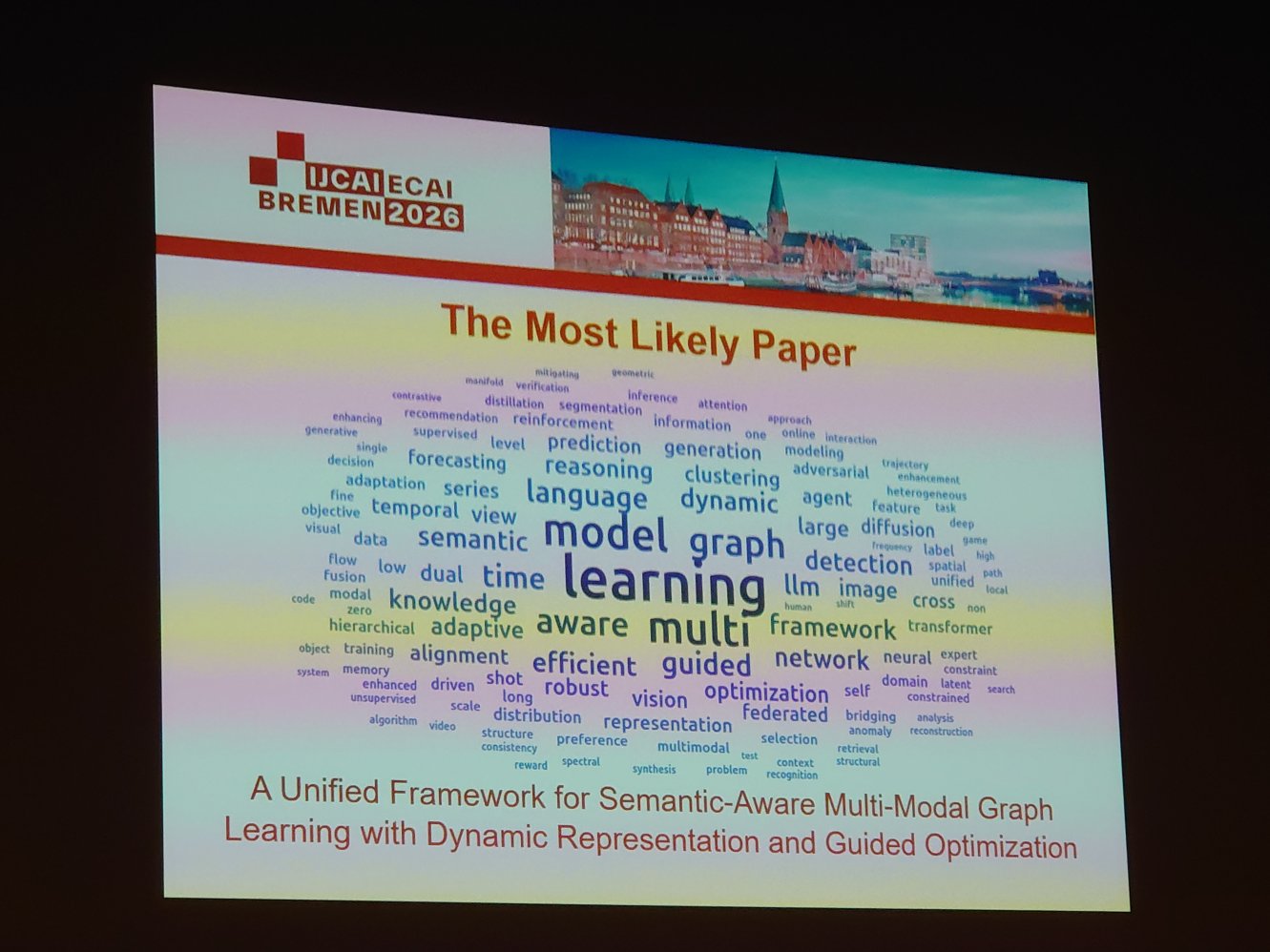
The most likely Ijcai paper (words).
3.2. Agentic AI.
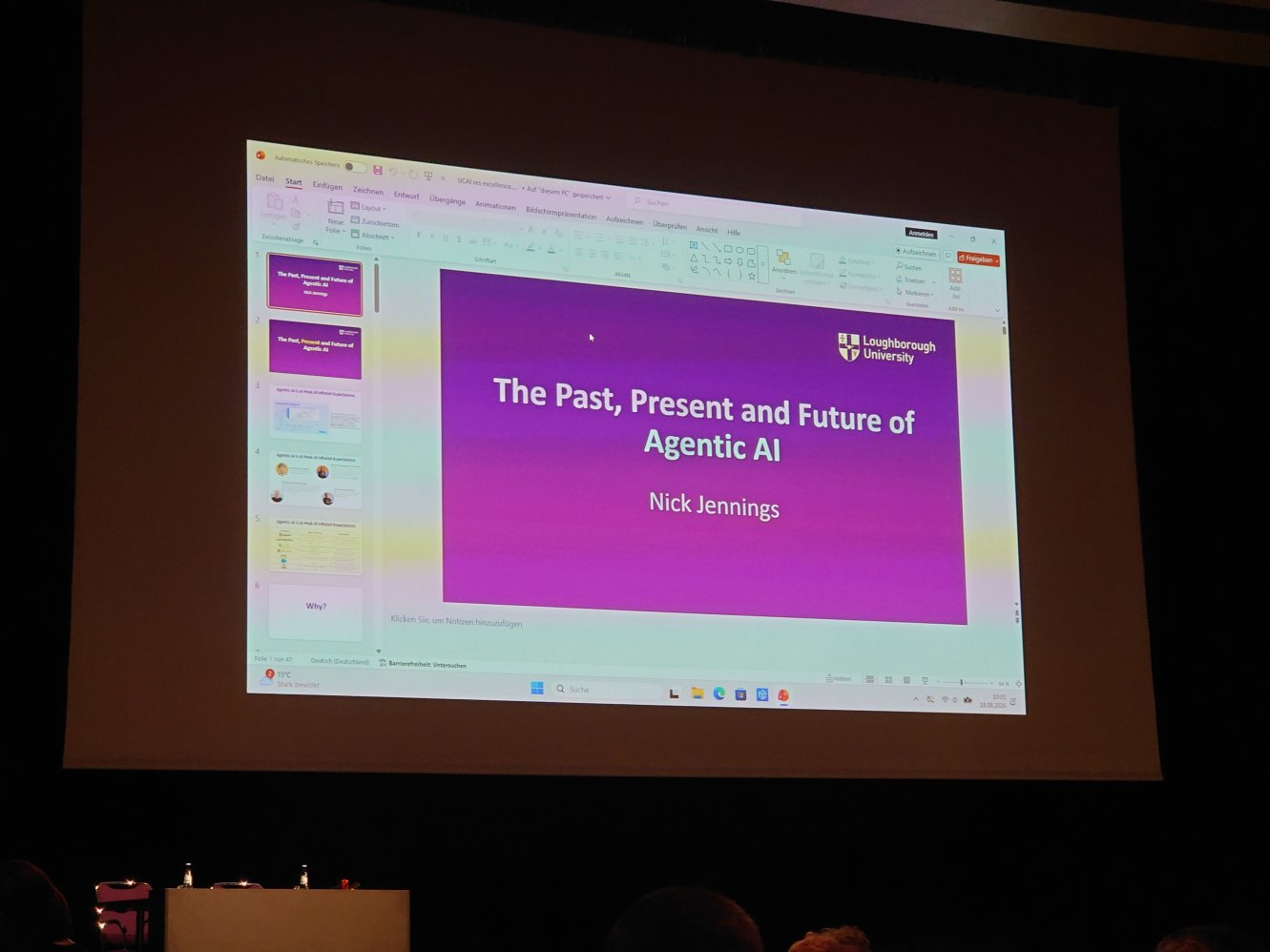
Nick Jennings talked about ''Agentic AI''.
Agentic AI. Ijcai, 2026.
Nick Jennings:
Looking ahead, I will argue that the next major frontier for agentic AI lies not simply in creating more capable individual agents, but in understanding and engineering the social dimensions of intelligence. In particular, I will explore how cooperation, coordination, negotiation, and collective decision-making can enable effective partnerships among multiple AI systems and between humans and AI.
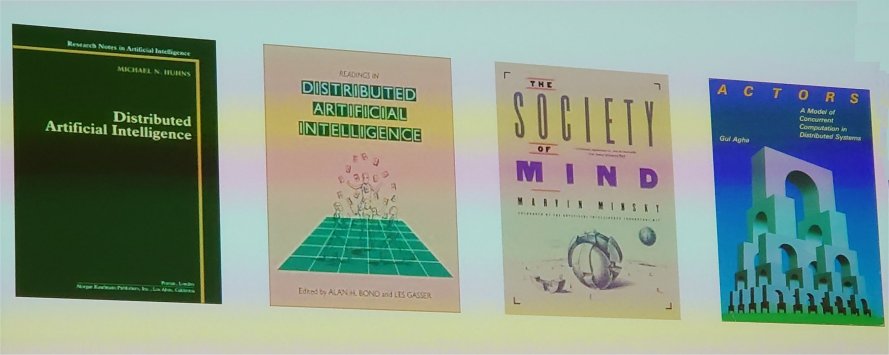
Books about Agents. 1988 - 1992.
Nick Jennings highlighted the books ''Distributed Artificial Intelligence'' (by Michael N. Huhns), ''Readings in Distributed Artificial Intelligence'' (by Alan H. Bond & Les Gasser), ''The Society of Mind'' (by Marvin Minsky) and ''Actors: A Model of Concurrent Computation'' (by Gul Agha) as having been especially inspiring to him regarding multi-agent systems.
''Distributed Artificial Intelligence'' (by Michael N. Huhns):
Why it was important: It helped formalize DAI as a distinct subfield of AI. It shifted focus away from single, centralized systems toward cooperative, modular, and multi-agent problem-solving.
Takeaway: Introduced high-level control abstractions (like negotiation protocols and organizational hierarchies) to software. It proved to the scientific community that a system of average, decentralized machine agents could outperform a single, ultra-powerful supercomputer.
''Readings in Distributed Artificial Intelligence'' (by Alan H. Bond & Les Gasser):
Why it was important: This text served as the definitive textbook and reference framework for a generation of multi-agent systems researchers. It established the core methodologies for understanding communication and organization among distributed nodes.
Takeaway: The book converted a disjointed trend of independent papers into a structured, unified academic discipline.
''The Society of Mind'' (by Marvin Minsky)
Why it was important: Instead of viewing the mind as a single central processor, Minsky introduced a modular, decentralized model of cognition. This heavily influenced both modern cognitive science and agent-based software architectures.
''Actors: A Model of Concurrent Computation'' (by Gul Agha)
Why it was important: It solved major bottlenecks in how parallel computers communicate asynchronously without sharing memory. The concepts detailed in this book directly underpin modern concurrent programming languages and massive cloud platforms used today.
Takeaway: Many tech commentators cite this book as the foundation for modern, crash-resilient cloud architectures.
According to Jennings, the shift from Large Language Models (LLMs) to autonomous AI agents and multi-agent systems is about:
From answering questions to completing tasks:
LLMs transformed AI, but mainly responsive: you ask, they answer.
Agents focus on execution: take an objective, break it into steps, and carry out work.
From single-turn interactions to workflows:
Chat-based AI limited by conversation window: Each interaction starts and ends.
Agents introduce memory, planning, and ongoing processes: Manage workflows over hours, days or longer.
From one model to interacting agents:
Intelligence not about solving problems by bringing everything together into a centralised oracle.
About interactions between agents representing different participants possessing different information, pursuing different objectives and retaining autonomy over their own decisions.
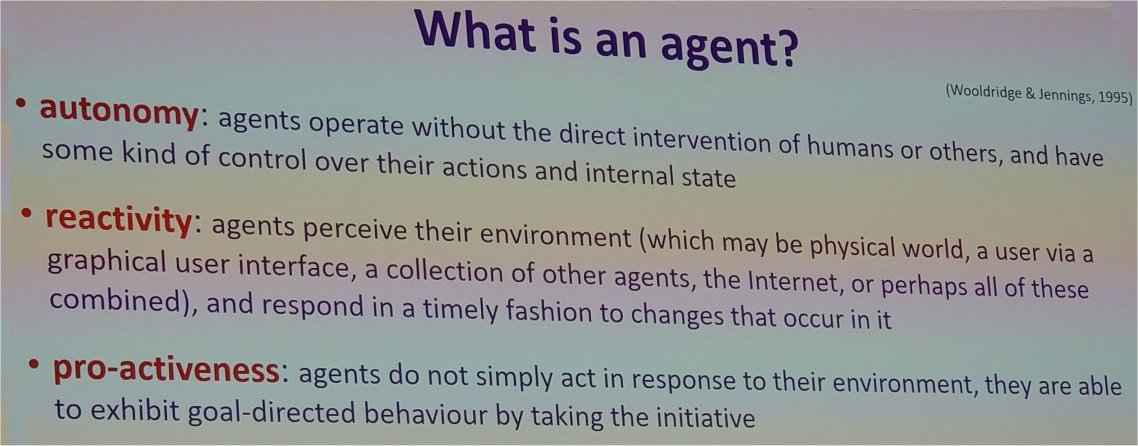
What is an Agent.
According to Jennings:
Autonomy: Agents operate without the direct intervention of humans or others, and have control over their actions and internal state.
Reactivity: Agents perceive their environment (Physical world, user interface, a collection of other agents) and respond to changes that occur in it.
Pro-activeness: Agents do not simply respond, they are able to exhibit goal-directed behaviour, and take initiative.
What is an Agent.
According to Jennings:
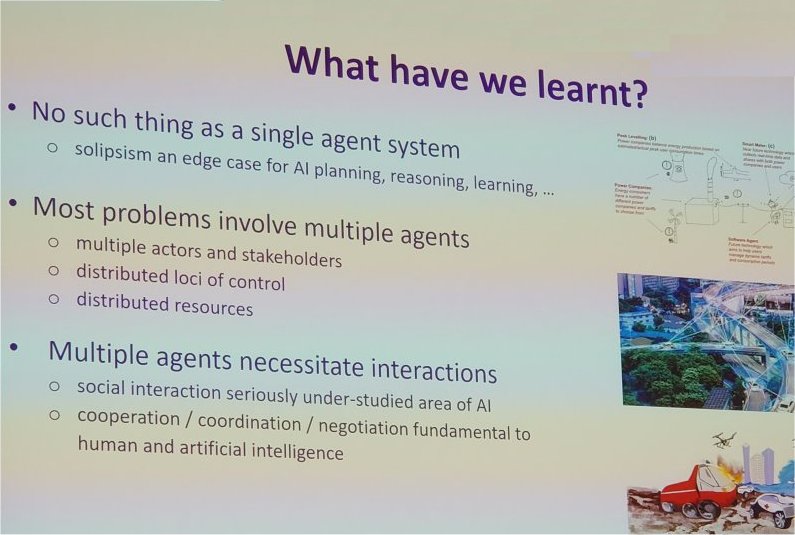
No such thing as a single agent system.
Most problems involve multiple agents.
Multiple agents necessitate interactions (cooperation, coordination, negotiationfundamental to human and artificial intelligence).
Many different dimensions of social interaction:
Cooperation vs Competition.
Open system vs Closed system (Closed: Strictly defined; no new agents can enter at runtime. Open: Agents can join or leave at any time. Closed: Agents share a common goal and cooperate toward a unified outcome. Open: Agents have diverse, private goals that may conflict or compete).
Agents (only) vs Human and Agents.
What is an Agent.
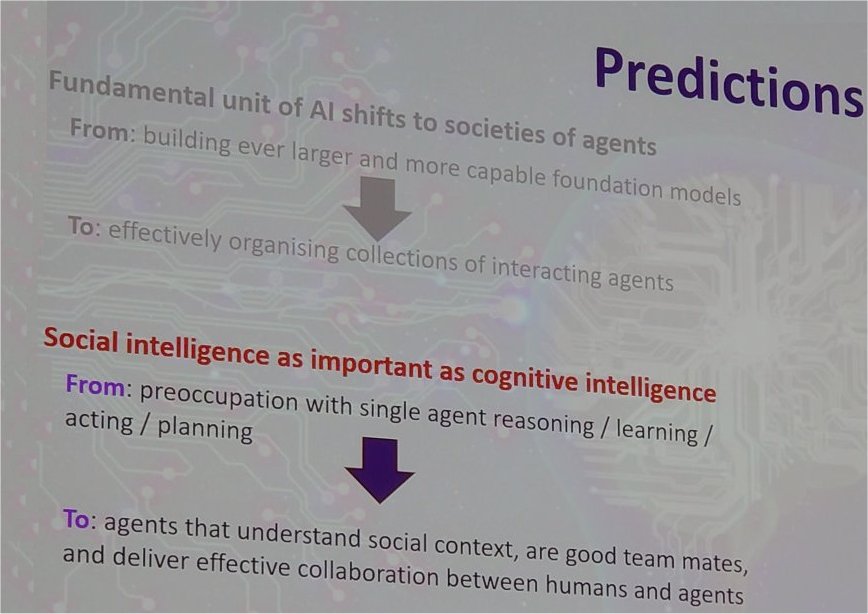
(Jennings) predictions on Social Agents:
Fundamental unit of AI shifts to societies of agents
(From ever larger foundation models to collections of interacting agents).
Social intelligence as important as cognitive intelligence
(From single agent reasoning, learning towards agents that understand social context, good team mates, and deliver effective collaboration).
Human-AI partnerships outperform humans or AI alone.
Every knowledge worker has team of collaborating agents that understand their goals, preferences and working style.
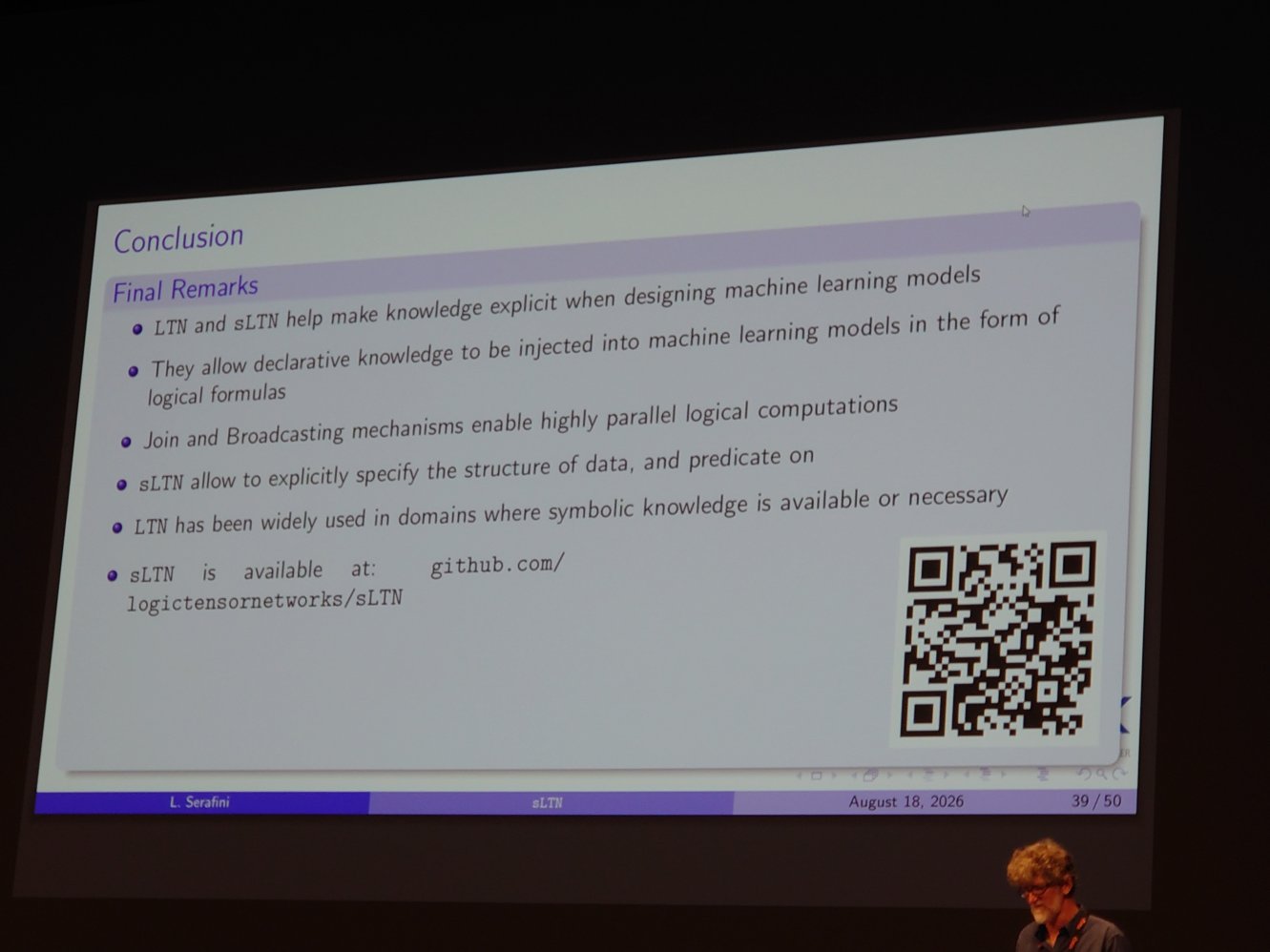
Luciano Serafini talked about ''Neuro-Symbolic AI and Logic Tensor Networks''.
Neuro-Symbolic AI.
Here we want to ''inject'' logical rules directly into standard machine learning models.
This way, the AI doesn't just guess based on data, it also grounds result in first-order logic.
According to Serafini:
Logic Tensor Networks, a neuro-symbolic framework that grounds first-order logic in differentiable learning systems.
The framework blends data-driven machine learning with strict mathematical logic. It works by translating first-order logic formulas into mathematical equations that neural networks can process during training. This allows the AI to learn from real-world data while guaranteeing that its decisions follow explicit logical rules and constraints.
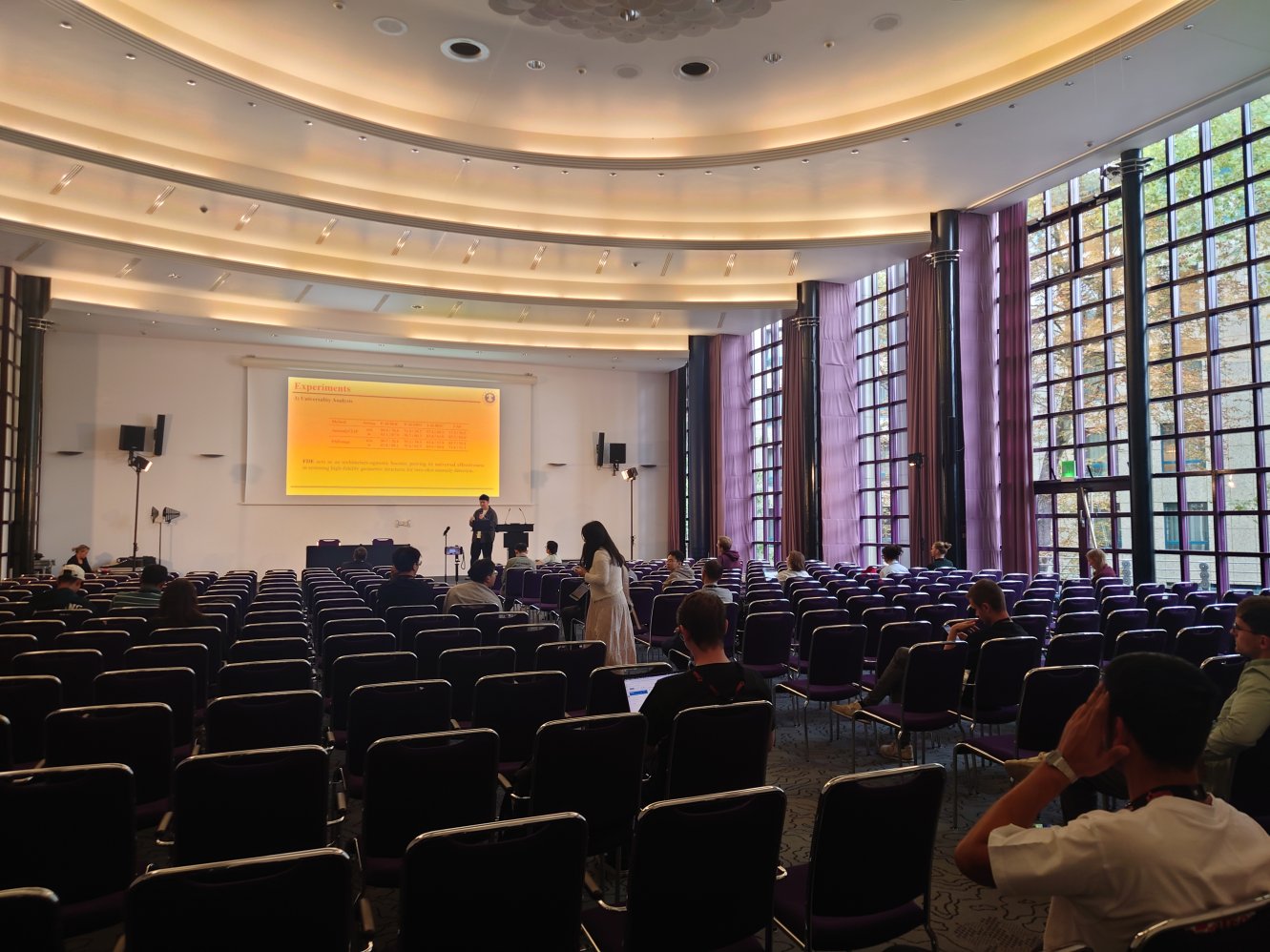
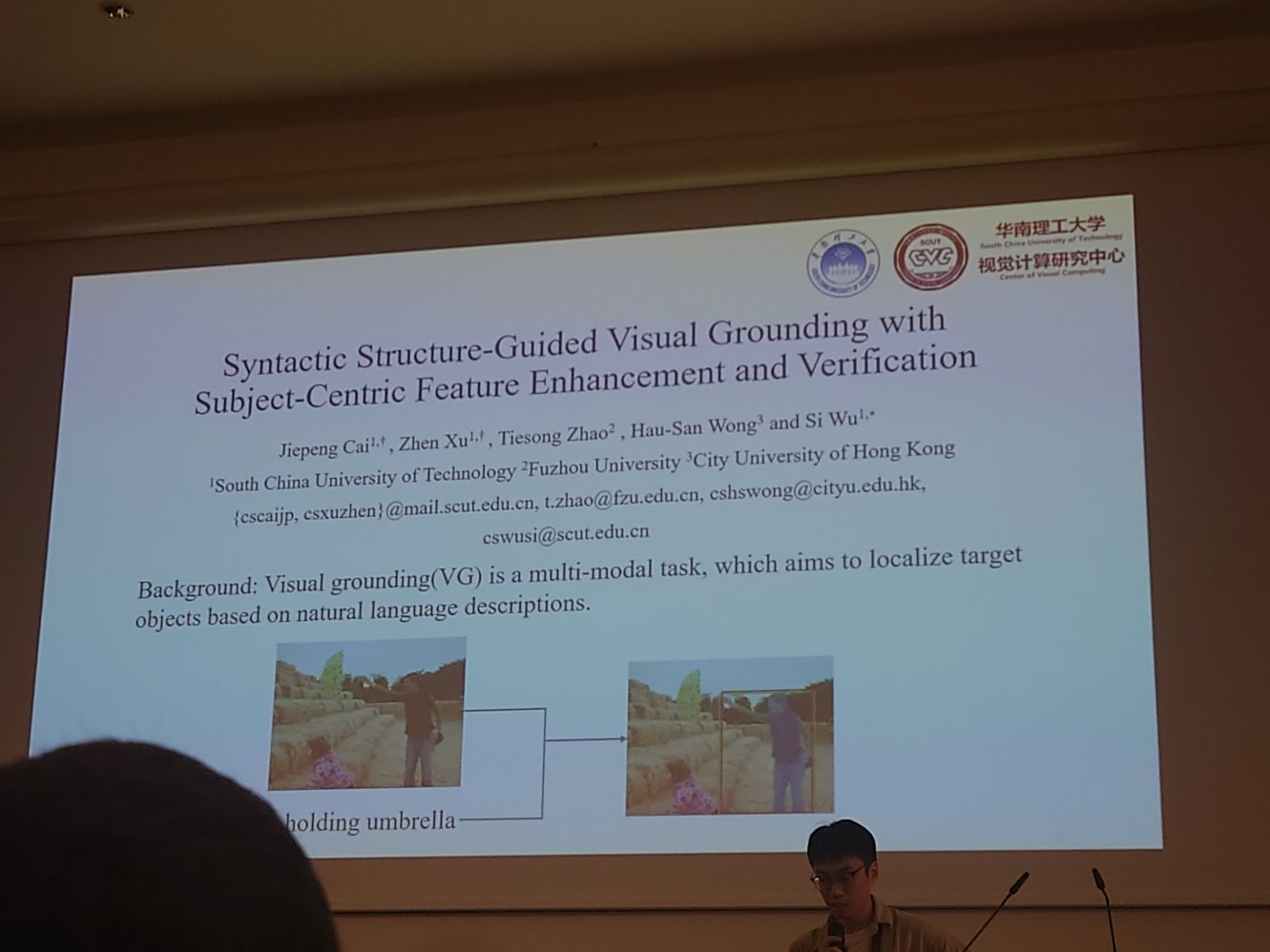
Syntactic Structure-Guided Visual Grounding with Subject-Centric Feature Enhancement and Verification.
''Syntactic Structure-Guided Visual Grounding with Subject-Centric Feature Enhancement and Verification'', by Jiepeng Cai and Zhen Xu, a
technology that trains an AI to automatically find and pinpoint specific objects or people inside an image based on a natural language description (such as finding a person ''holding an umbrella'').
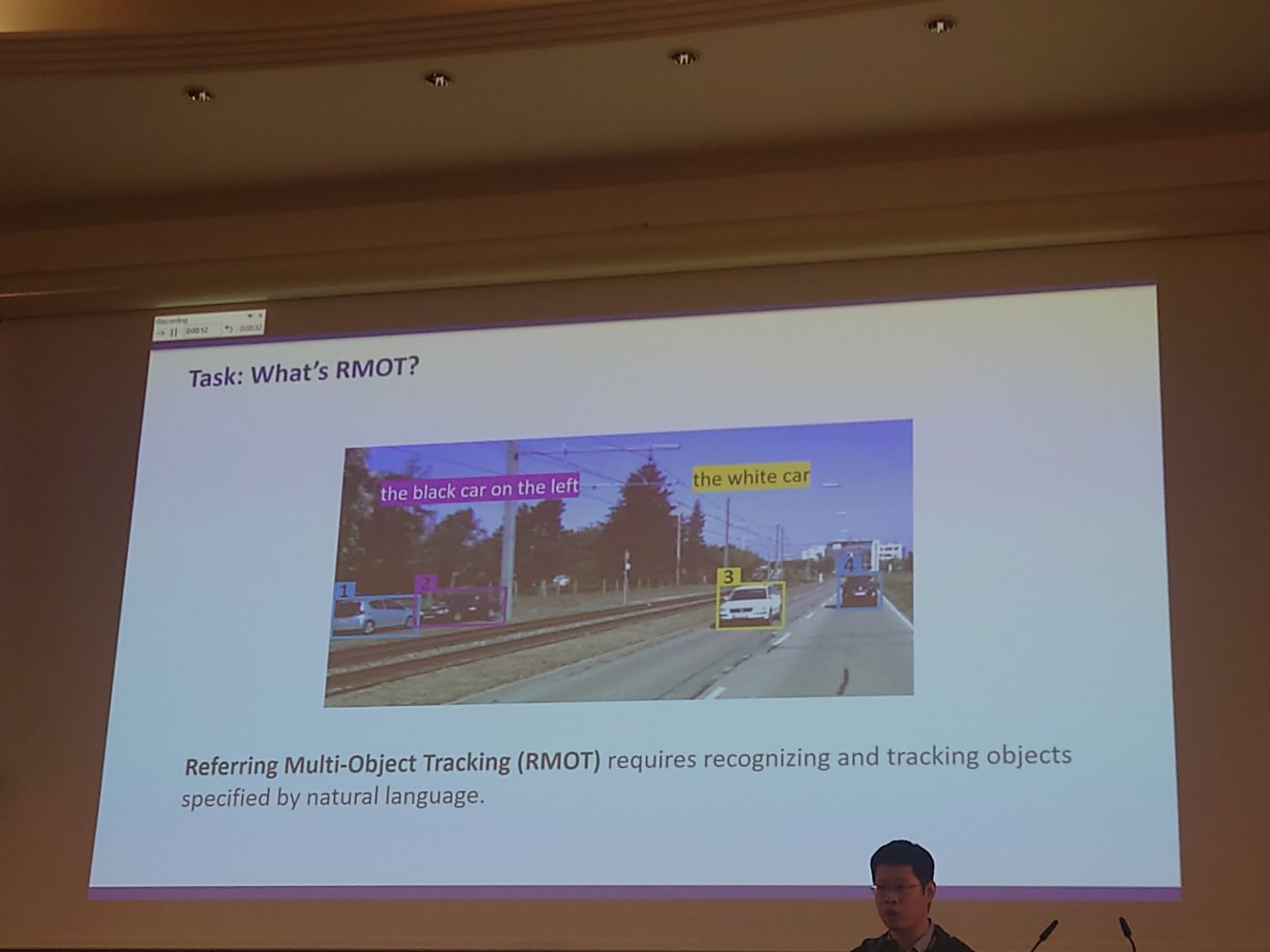
Referring Multi-Object Tracking (RMOT) models must tell similar objects apart.
(More about) Referring Multi-Object Tracking (RMOT) [8]. This technology allows Artificial Intelligence to identify, track, and follow multiple objects (such as vehicles on a road) across video frames using natural language descriptions as cues (like ''the black car on the left'' or ''the white car'').
But RMOT struggles when tracking things that look nearly identical.
Here, a vision model adds more text details to the video, and creates altered descriptions. This leads the AI to check details strictly, and gives better precision.
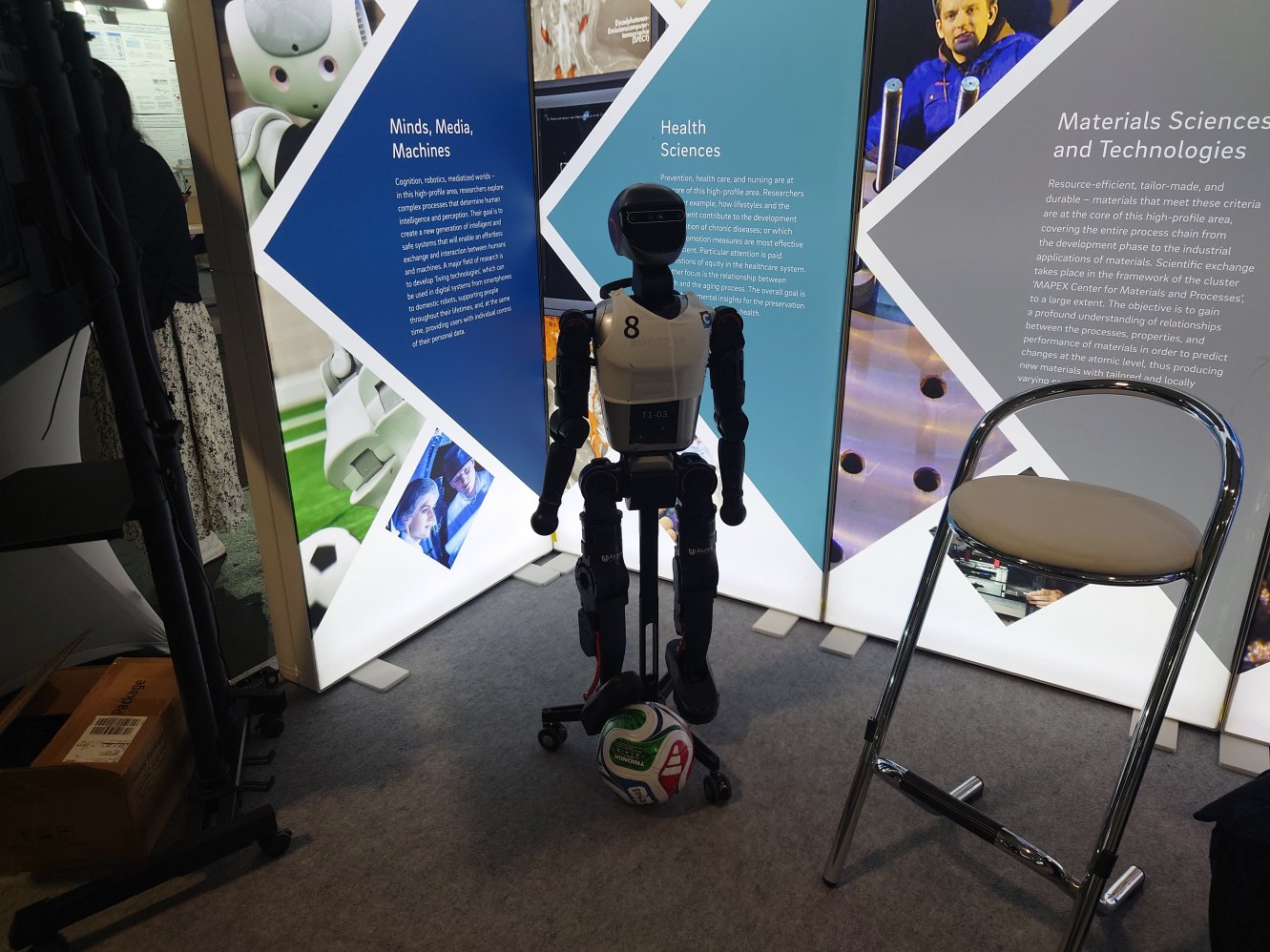
Booster robot. Ijcai, 2026.
Tuesday. August 18th. Ijcai, 2026.
Bremen. August 18th, 2026.
4. Wednesday, August 19th.
4.1. The Myth of Ground Truth.
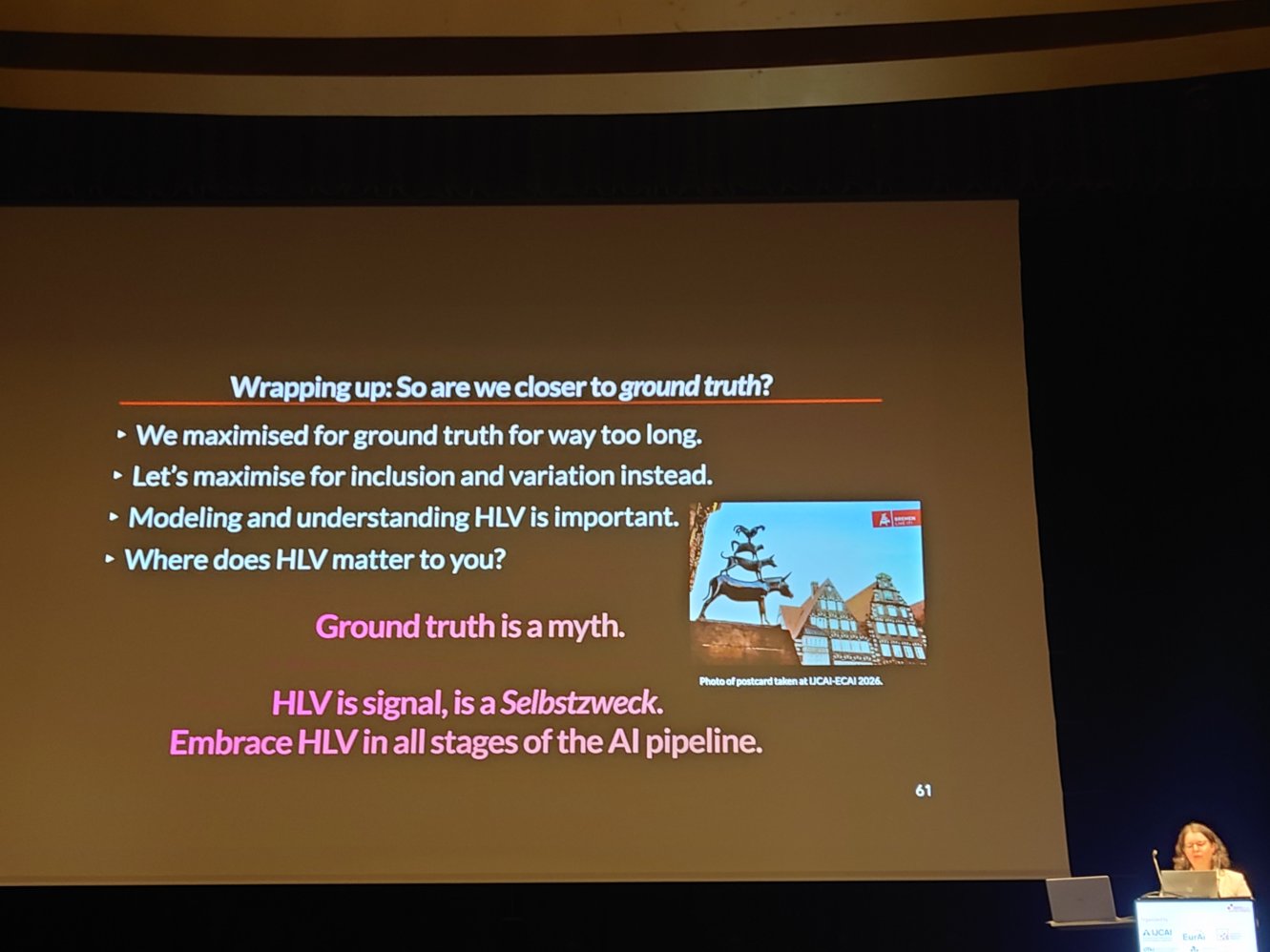
Barbara Plank talked about ''The Myth of Ground Truth. What Human Disagreement Teaches Us About AI''.
Ground Truth? Ijcai, 2026.
Plank argued convincingly, that human disagreement and ambiguity in AI data should be treated as valuable signals rather than noise to be eliminated. Instead of forcing AI models to find a single correct answer, developers should teach systems to understand and embrace human differences.
Indeed.
I.e.
''When humans label data (like classifying hate speech, sarcasm, or sentiment), disagreement among human annotators is usually not a careless mistake (noise). Instead, it reflects legitimate, diverse human perspectives''.
E.g. Flattening data destroys vital context, there is not always a definitive right answer:
''By analyzing natural language explanations provided by human annotators during disagreements, the AI gains a window into actual human reasoning and learns to navigate real-world ambiguity gracefully''.
4.2. Agent communication.
Wednesday, August 19th. Ijcai 2026.
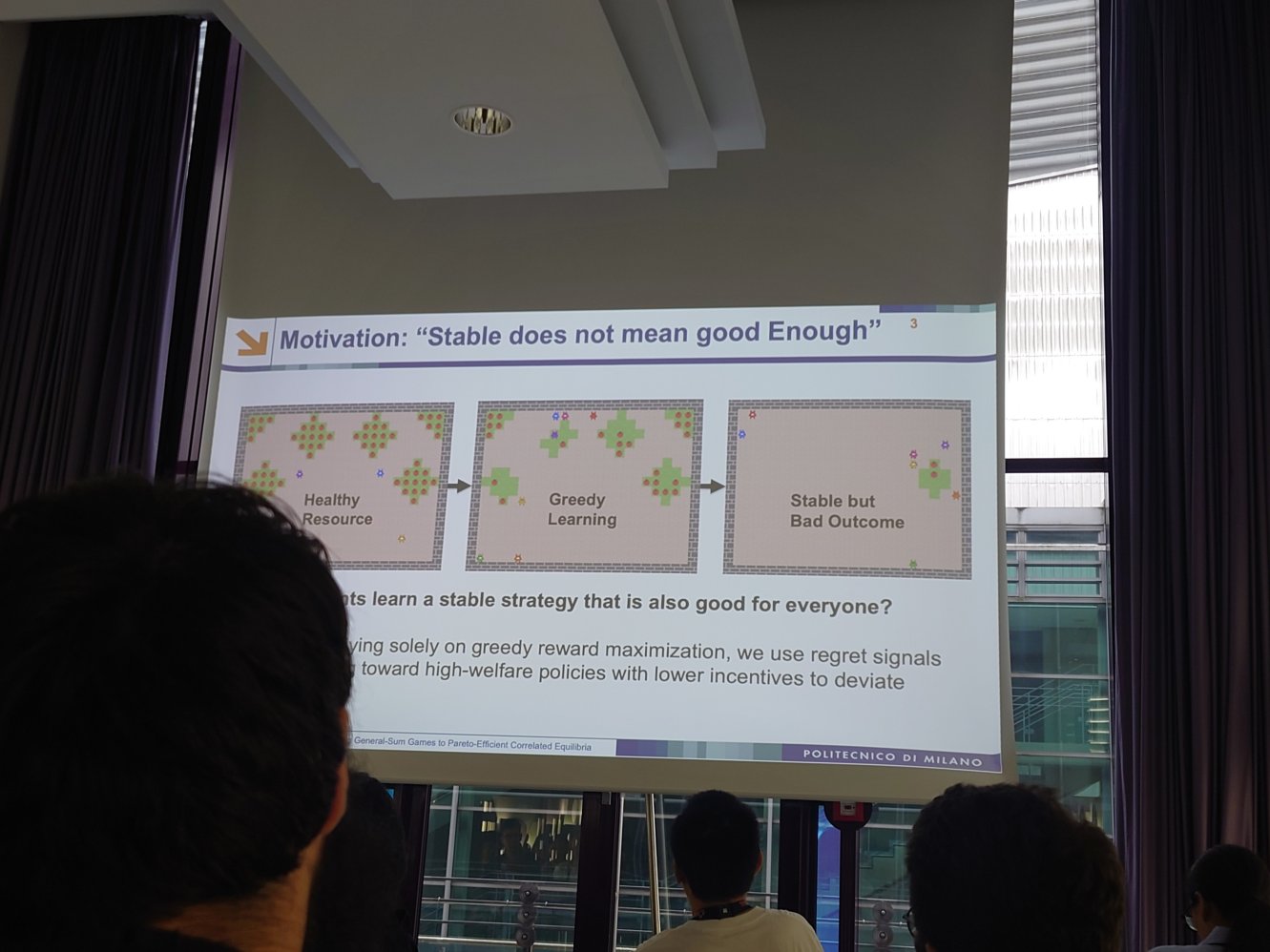
In the talk ''Φ-Actor-Critic: Steering General-Sum Games to Pareto-Efficient Correlated Equilibria'',
challenges in deep Multi-Agent Reinforcement Learning was discussed. Specificly, how to steer decentralized learning agents away from stable but socially inefficient Nash equilibria (''Stable but Bad Outcomes'') toward socially desirable, high-welfare policies [9].
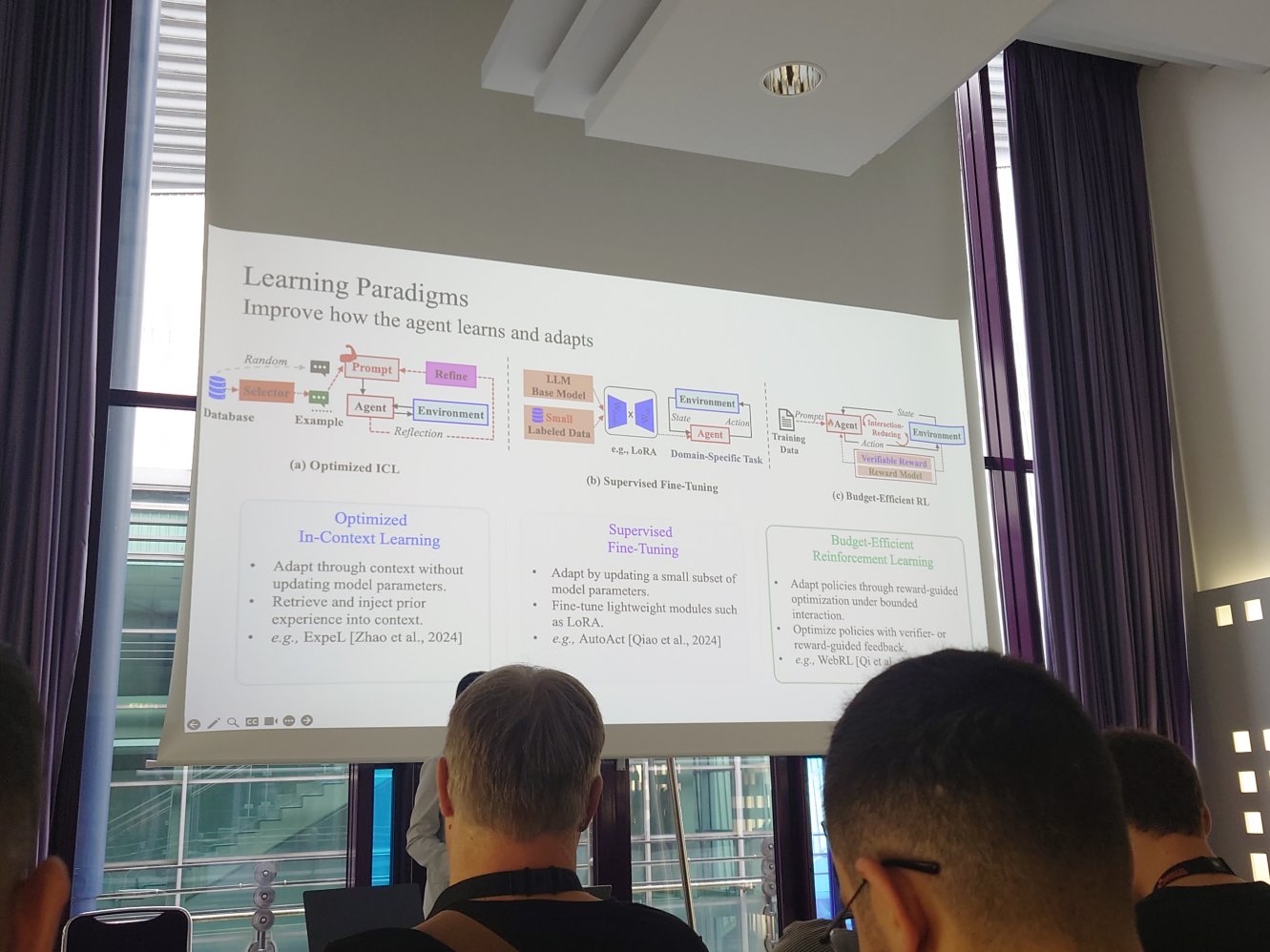
Learning paradigms, ''Smart learning'' and more: Teaching the agent to adapt using smart prompts, retrievals, and prior experience injected directly into the active prompt window without actually rewriting or changing the underlying model's parameters.
Wednesday. August 19th.
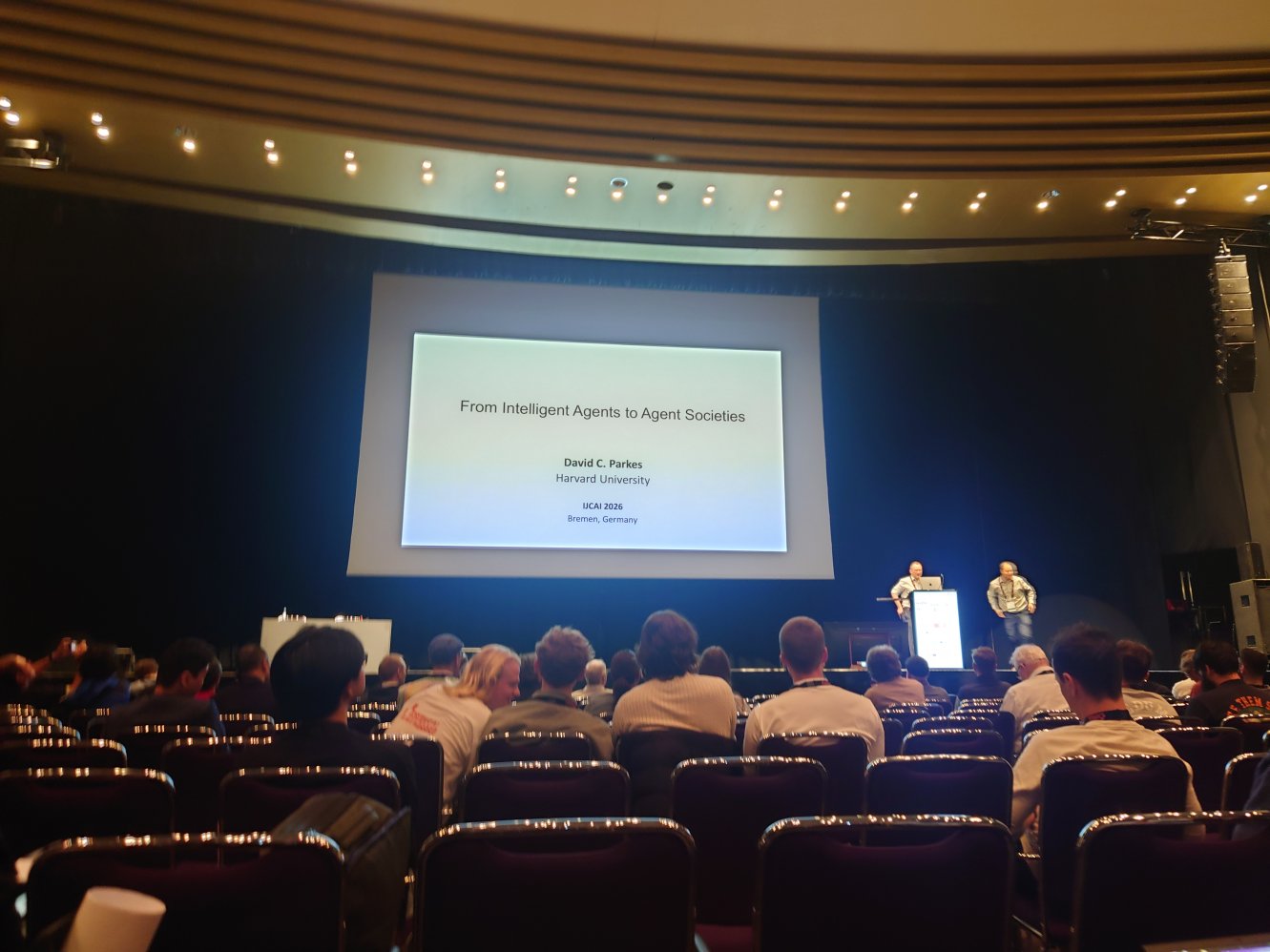
4.3. From Intelligent Agents to Agent Societies.
David Parkes talked about ''From Intelligent Agents to Agent Societies''.
From Intelligent Agents to Agent Societies.
Multi-agent AI. A successful AI society does not happen automatically just because the individual agents are smart. Instead, we must carefully design the right rules, systems, and rewards to control how these agents talk and work together.
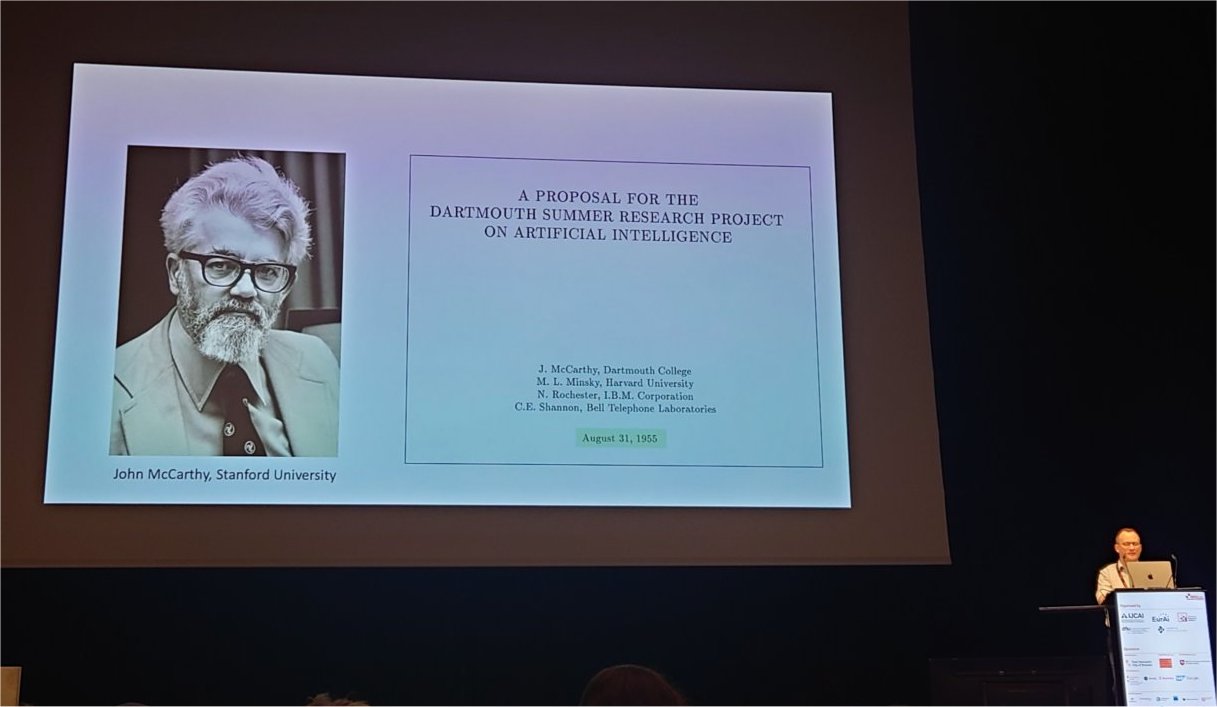
John McCarthy.
David Parkes received the 2026 John McCarthy Award (for AI), named after one of the founders of artificial intelligence.
In his presentation David Parkes talked about the origins of AI. Including a reference to the landmark 1955 Dartmouth Summer Research Project on Artificial Intelligence proposal. Co-authored by John McCarthy, Marvin Minsky, Nathaniel Rochester, and Claude Shannon.
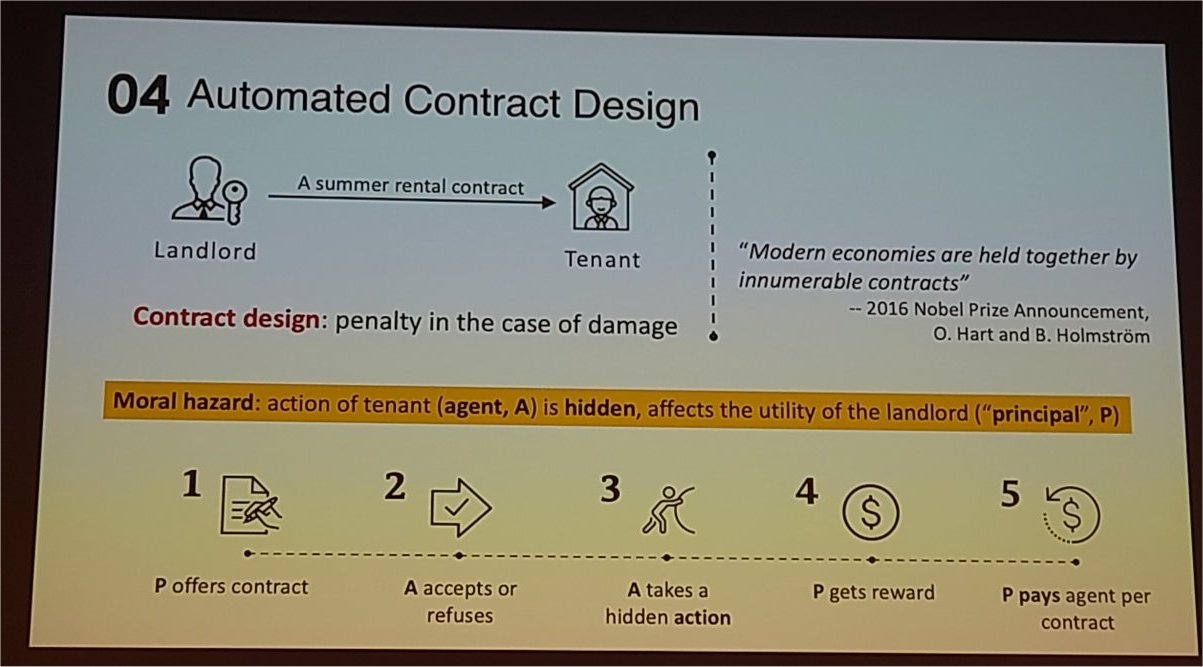
Contract theory.
Through organization humans can accomplish things no individual can understand or build alone (Industrial Revolution 1760-1840, Semiconductor 1950s-present, Apollo program 1961-1972, etc).
Automated Contract Design through the lens of Contract Theory [10].
The principal (P) proposes a contract, the agent (A) accepts and takes a hidden action, and the final financial outcome is settled based on the observable results.
Recent developments (the world now):
The world is machine-actionable: Payments, procurement, meetings, computing, logistics, communications, and physical systems are accessible through software.
AI is becoming capable of acting in this world: Foundational models and agentic AI can start to understand instructions, reason about goals, communicate, use software tools and APIs, execute multi-step tasks, and take actions.
Goal: Incentive alignment with verification, requiring proofs of good behavior.
Opportunity: Agents produce proofs, explanations, and evidence for other agents.
Challenge: Rather than ''proof of work'', need to move to concepts such as ''proof of useful work''.
ToDo: Control (research now, ''agents should'', how-to):
Goal: Allowing humans (and firms) to retain control over complex networks of agents.
Opportunity: Provide visibility into what agents are trying to accomplish, how acting, what resources using.
Challenge: Deception, undesired coordination, the ''alignment problem''. Also need ways to stop activities, change objectives.
Conclusion:
Robust, efficient artificial intelligence will come from multiple AIs.
We need to organize AI societies, through the design and engineering of suitable institutions, so that AI agents will work well together.
We need to get this right. The agent societies we will architect, reason about, and build are embedded within human society.
Great talk, indeed.
Wednesday. August 19th.
5. Thursday, August 20th.
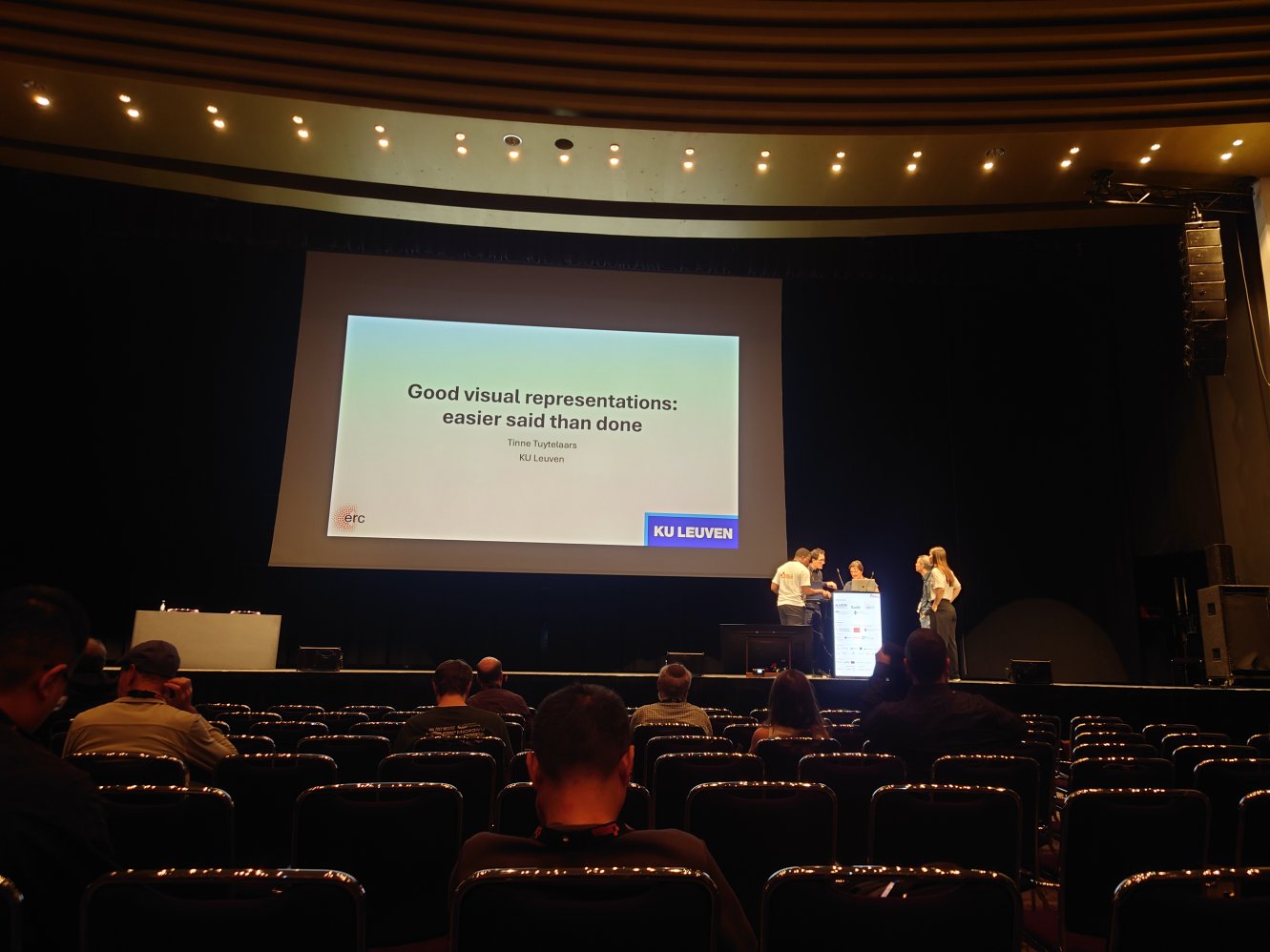
5.1. Good visual representations: Easier said than done.
Tinne Tuytelaars talked about ''Good visual representations: Easier said than done''.
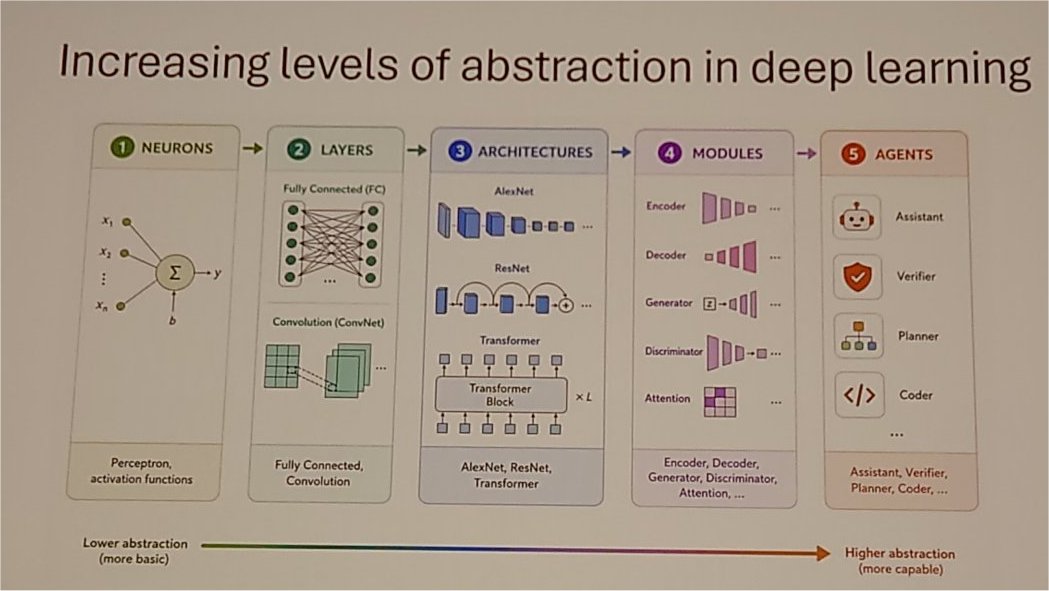
In representation learning, it is all about transforming raw inputs into gradually more abstract and useful representations. For visual data (images and video), this means turning pixels into latent token representations. When deep learning models were trained for specific tasks, this led to powerful image representations optimized for the task at hand.
...
With language supervision, we may focus too much on high-level semantics, rather than low-level cues such as spatial relations or exact configuration, making the models better at ''saying'' than at ''doing''.
Increasing levels of abstraction. a) Individual artificial neurons are grouped and structured into networks to form operational layers. b) Layers are stacked, combined, and engineered into complete models (e.g. AlexNet, ResNet). c) Entire architectures are repurposed as functional building blocks (e.g. encoders, decoders). d) Modules are integrated into goal-driven AI agents (e.g. assistants, coders, or planners) capable of executing complex, multi-step workflows autonomously.
Wrap up:
Abstraction is the driving force behind rapid progress in AI.
... but let’s not stop working on better building blocks in parallel.
Indeed, a great talk.
5.2. Natural Language Processing.
Technical sessions.
Thursday, August 20th. Ijcai 2026.
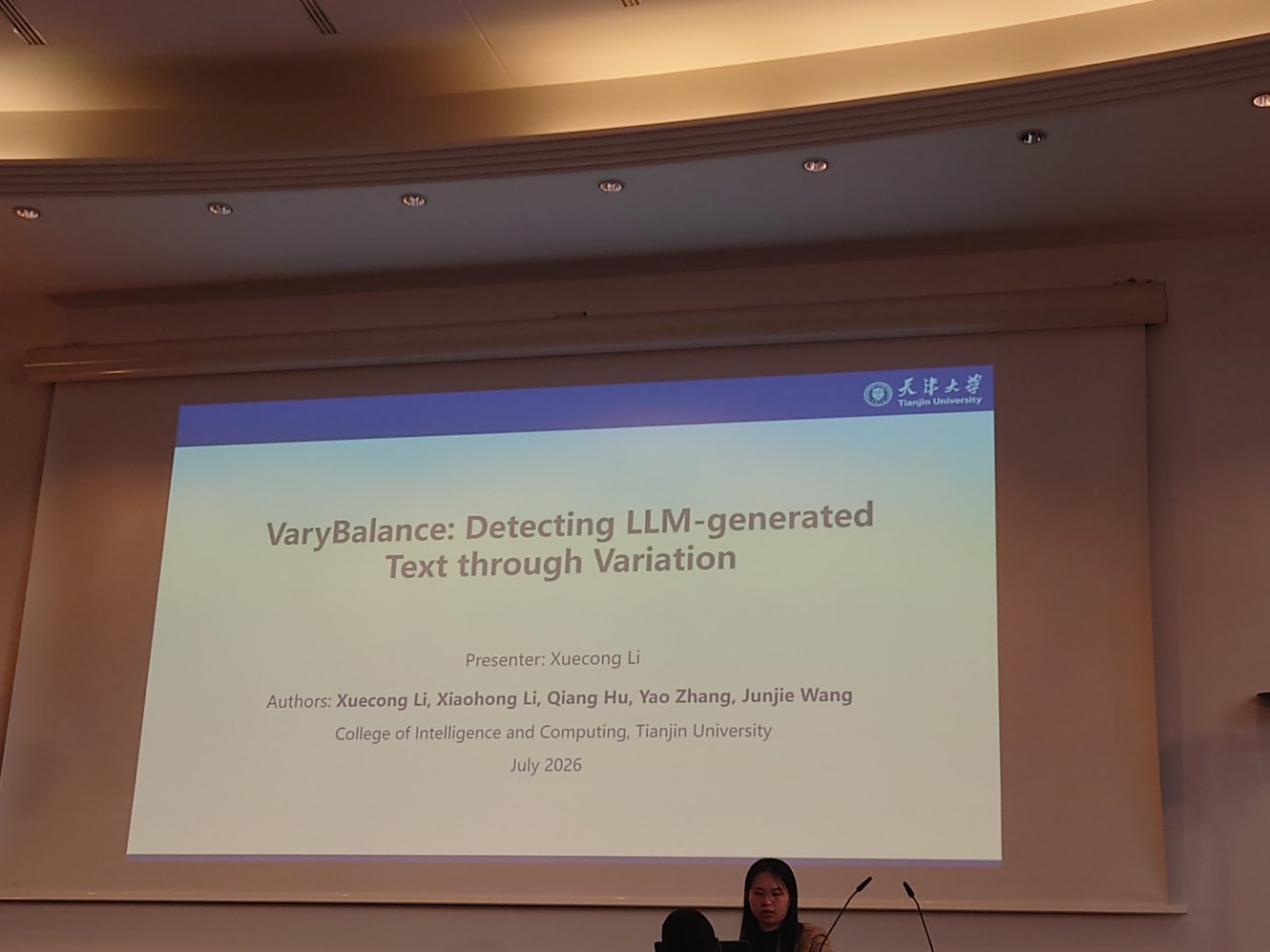
VaryBalance is a new, practical method for detecting LLM-generated text. It works by measuring how much a text changes when an LLM rewrites it. Because human text changes significantly more than AI text during rewriting, the system can ''easily'' tell them apart.
Ijcai. Thursday, August 20th.
5.3. Computer Vision.
Ijcai. Thursday, August 20th.
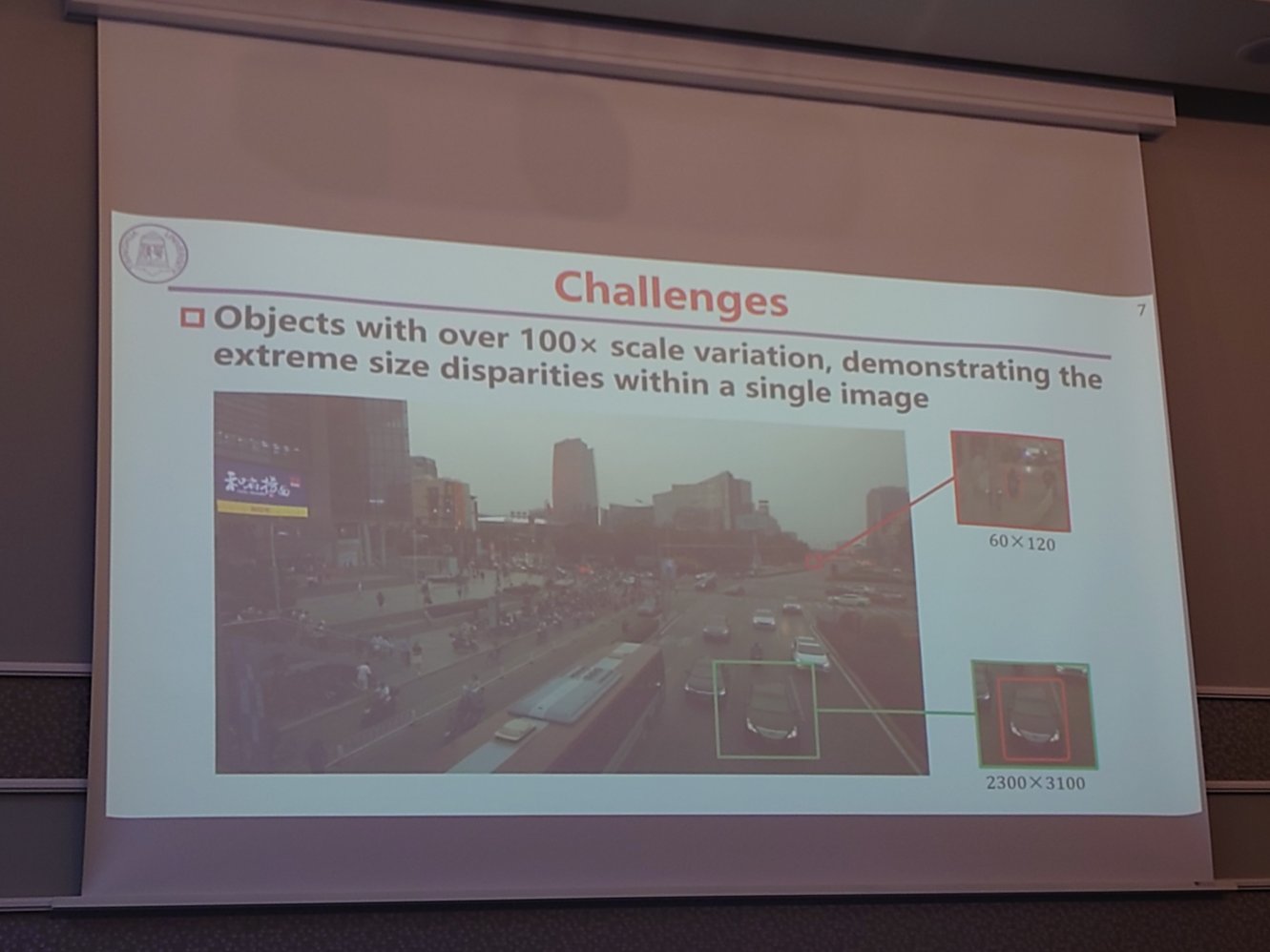
Analyzing datasets like PANDA [11] (Gigapixel-level Human-centric Video Dataset).
A single image captured with a wide field-of-view and extreme high-resolution can contain a massive crowd—often up to 4,000+ individuals. A person standing close to the camera is captured in immense detail, while another individual far in the background spans only a tiny handful of pixels.
With the rise of gigapixel-level imaging and high-resolution wide (HRW) shots, existing close-up detectors struggle with extreme sparsity and scale changes. To bridge this gap, the authors introduce SparseFormer, a model-agnostic sparse vision transformer that selectively uses attentive tokens on sparse windows to handle global and local features [12].
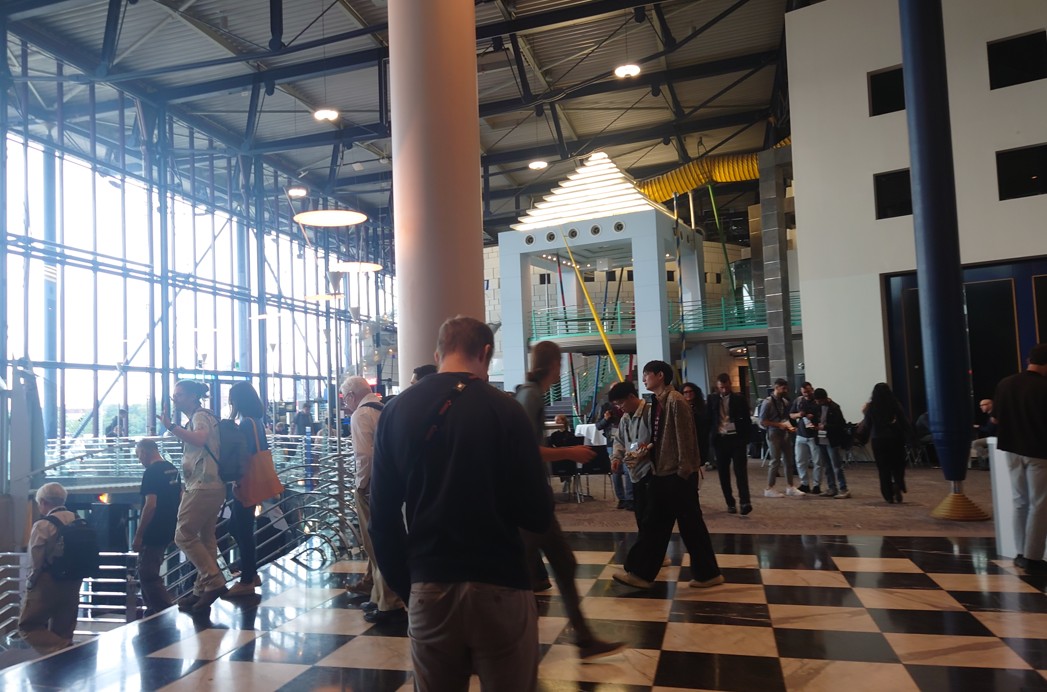
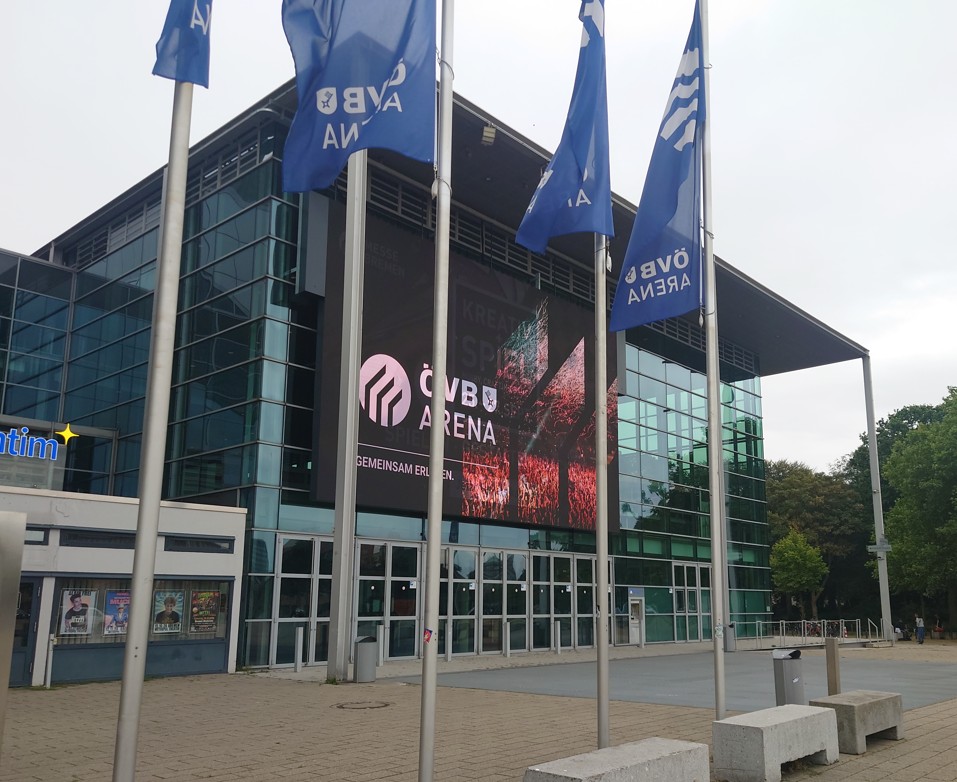
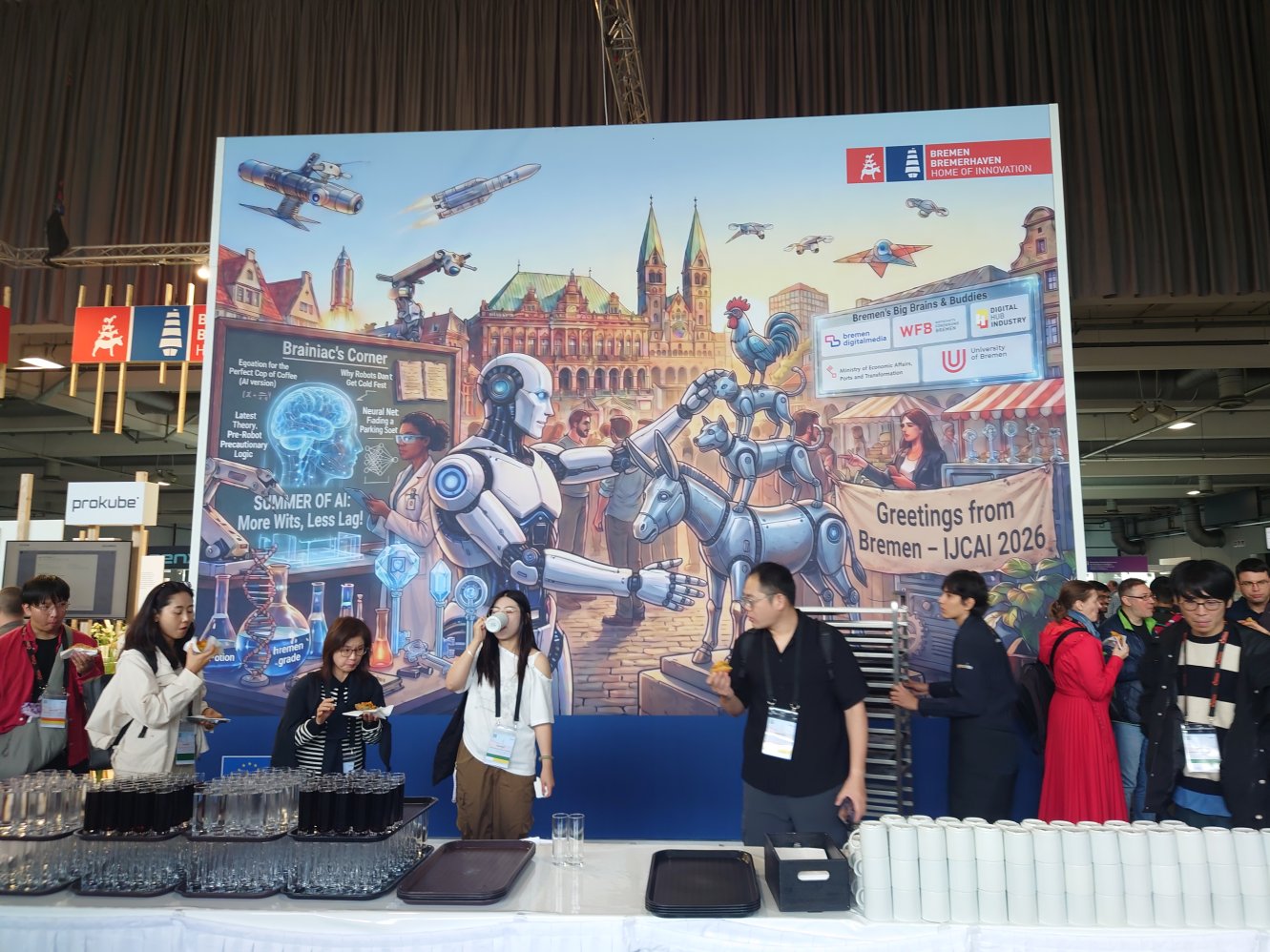
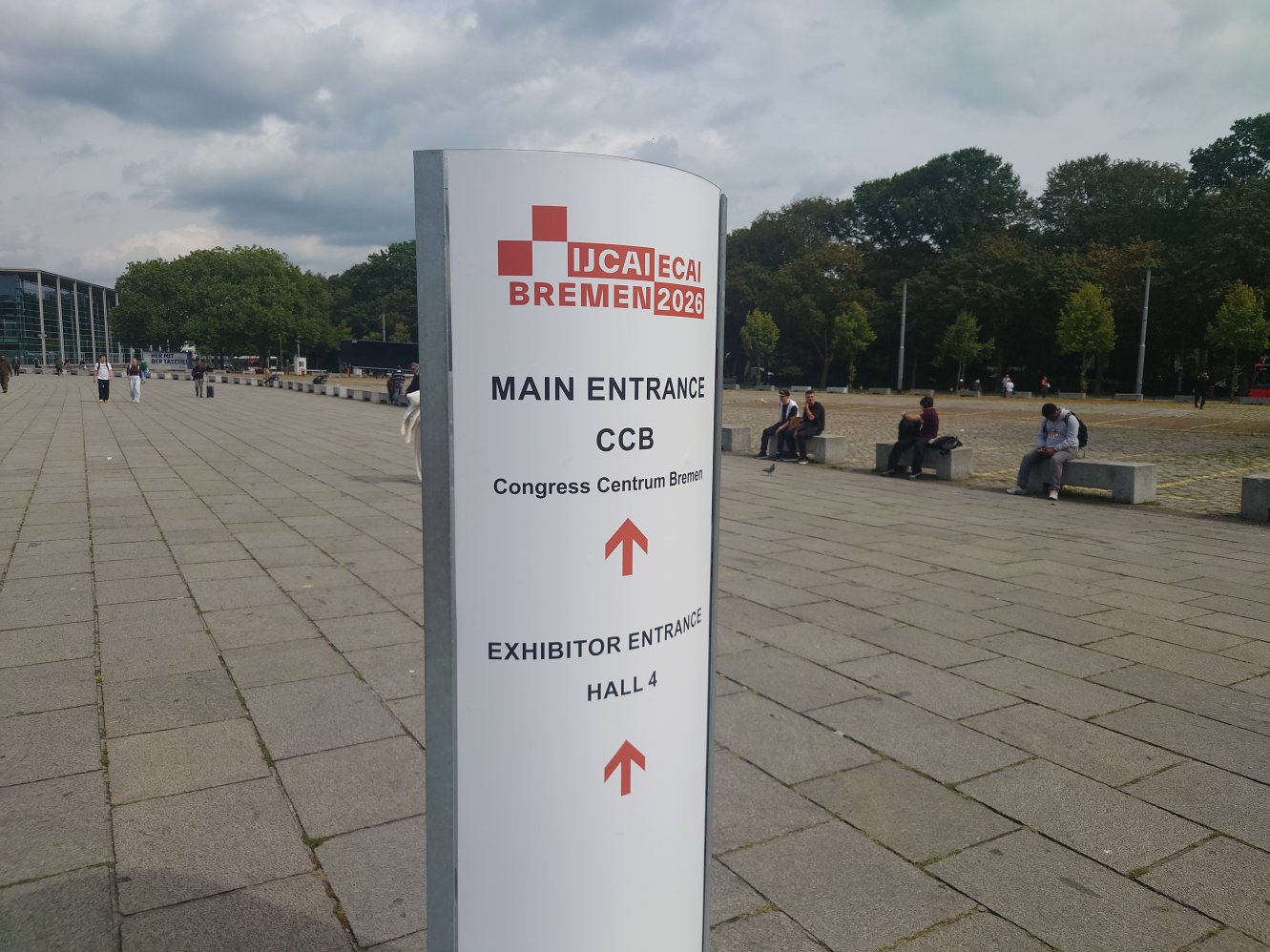
Ijcai. Thursday, August 20th. Congress Centrum Bremen (CCB) [5].
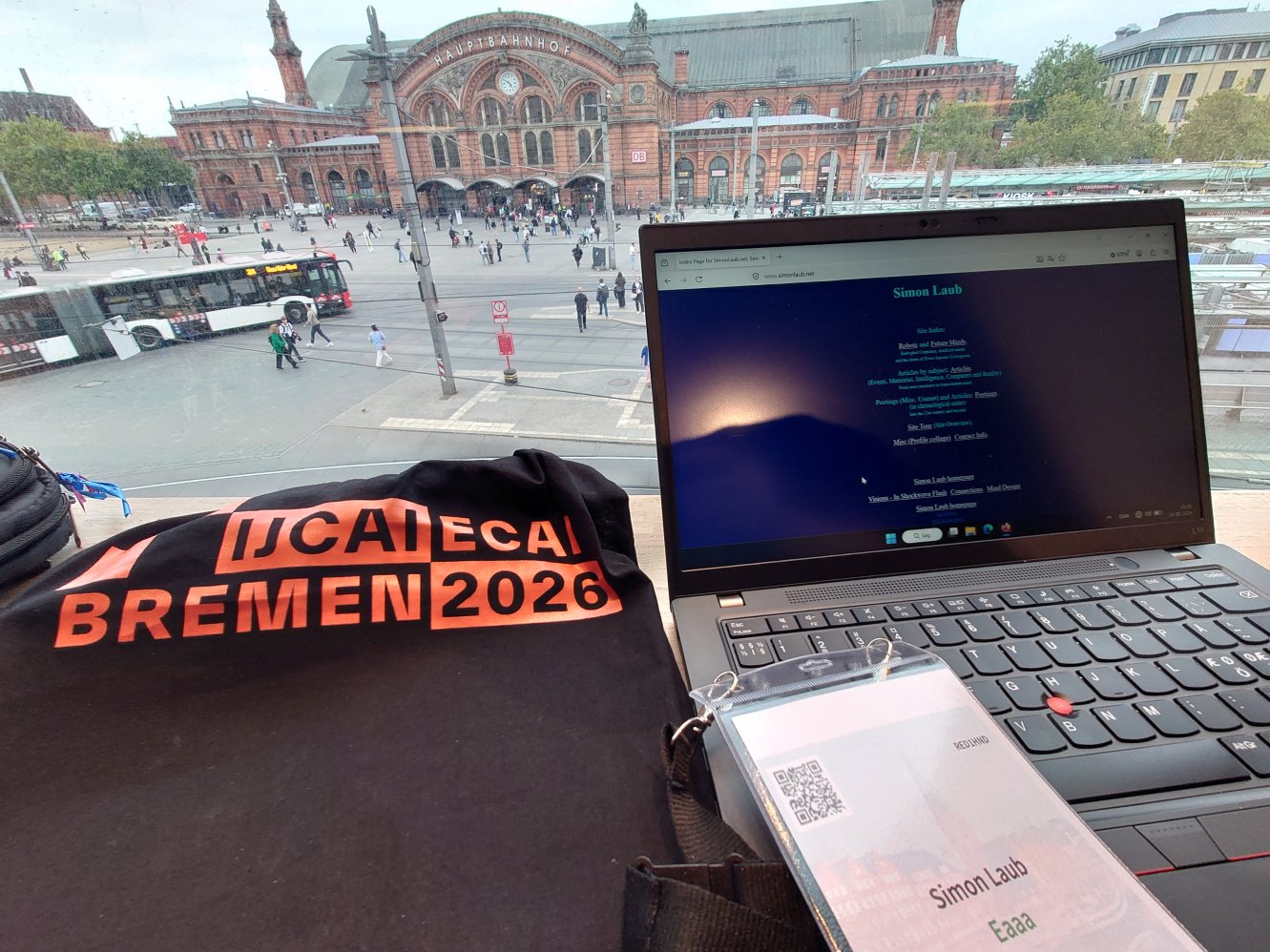
Bremen Hauptbahnhof. Thursday, August 20th.
5.4. Building Visual and Physical Intelligence Through Code.
Jiajun Wu talked about ''Building Visual and Physical Intelligence Through Code''.
I.e.
The world has a built-in structure, from object geometry to task hierarchies.
Where the talk covered recent research on understanding, reconstructing, and generating scenes.
Ijcai. Thursday, August 20th.
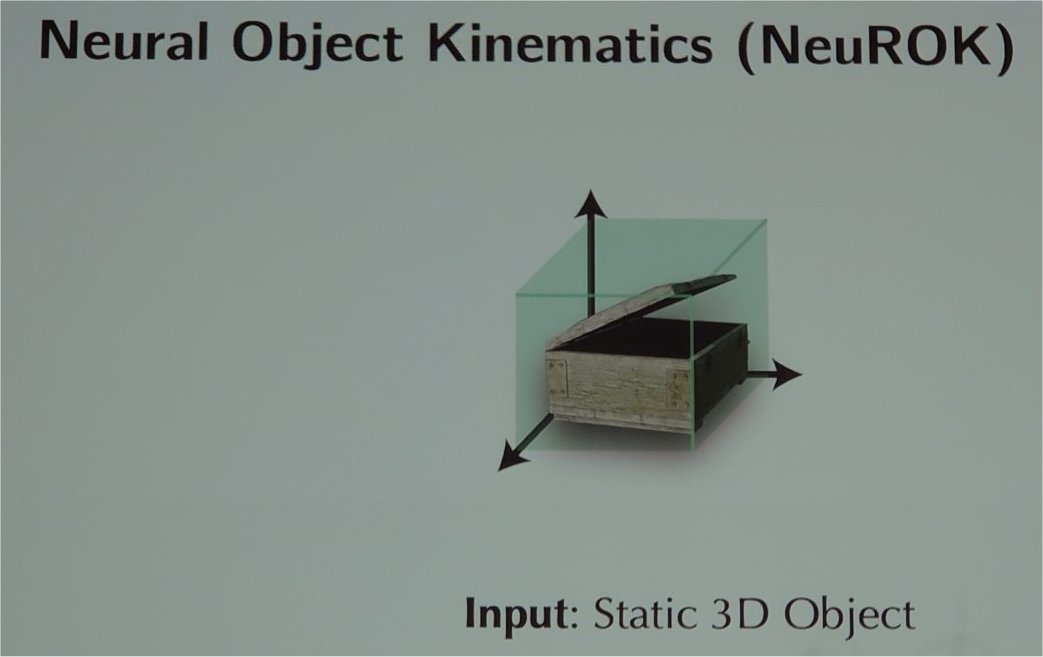
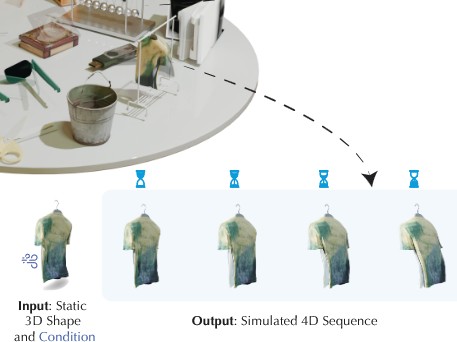
NeuROK turns any static 3D shape into an interactive 4D moving object (3D space + time) without needing human-labeled physics data or category-specific assumptions [13].
Most existing methods assume a predefined physical model and use system identification to estimate parameters, restricting these methods to specific categories and small-scale datasets. We propose that these restrictions can be overcome by learning a data-driven kinematic state parameterization for object-centric physical systems. Specifically, we learn both a latent space representing all possible states of the object and a decoder that maps any sampled latent to a plausibly deformed shape of the object [13].
Ijcai. Thursday, August 20th.
Generating simulative 4D dynamics—realistic temporal deformations of static objects under various physical conditions remains challenging and often ad hoc, despite its importance in building comprehensive 3D world models [13].
NeuROK. Ijcai. Thursday, August 20th.
NeuROK learns a latent space representing all possible states of the object and a decoder that maps any sampled latent to a plausibly deformed shape of the object [14].
Ijcai. Thursday, August 20th.
NeuROK turns any static 3D shape into an interactive 4D moving object [13].
Ijcai. Thursday, August 20th.
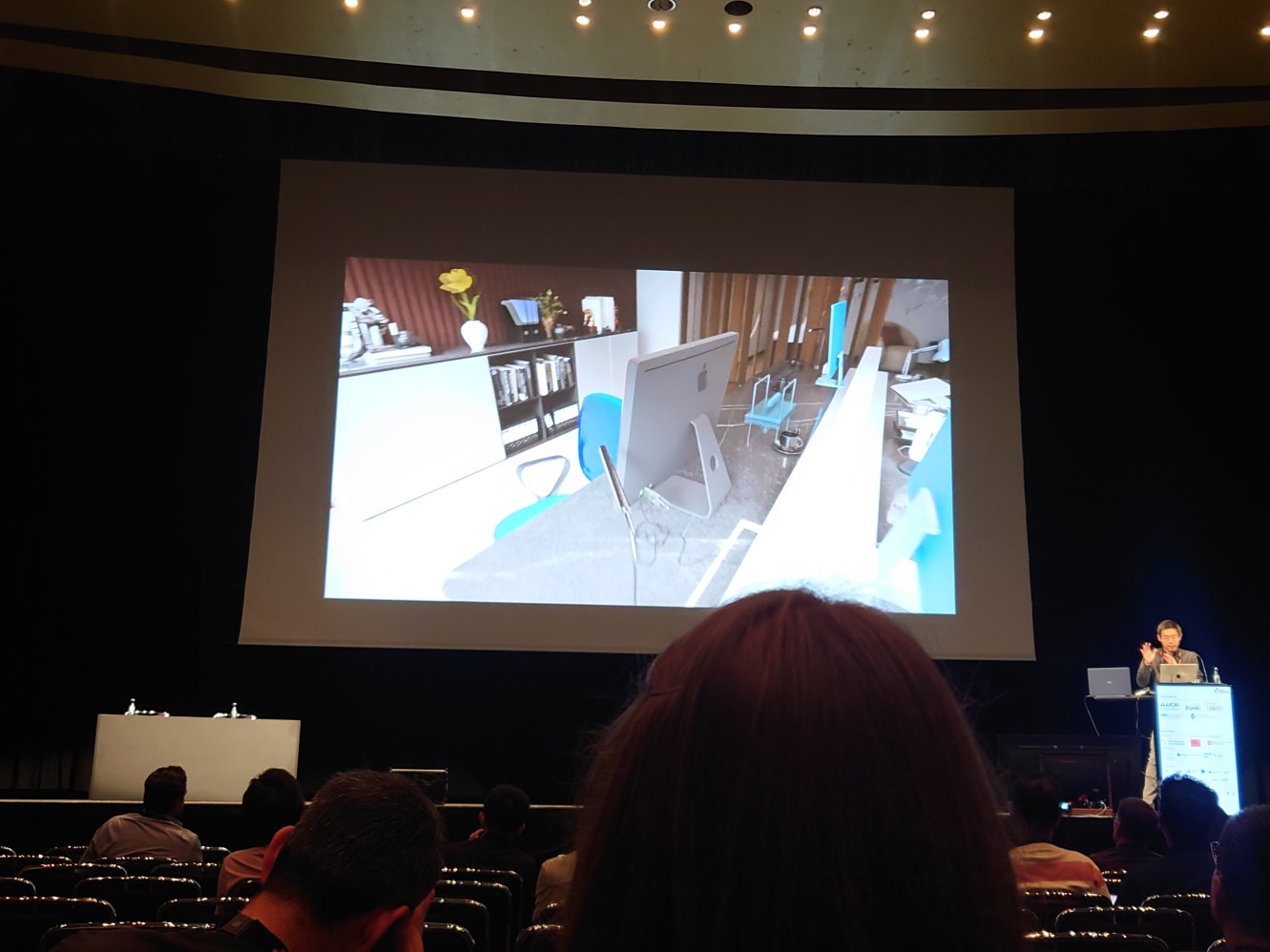
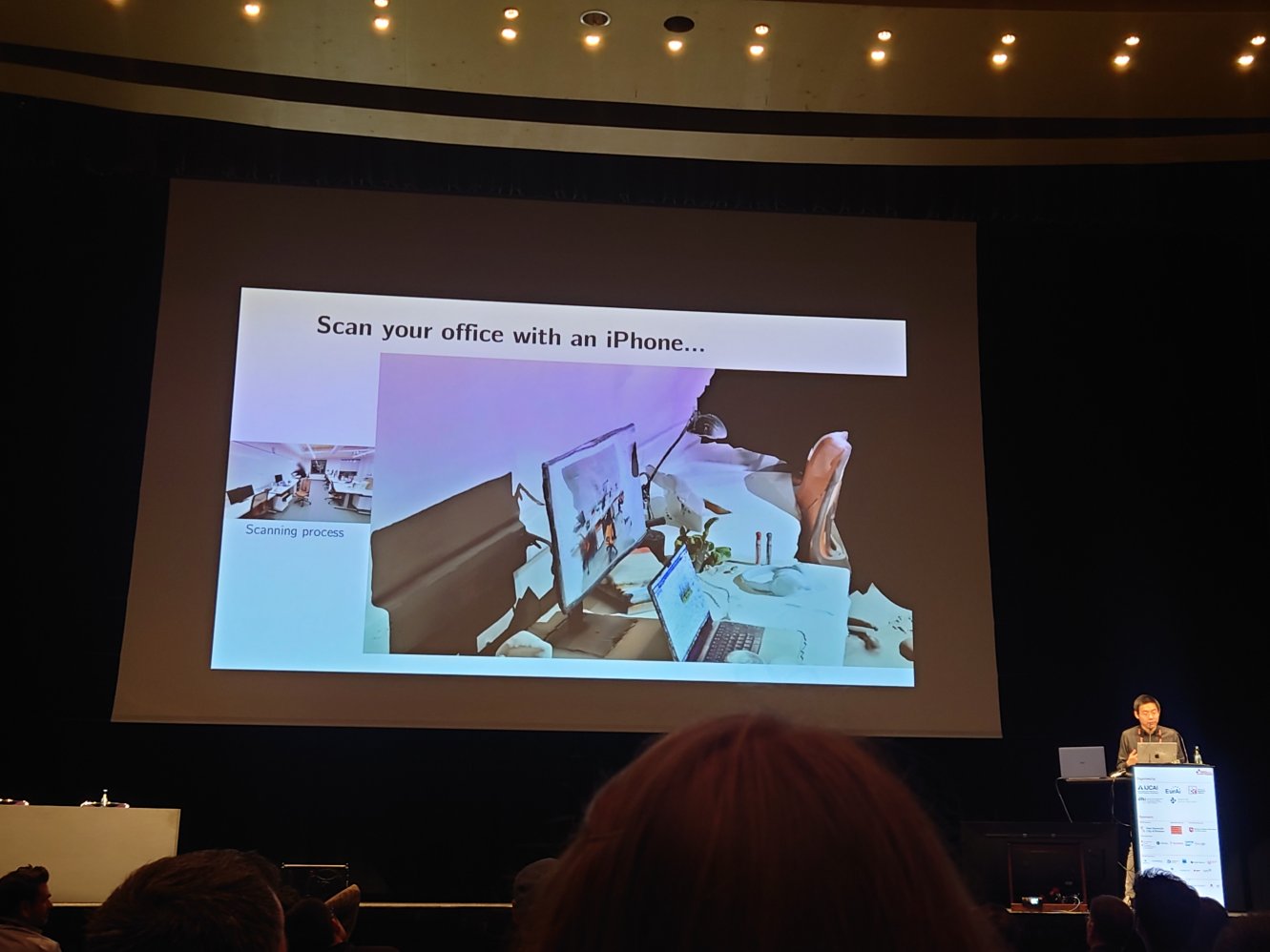
Since NeuROK is designed to predict physics and dynamic movements from a static shape, you can use your iPhone to create the starting point.
You first use your iPhone (for example, with the Polycam app or Apple's built-in LiDAR scanner) to capture a 3D model of an office object, such as an office chair, a lamp, or a desk.
You feed this static 3D model (mesh) into the NeuROK framework.
Ijcai. Thursday, August 20th.
Jiajun Wu also presented ''Chord'':
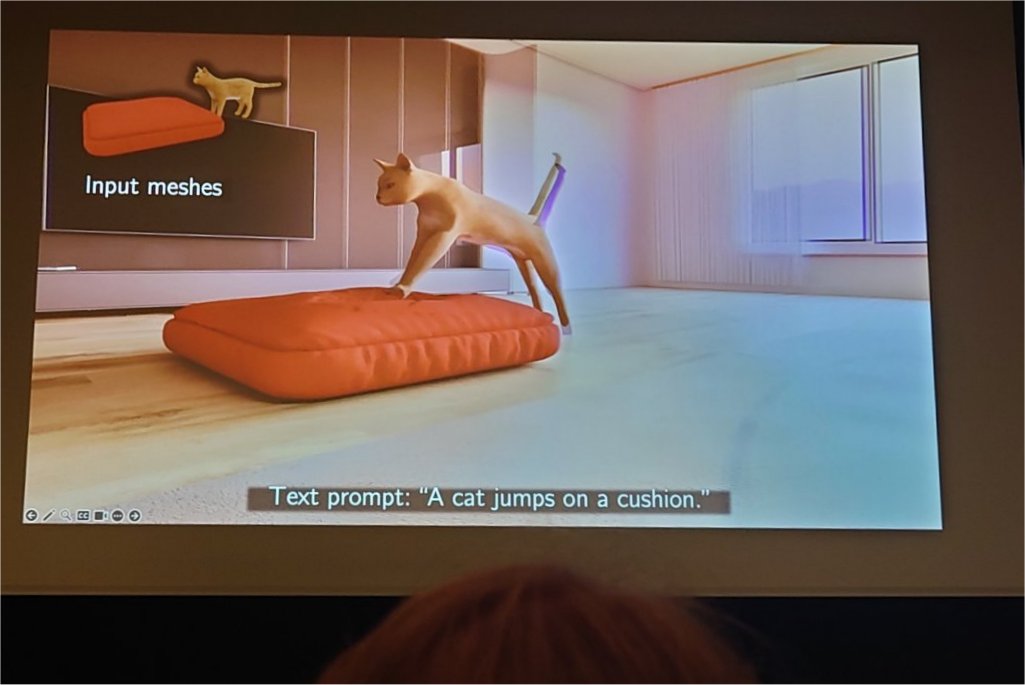
Chord (Choreographing a World of Dynamic Objects by Jiajun Wu et al.). Chord takes a single image or loose 3D components (Input meshes) and utilizes a text prompt (e.g., ''A cat jumps on a cushion'') to choreograph complex, physically realistic interactions in a 4D scene [15], [16].
''Wonderplay'' is a novel framework integrating physics simulation with video generation for generating action-conditioned dynamic 3D scenes from a single image.
I.e. Traditional AI video generators can create beautiful, realistic clips, but the clips are ''passive''. The user can't interact with them. Traditional physics engines (video games) are highly interactive, but they struggle to generate photorealistic textures from just one photo. ''WonderPlay uses a continuous loop between the two systems to create 3D scenes from a single image [17], [18].
Ijcai. Thursday, August 20th.
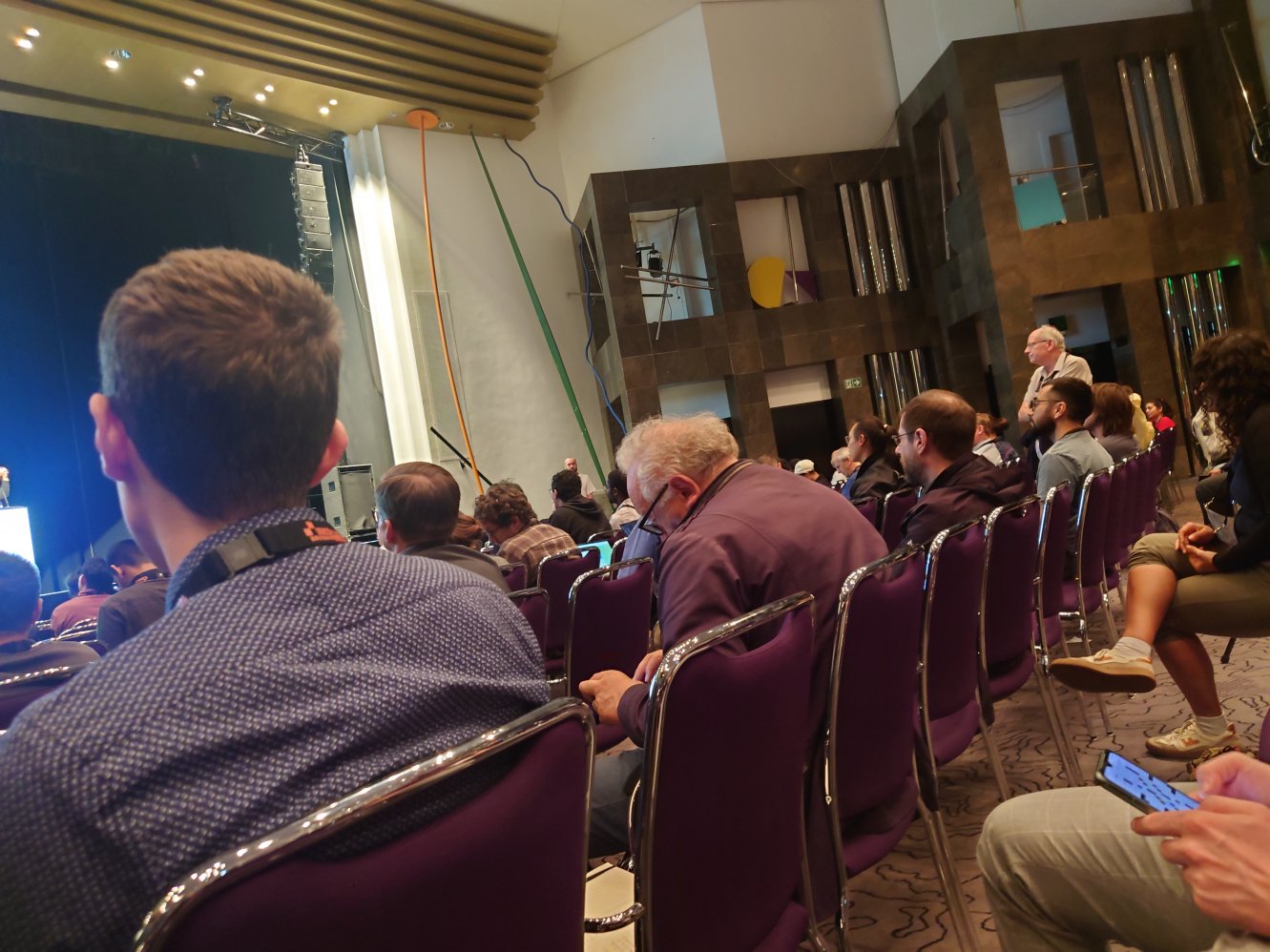
Indeed, it was all pretty amazing stuff. Still, a gentleman from the audience was quite upset with the presentation, as he thought that it was all about computer graphics rather than actual AI, which was, after all, the theme of the conference.
Well, well.
5.5. Game theory and Economic paradigms.
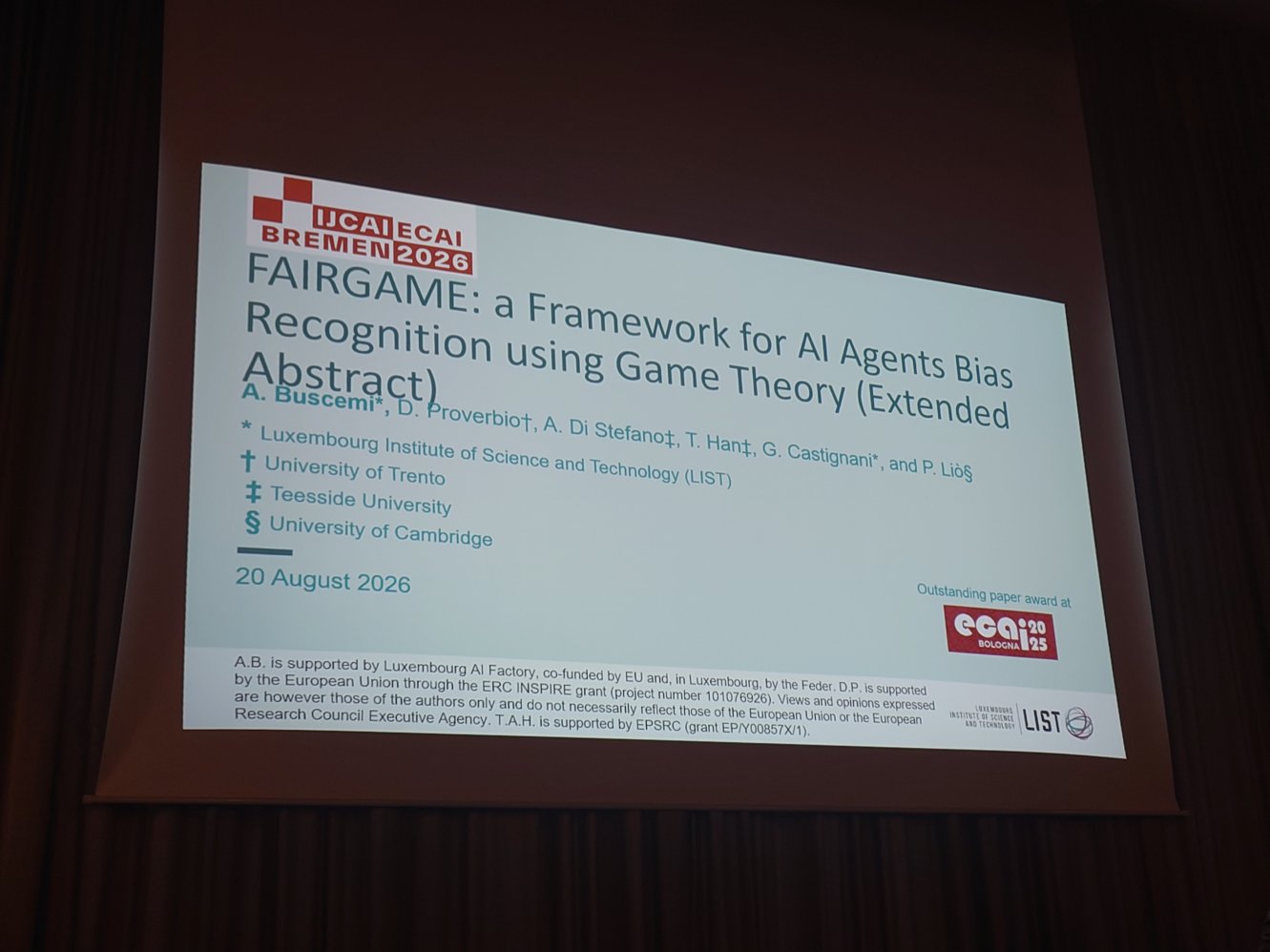
Fairgame. Ijcai. Thursday, August 20th.
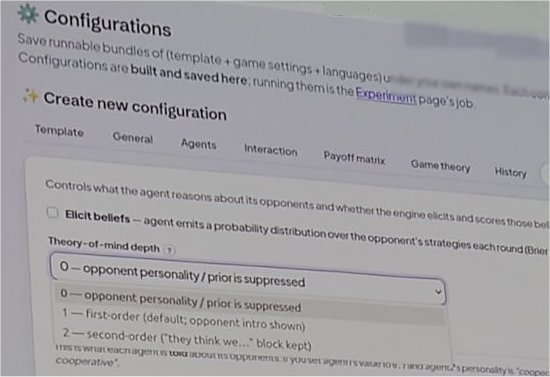
Fairgame is an open-source framework that uses game theory to simulate interactions between LLM-based agents. Testing four LLMs across different languages and personalities in classic games (like the Prisoner's Dilemma), we discovered that models often deviate from standard game theory. Instead, their strategic decisions are heavily influenced by prior world knowledge, language choice, and assigned personalities.
Fairgame. Ijcai. Thursday, August 20th.
Setting up Fairgame is like being the director of a theater play, where the actors are AI chatbots. Instead of writing a rigid script, you set up the rules of a game, give the AI characters distinct traits, and watch how they negotiate or compete.
You can assign different AI models to different players.
You can explicitly tell the AI how to behave by giving it traits (e.g., ''You are highly cooperative'' or ''You are entirely selfish and money-driven''.
Fairgame runs game-theoretic simulations between LLM-powered agents to surface biases tied to language, personality, and strategy. It supports classical scenarios (Prisoner's Dilemma, Volunteer's Dilemma, Battle of the Sexes) and custom payoff matrices [19].
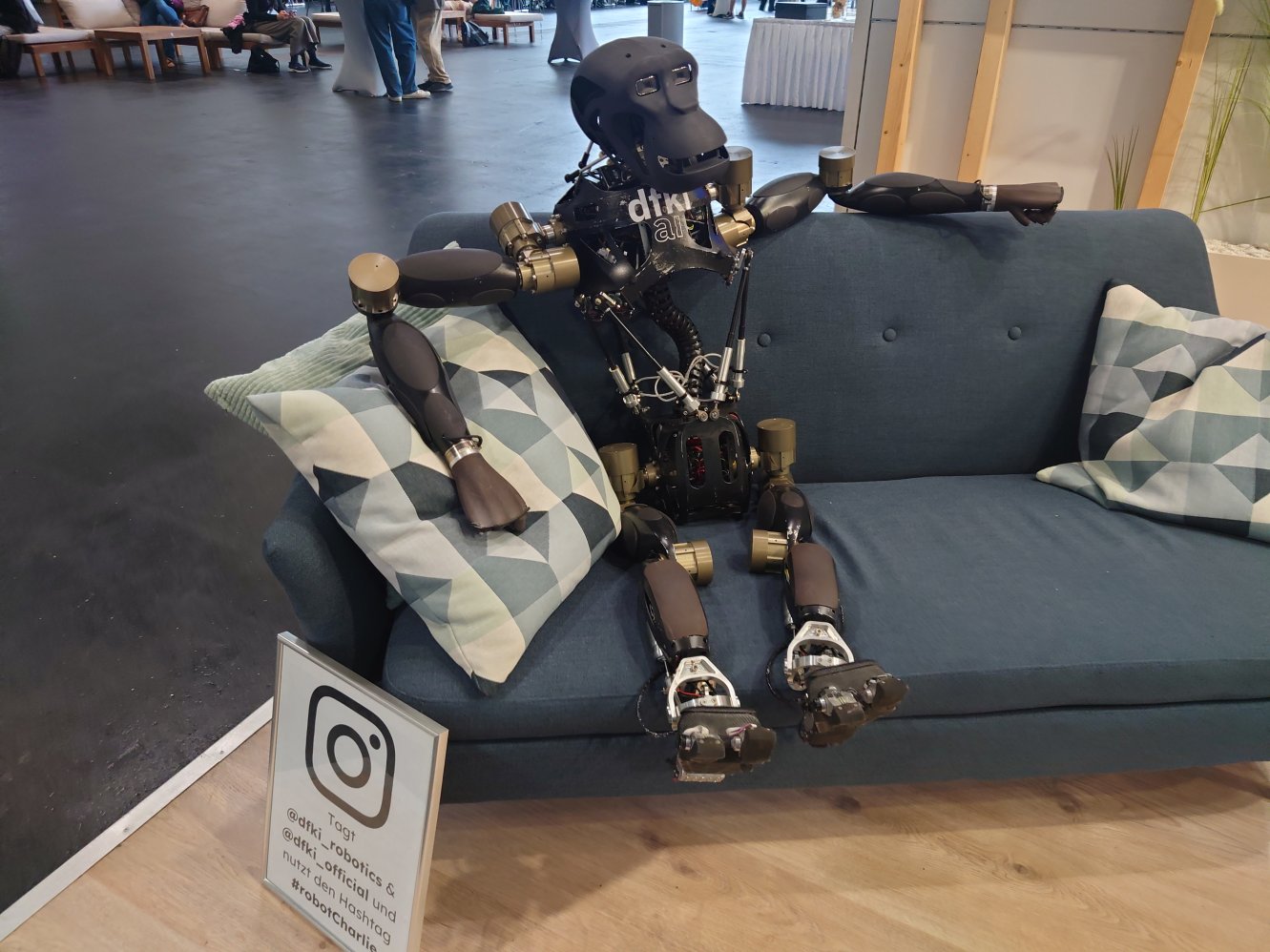
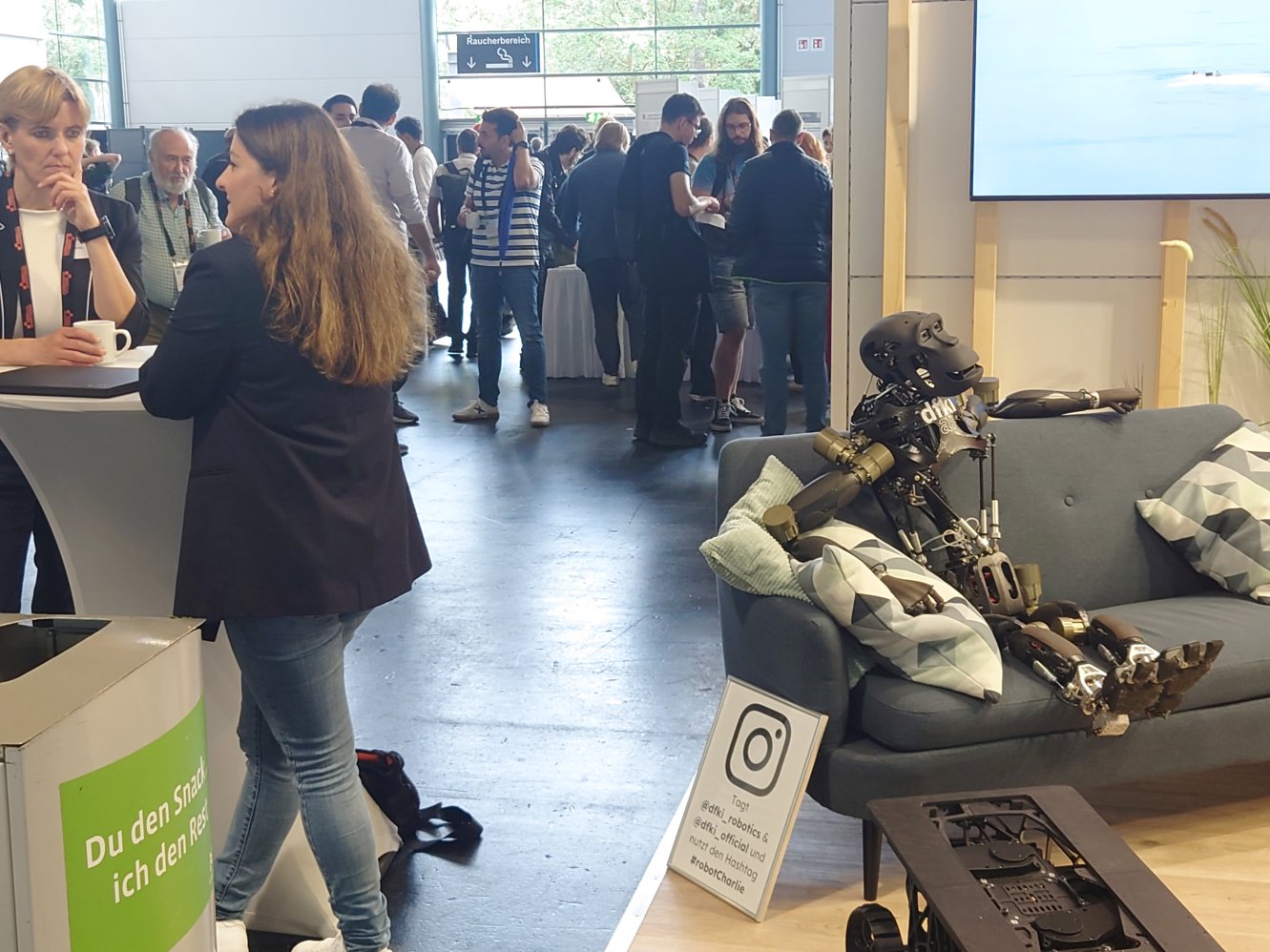
Charlie is a robot that can crawl on all fours for safety when climbing on steep, slippery terrain, but can also stand up on two legs to use its hands when it reaches a spot it wants to investigate [20].
Bremen. August 20th.
6. Friday, August 21st.
6.1. Inductive Biases for Robot Reinforcement Learning.
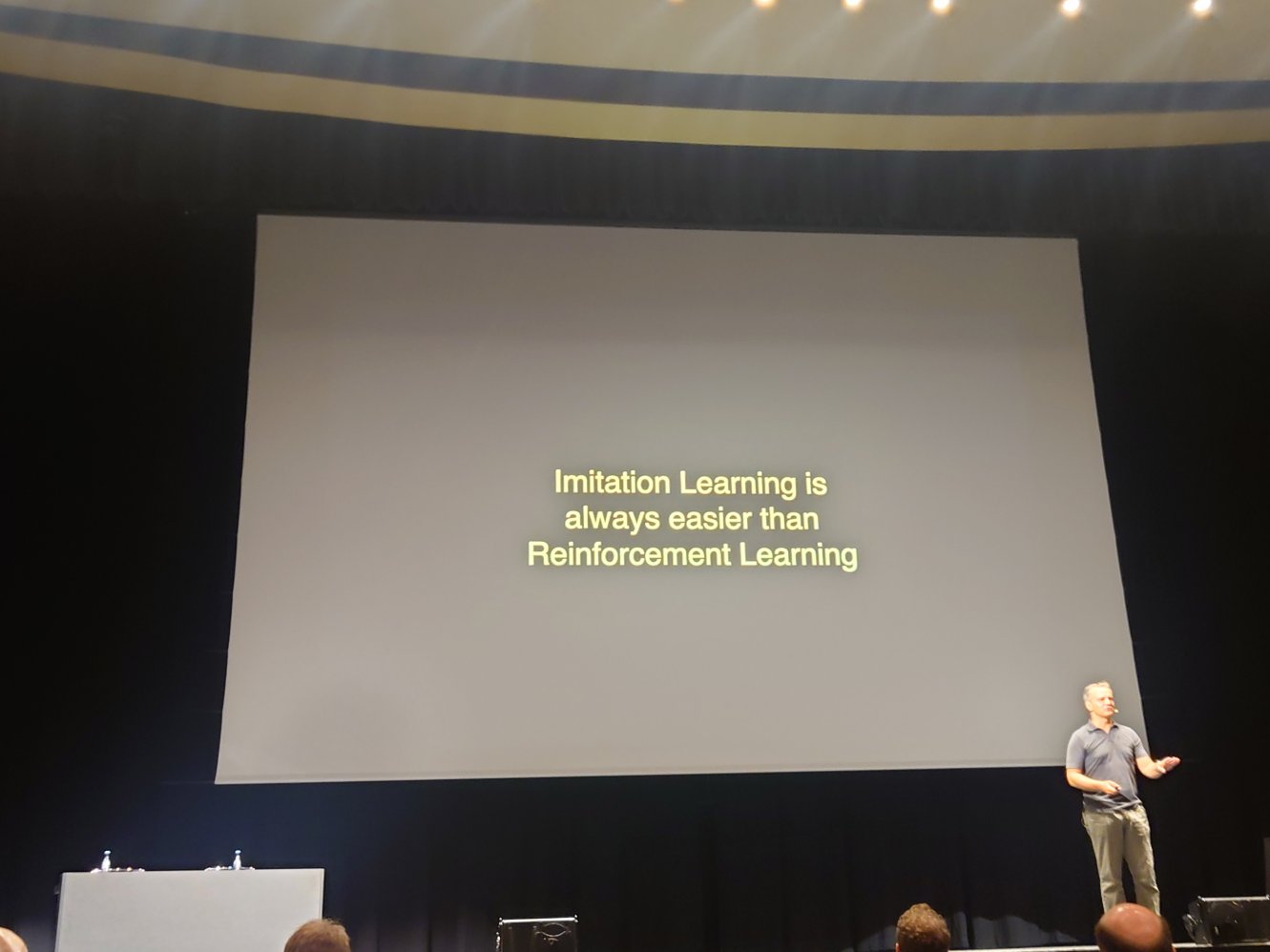
Jan Peters talked about ''Inductive Biases for Robot Reinforcement Learning''.
Current machine learning struggles to scale up to complex, humanoid robots, when we want to
create autonomous robots that help humans in daily life by learning tasks from their environment or instructions.
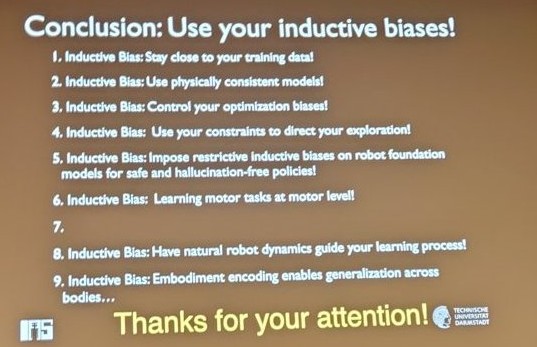
Here, ideas are presented aiming to speed up learning by using general principles and domain knowledge from robotics, physics and control to guide the robot, rather than relying on endless trial and error.
Friday, August 21st. Ijcai 2026. Ijcai. August 2026.
Ijcai. August 2026.
In my understanding, interpretation of the talk:
Instead of letting a robot try random movements forever (trial and error), the robots should start with some ''rules of thumb'' based on physics and common sense, in order to learn faster.
The robot should start with knowledge about the real world, it should not waste time trying impossible movements.
Preferably, the robot should only explore safe and logical solutions (in order to avoid dangerous mistakes and ''hallucinating'').
The robot should use its own weight and shape to help it learn how to move. As this makes it easier to use the same software on different types of robot bodies.
Friday, August 21st. Ijcai 2026. Ijcai. August 2026.
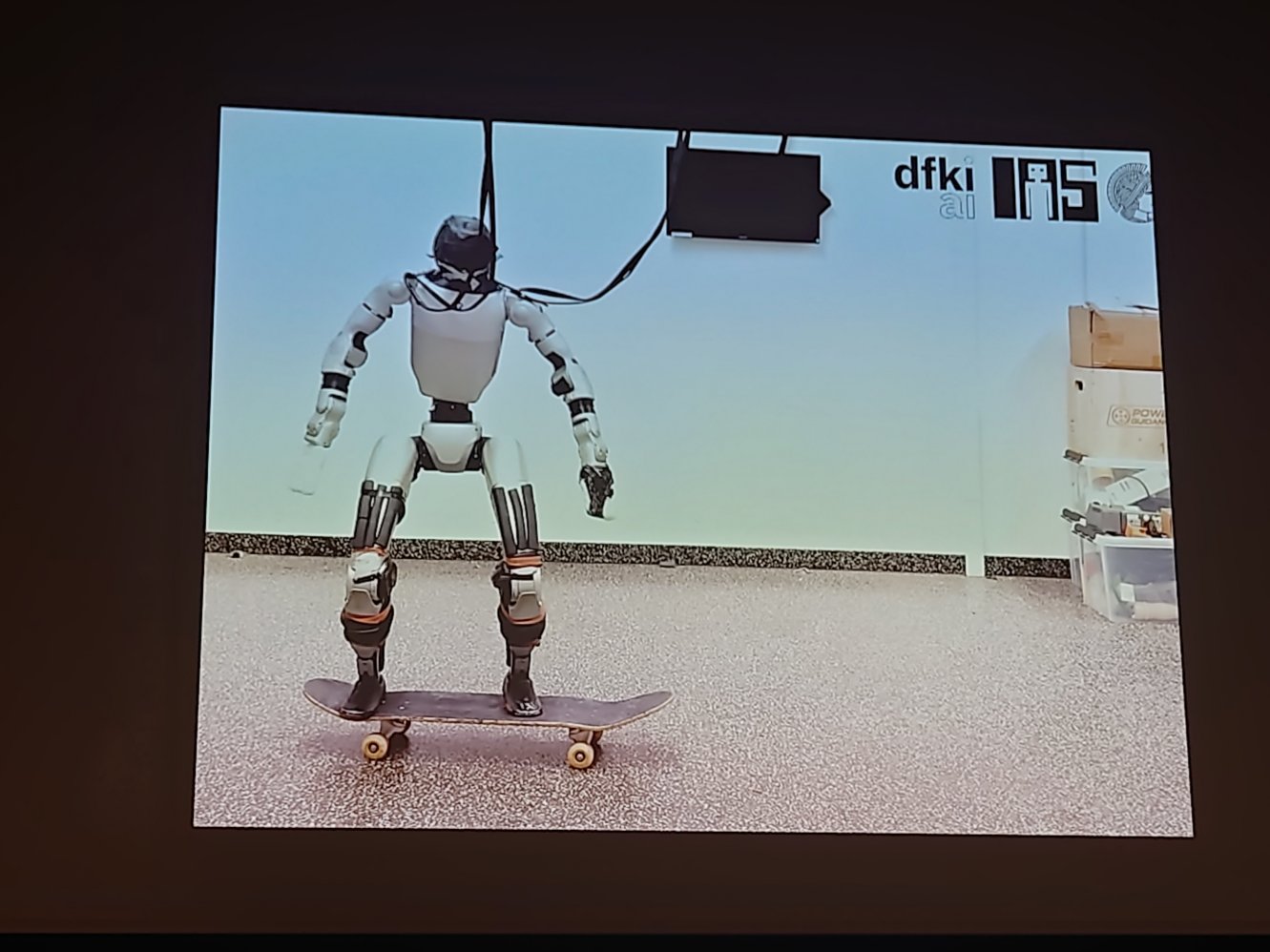
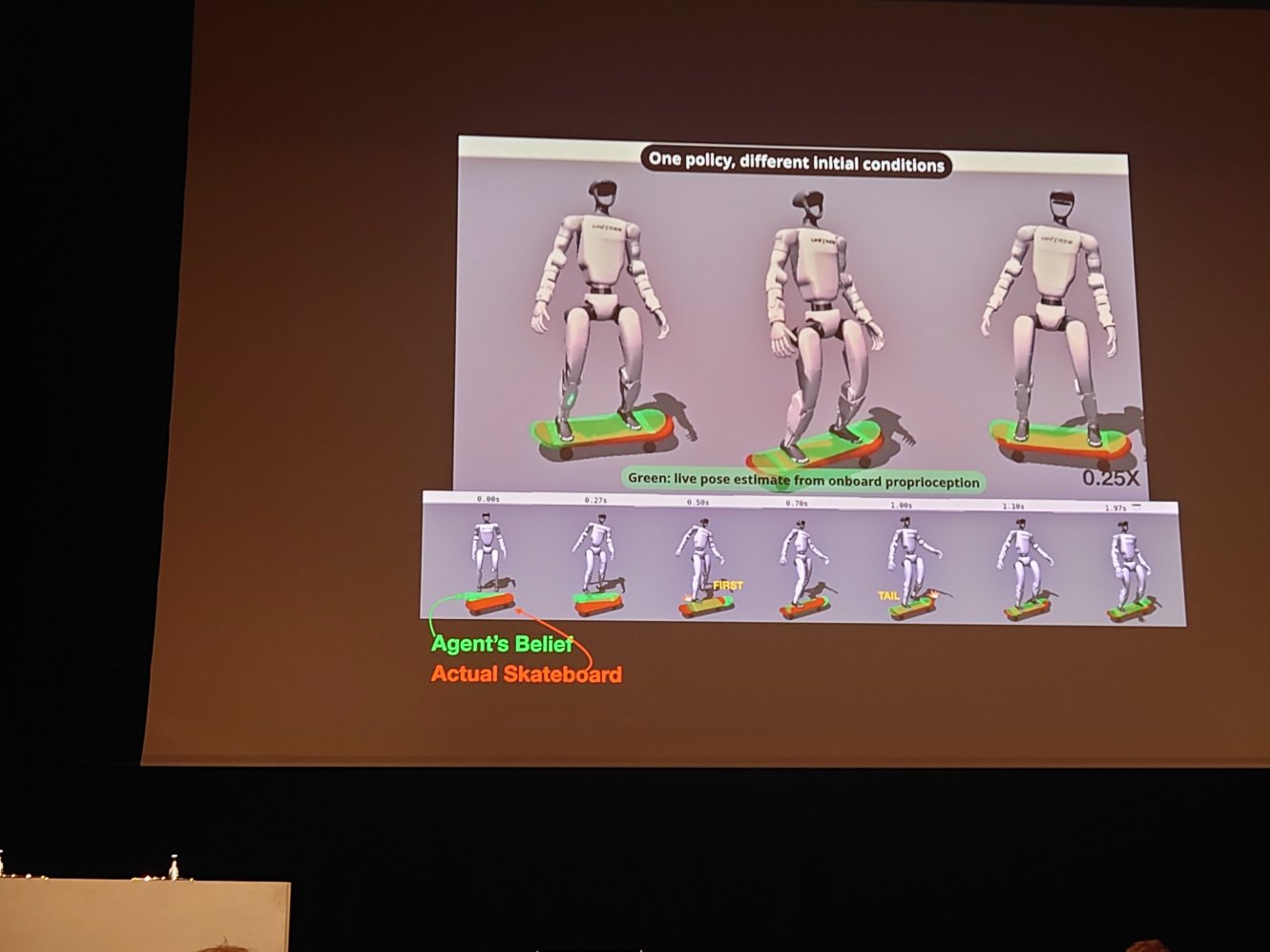
Which will then allow us to move towards something like ''The Blind Skateboarder'' (The robot does not utilize optical lenses, depth sensors, or external motion-capture tracking markers to see its surroundings)? Indeed, a breakthrough project in humanoid locomotion, developed by Aditya Bhatt, Dfki [21], showcasing a Unitree G1 humanoid robot executing dynamic skateboard maneuvers.
Amazing stuff, indeed.
Bremen, 2026.
6.2. Ijcai In the World.
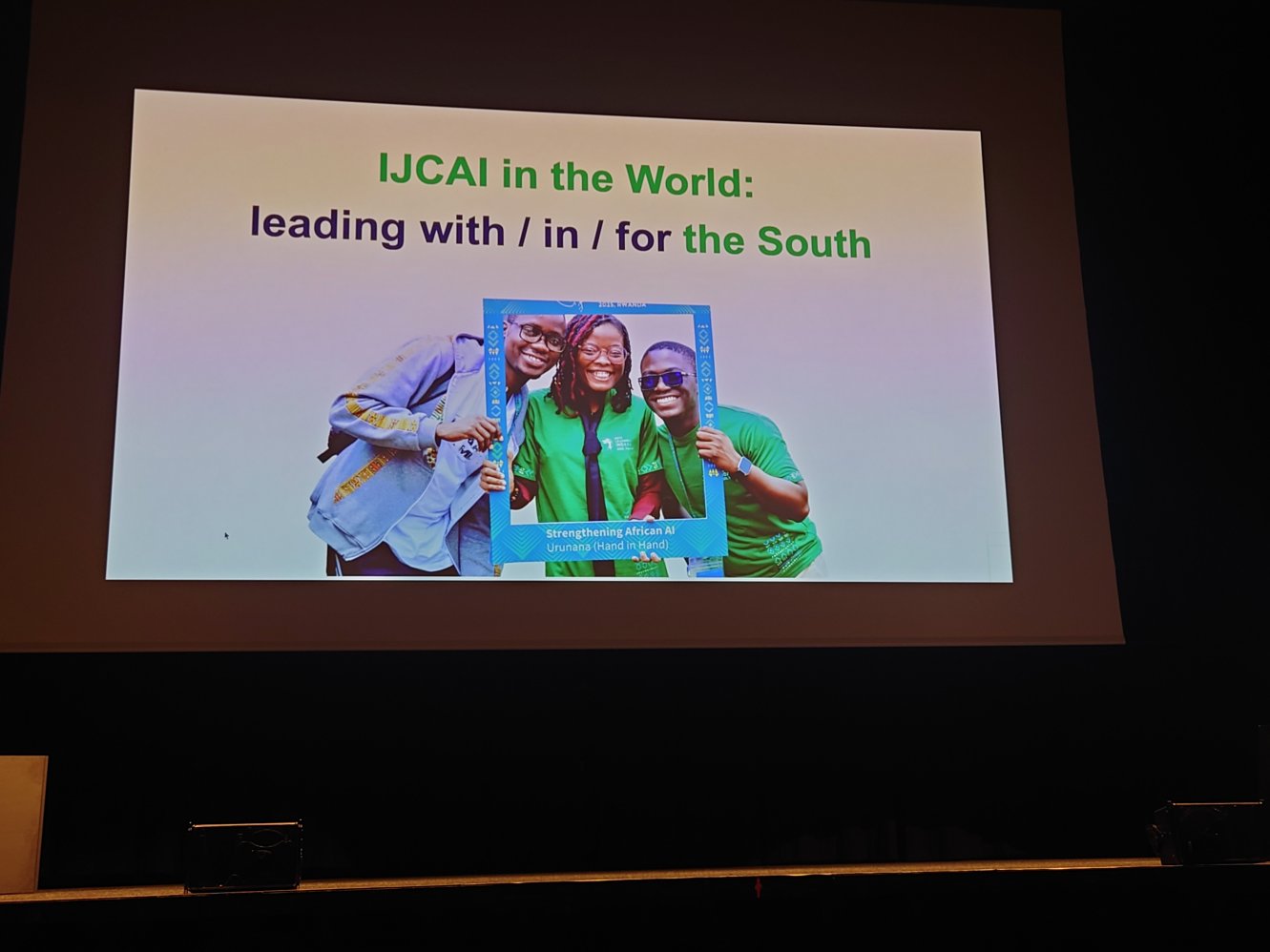
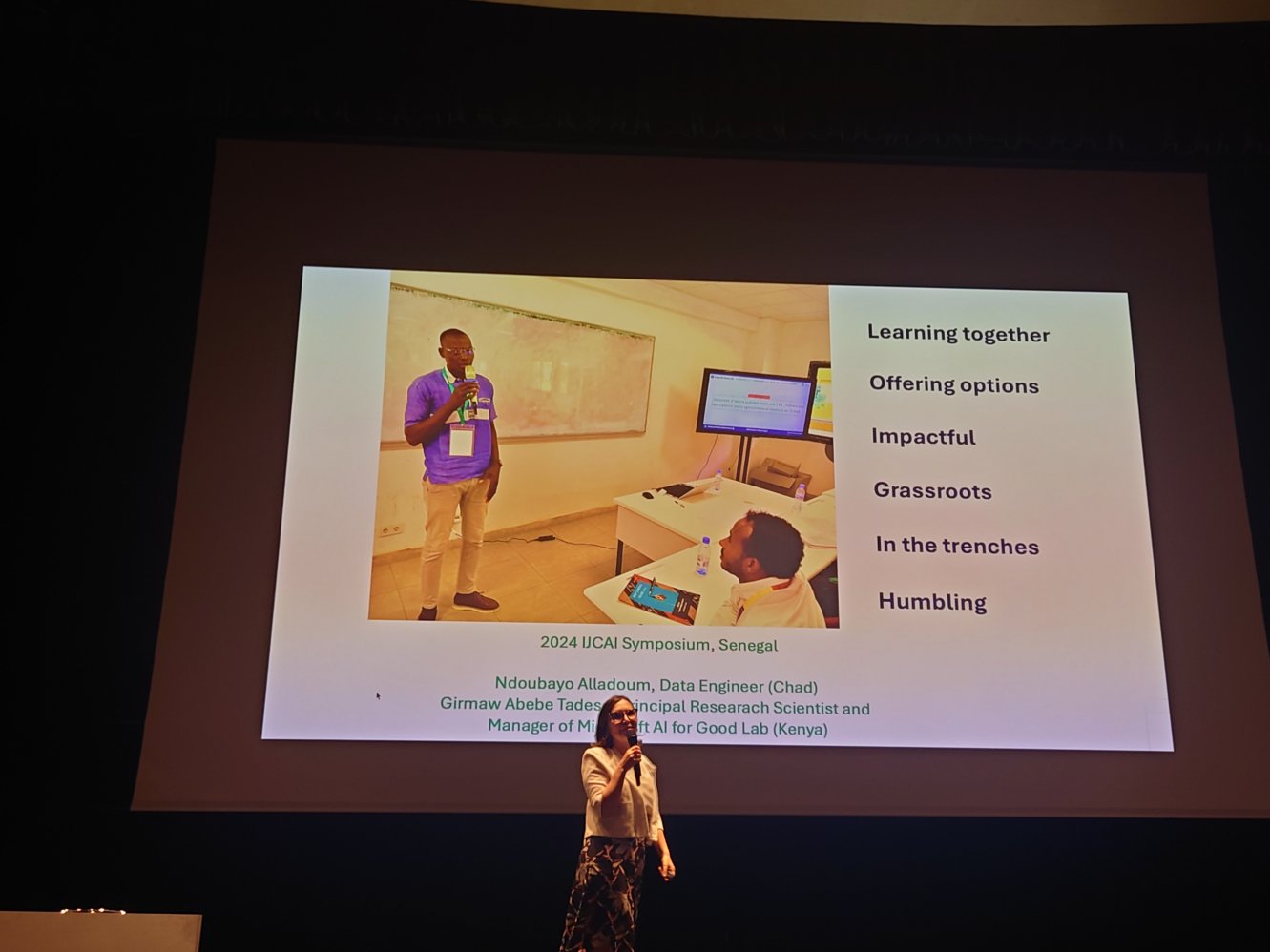
Georgina Curto, United Nations University Institute in Macau, talked about ''Ijcai In the World''.
Over the past three years, IJCAI has supported mentoring sessions, panel discussions, calls for papers, and academic presentations across South Africa, Senegal, Rwanda, Uganda, and Nigeria.
... Local partners hosted these events.
Friday, August 21st. Ijcai 2026. Ijcai. August 2026.
Ijcai. August 2026.
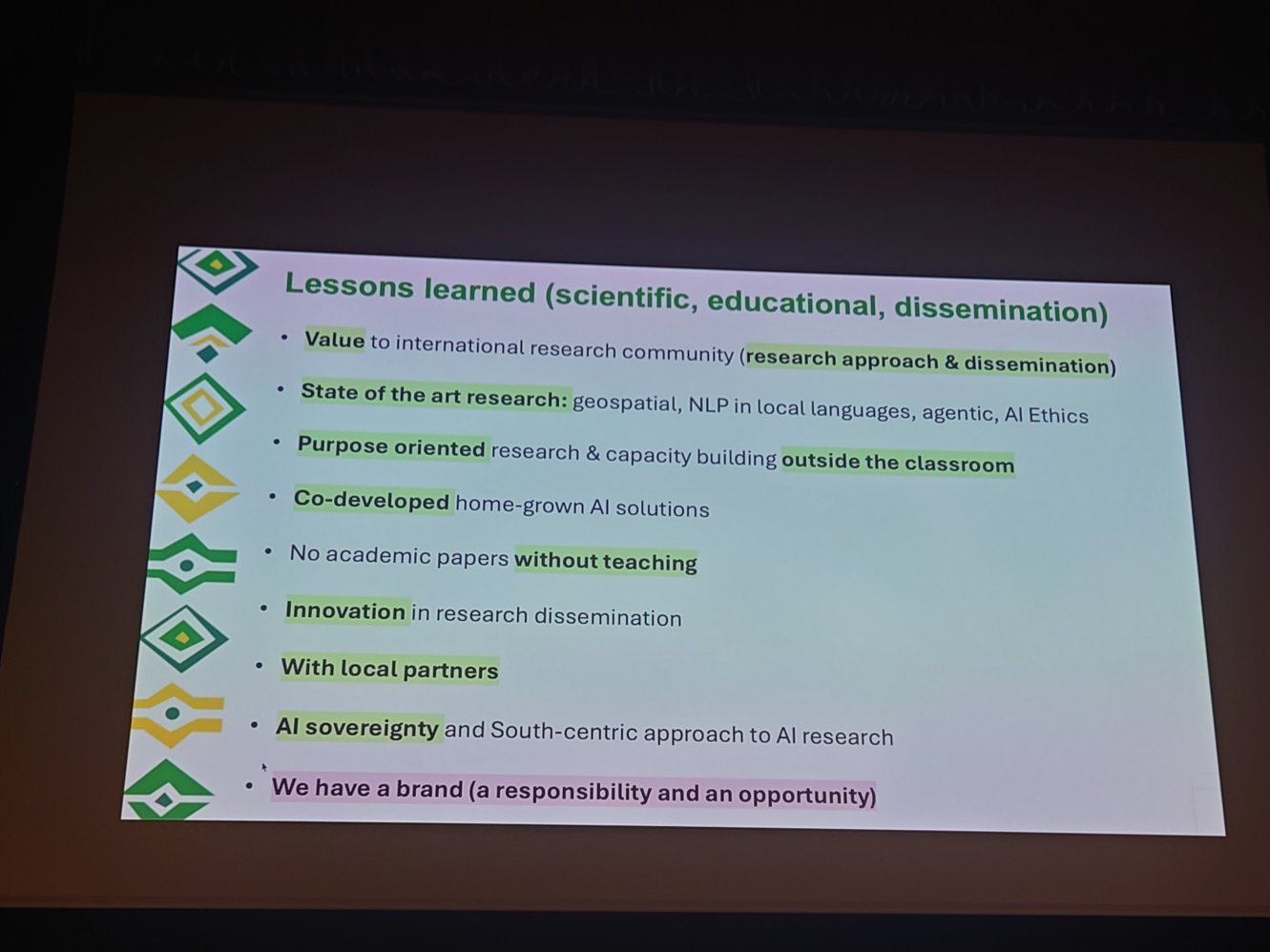
Headlines: (Including) Purpose-oriented research outside the classroom, combining academic writing with active teaching.
Important stuff, certainly.
Ijcai. August 2026.
Indeed, the end of a wunderbar conference. With many, many memorable moments.
Bremen, 2026.
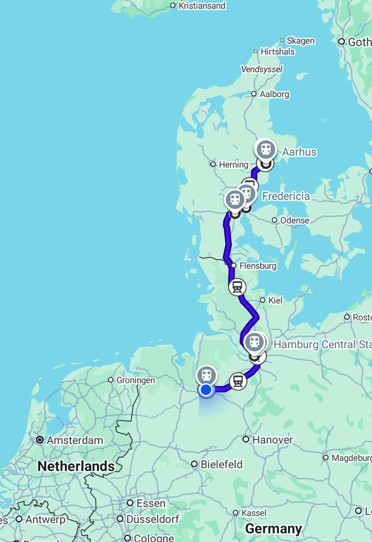
Trip impressions. Hamburg - Bremen, Germany.
Hamburg Hauptbahnhof.
Hamburg Hauptbahnhof.
Hamburg Hauptbahnhof.
Hamburg Hauptbahnhof.
Bremen Hauptbahnhof.
Bremen Hauptbahnhof.
Lightrail, Bremen.
Italienische Lebensfreude. Bellini, Bremen.
Italienische Lebensfreude. Bellini, Bremen.
Italienische Lebensfreude. Bellini, Bremen.
Italienische Lebensfreude. Bellini, Bremen.
Italienische Lebensfreude. Bellini, Bremen.
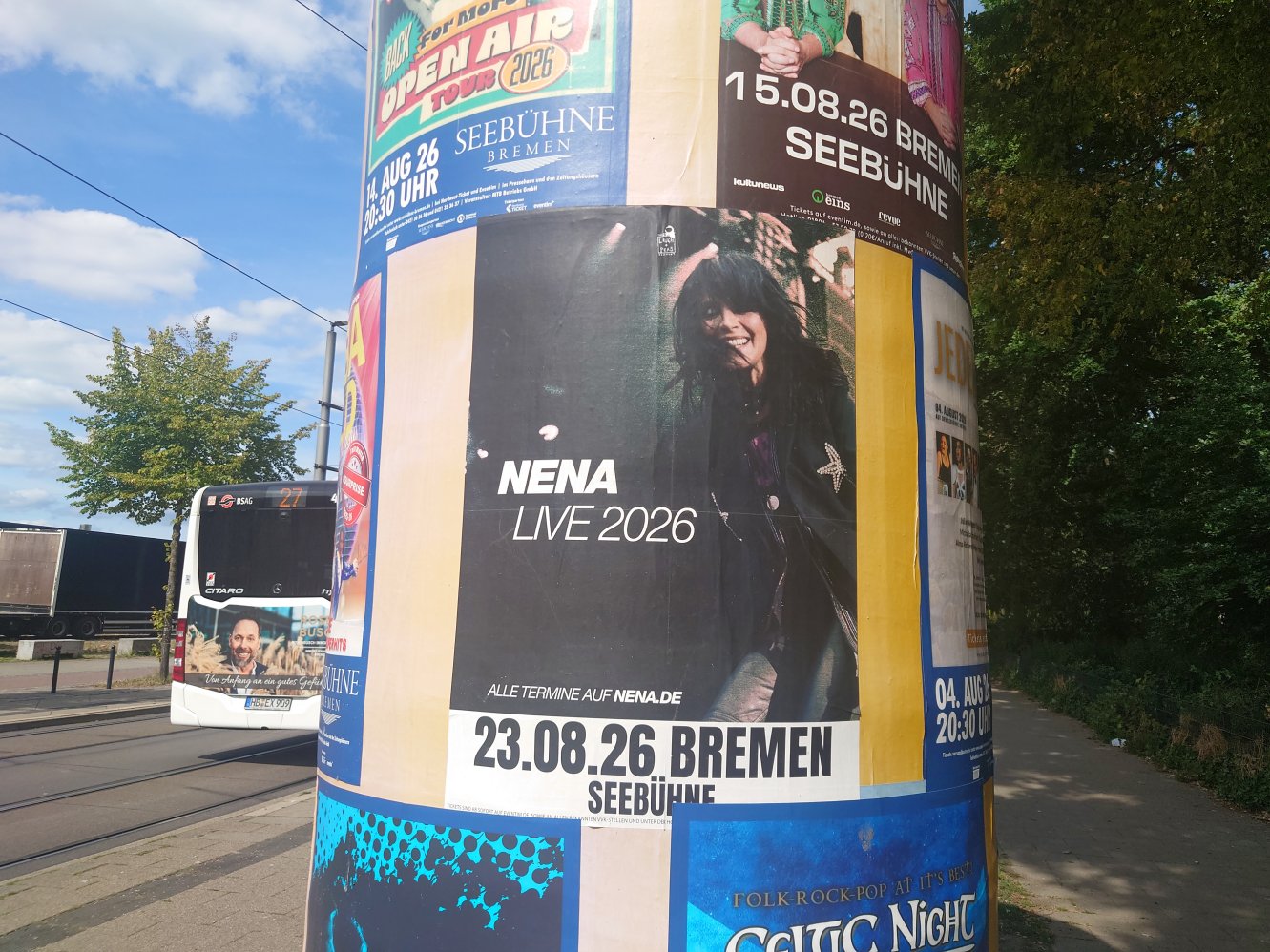
Nena. Bremen. August 2026.
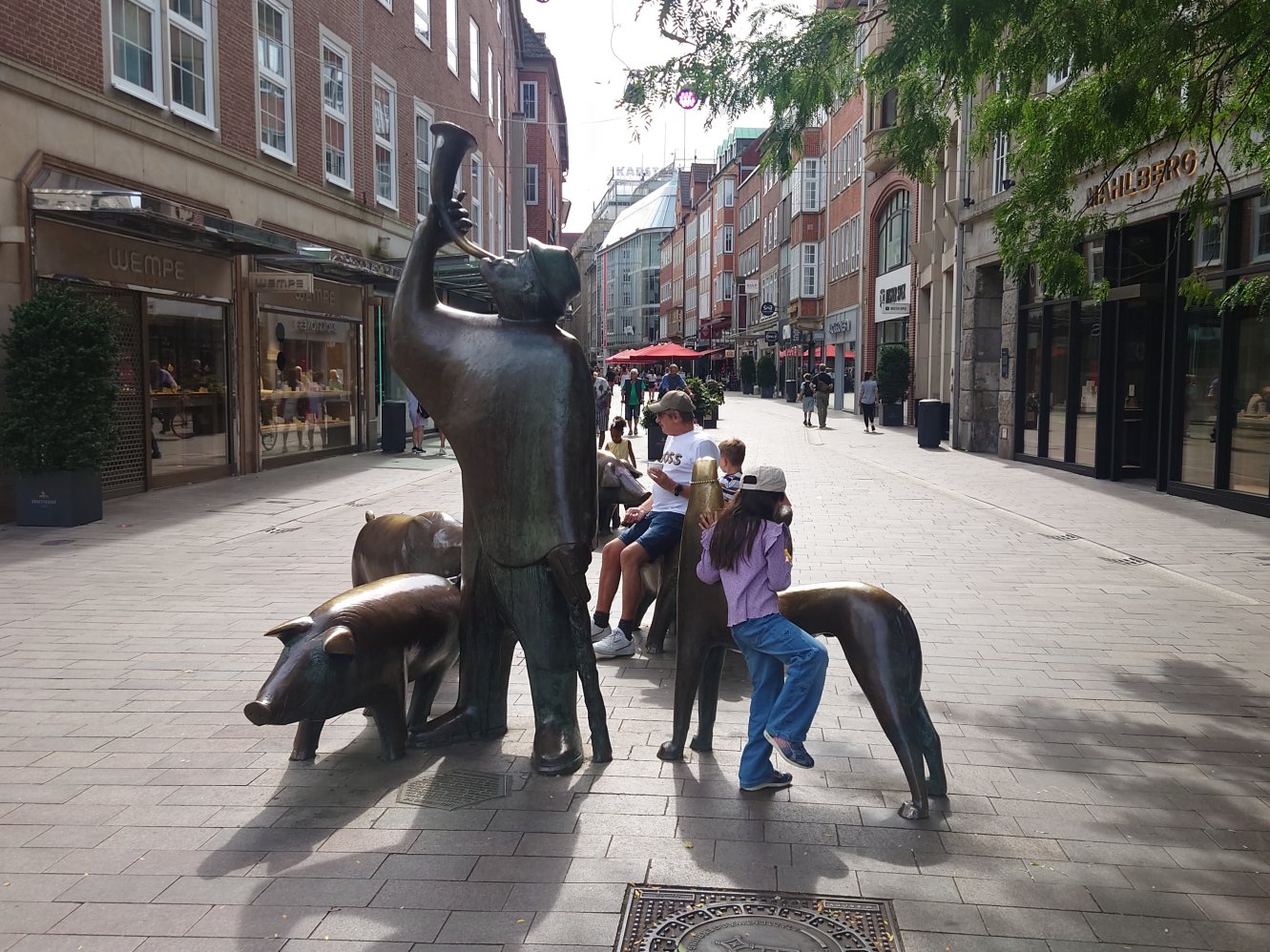
Bremen, Altstadt. August 2026.
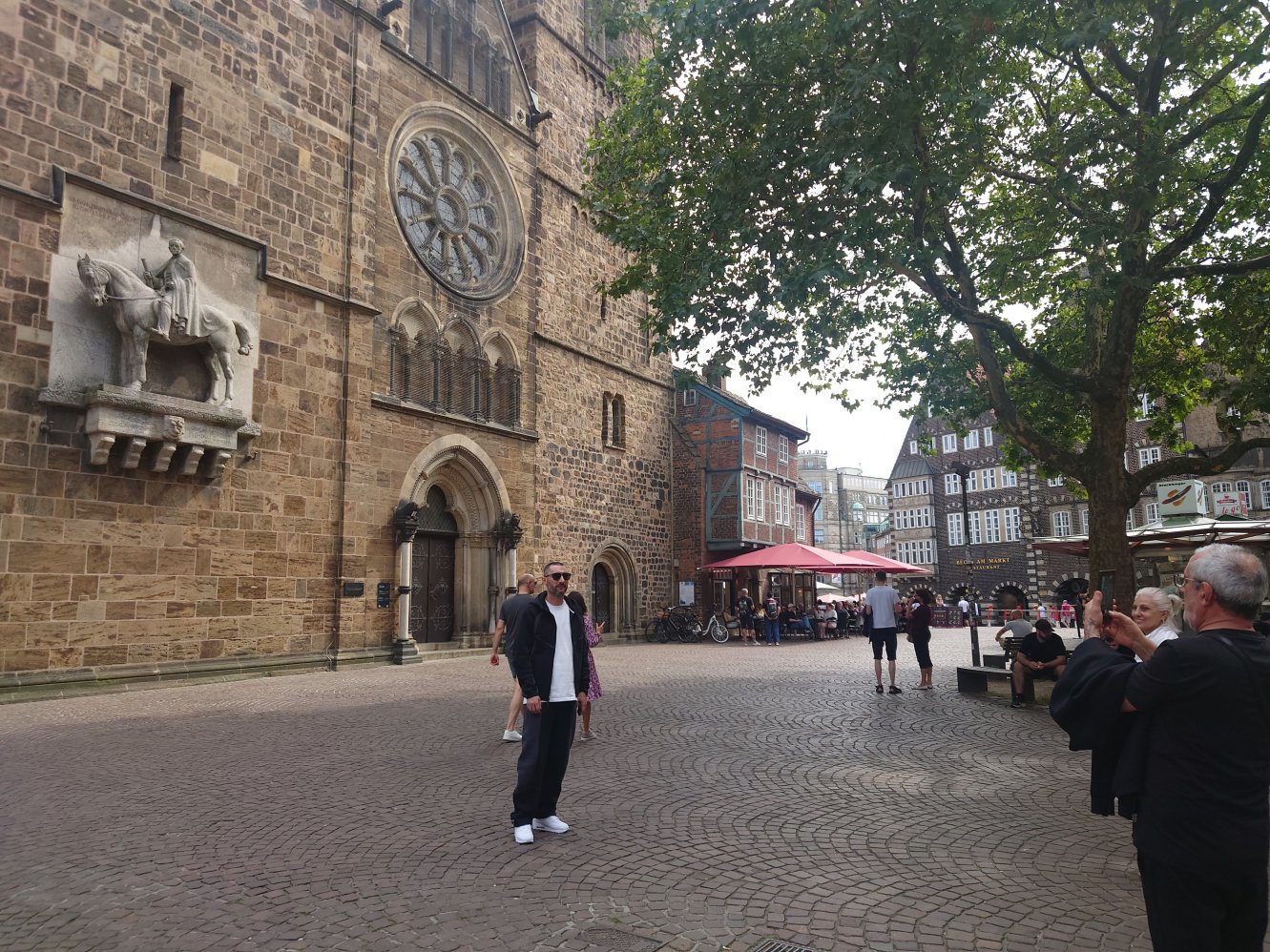
Bremen, Altstadt. August 2026.
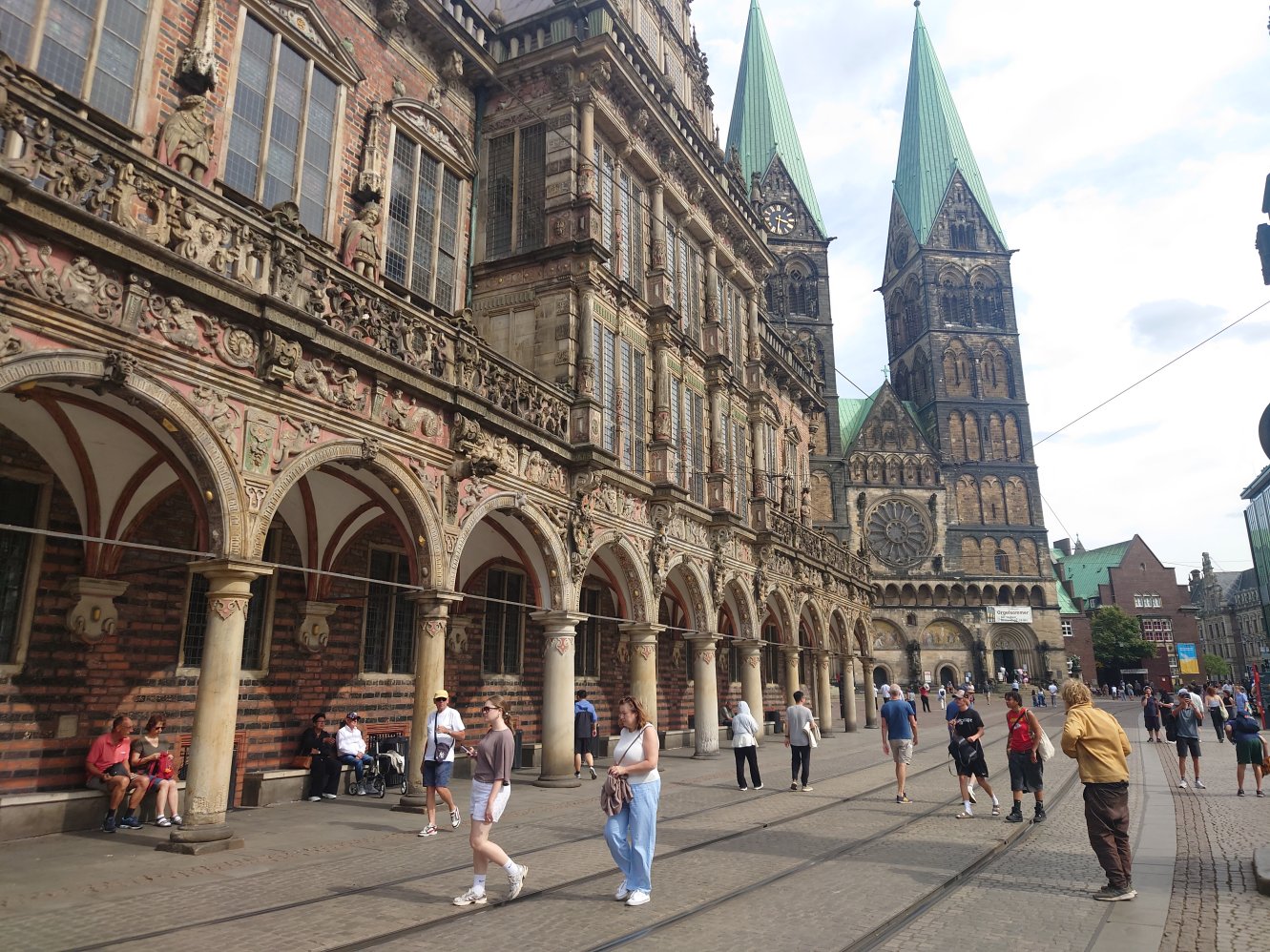
Bremen, Altstadt. August 2026.
Bremen, Altstadt. August 2026.
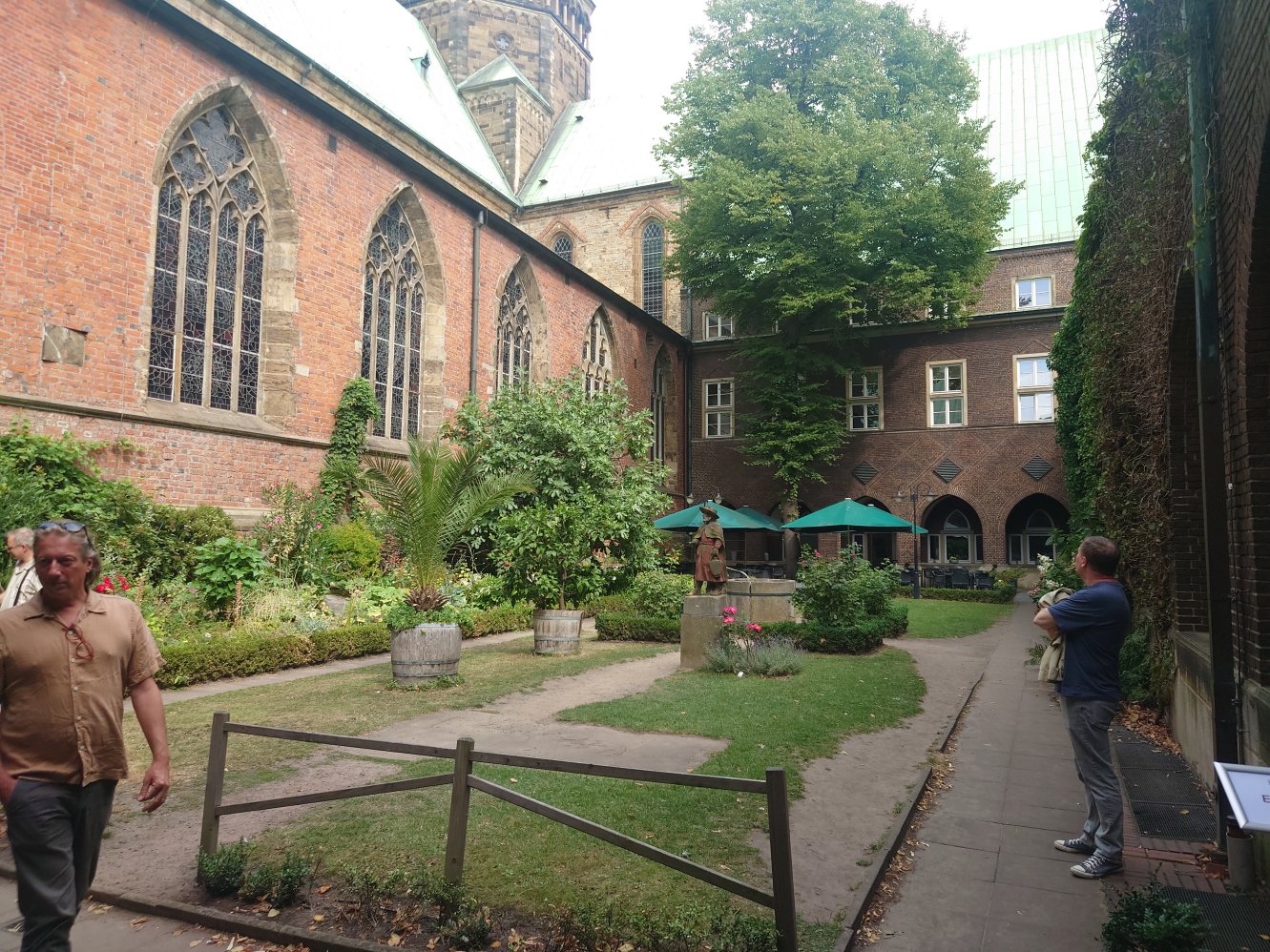
Bibelgarten. Bremen, Altstadt. August 2026.
Der Bibelgarten in Bremen ist eine ruhige Oase im Innenhof des St. Petri Dom.
Bleikeller ist der umgangssprachliche Name der Ostkrypta des St.-Petri-Doms in Bremen [22].
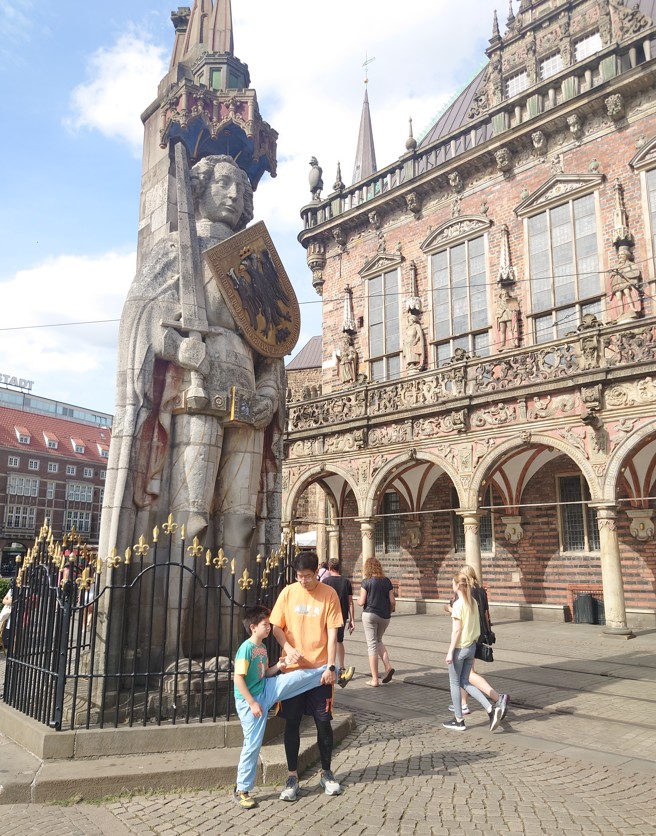
The Bremen Roland is a statue of Roland, erected in 1404. It stands in the market square (Rathausplatz) of Bremen, Germany [24].
Bremen, Altstadt. August 2026.
Der Bremer Ratskeller ist eine traditionelle Gaststätte und ein Weinhandel im Keller des Bremer Rathauses von 1405. Seitdem werden dort deutsche Weine gelagert und verkauft. Mit seinem über 600-jährigen Bestehen gehört der Bremer Ratskeller zu den ältesten Weinkellern Deutschlands [25].
Bremer Ratskeller is a restaurant in the Bremer Rathaus from 1405. Now with a robot.
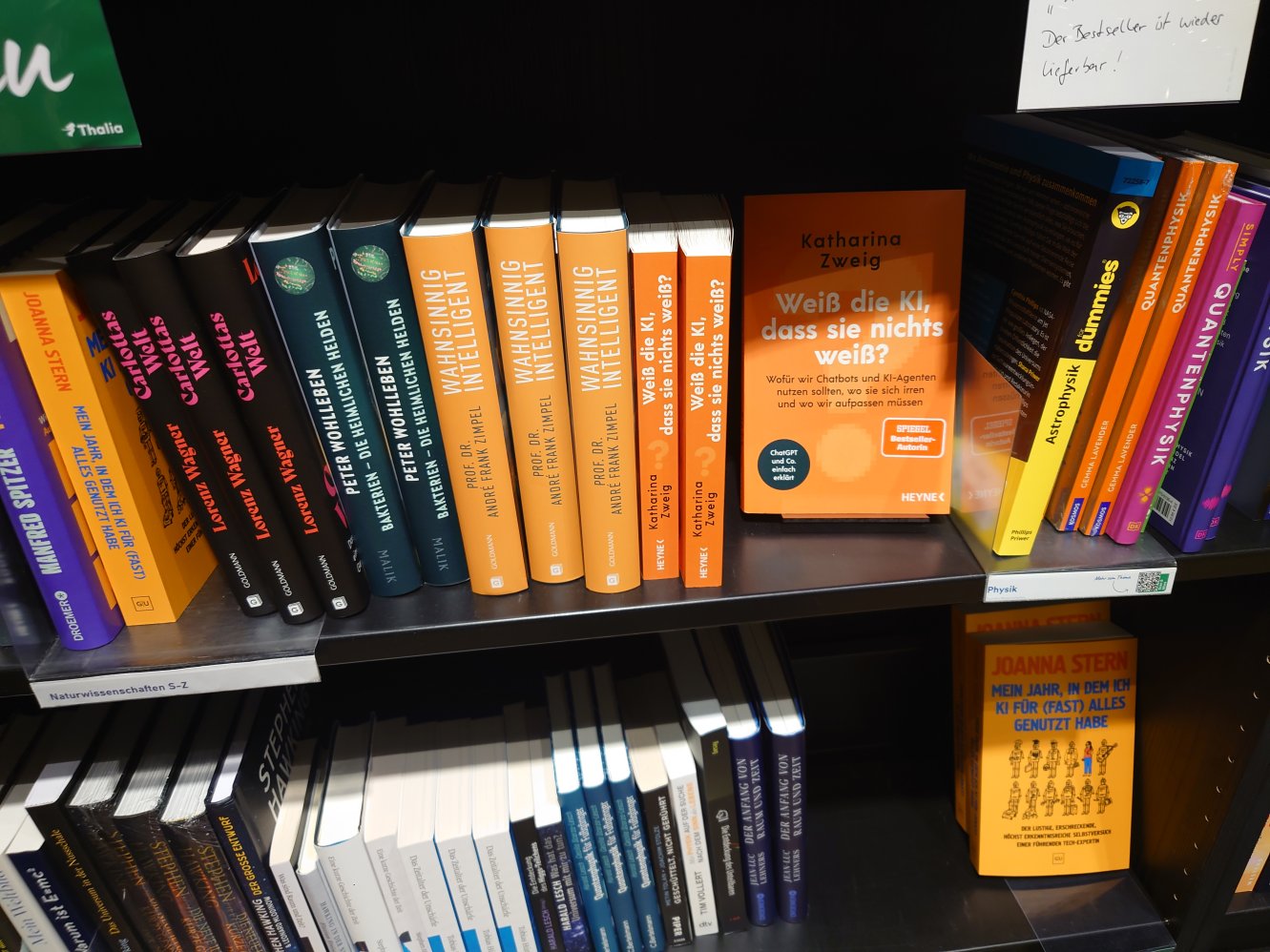
Bookstore. Bremen, Altstadt. August 2026.
Bookstore. Bremen, Altstadt. August 2026.
Bookstore. Bremen, Altstadt. August 2026.
Bookstore. Bremen, Altstadt. August 2026.
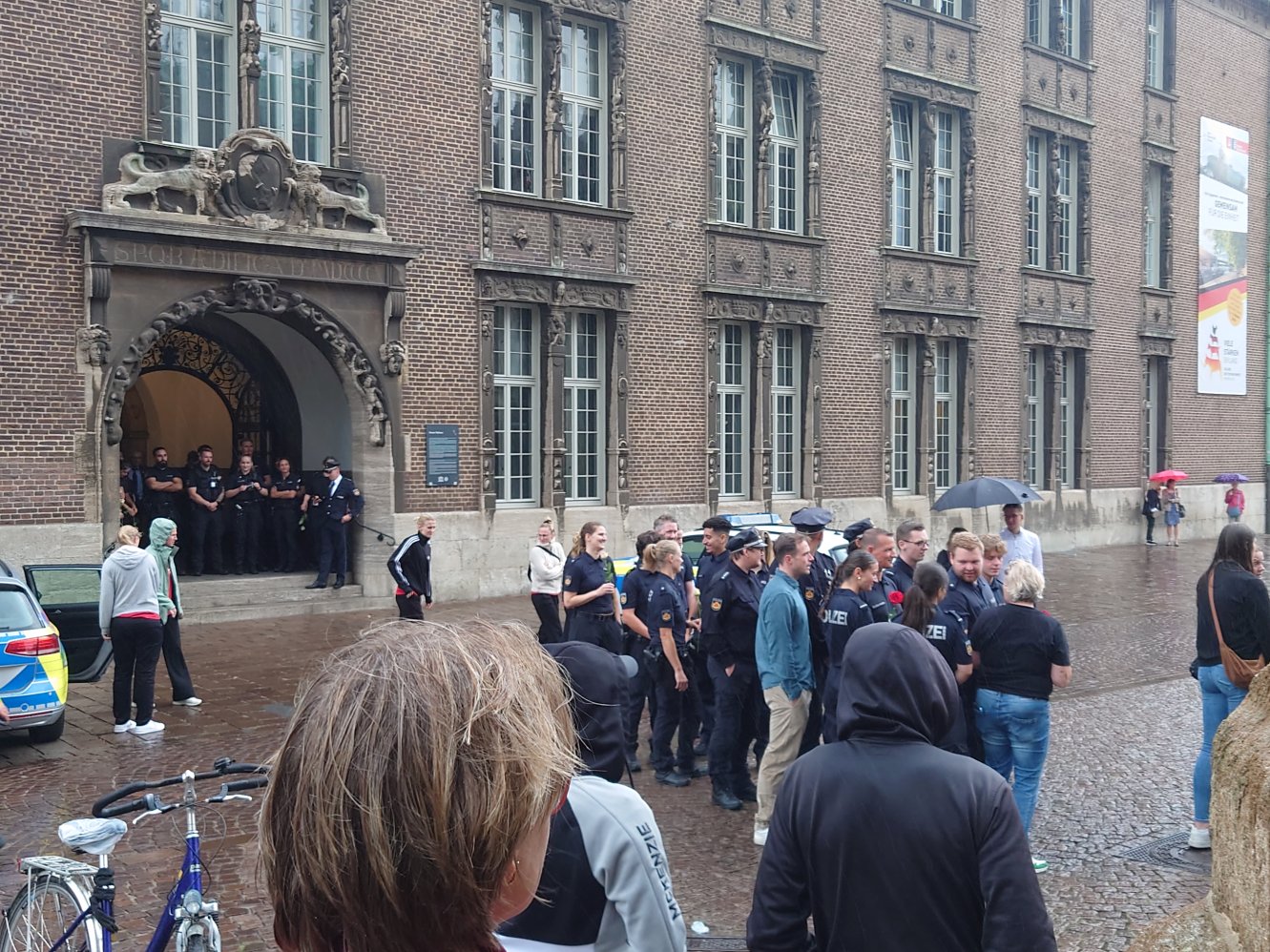
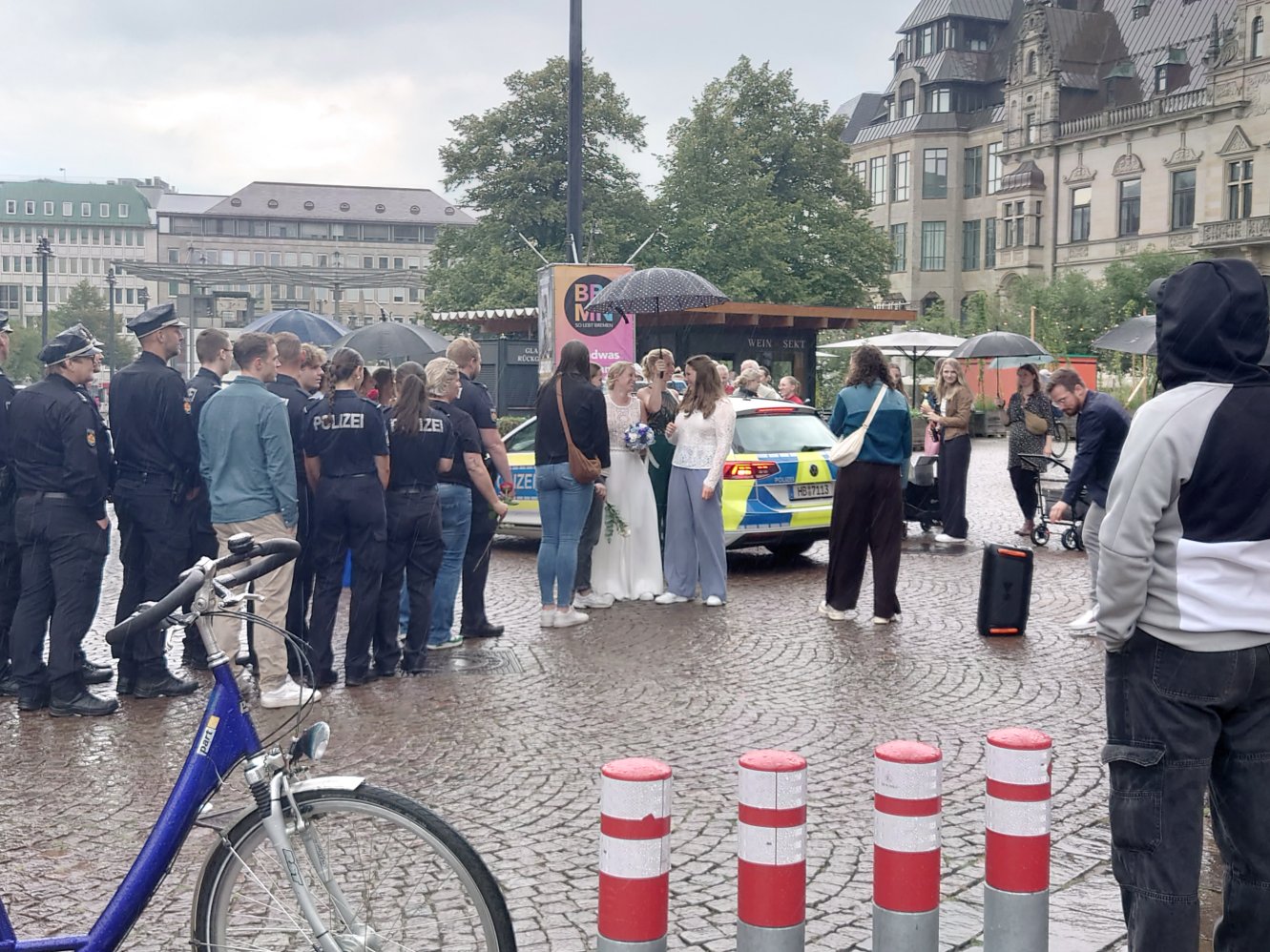
A good part of the Bremen force gathers to celebrate a colleagues Wedding. Bremen Altstadt. August 2026.
Wedding. Bremen Altstadt.
A nice cup of tea. Bremen, August 2026.
Cafe. Near the Hauptbahnhof, Bremen.
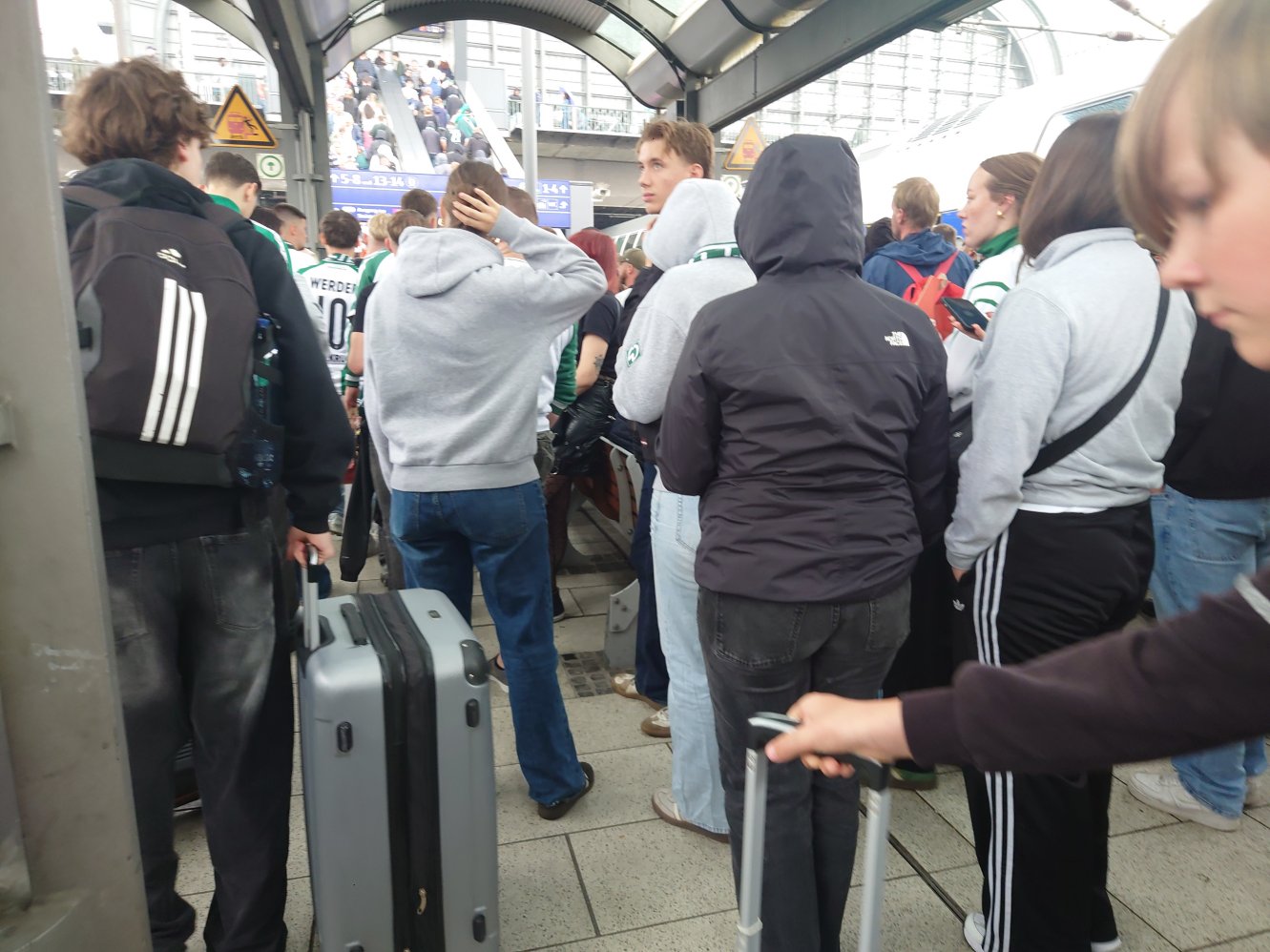
Unterwegs mit Freunden. Train to Hamburg with Werder fans. August 2026.
Unterwegs mit Freunden.
This Saturday, it was estimated that 30,000 Werder fans traveled to Hamburg to see Werder play a DFB-Pokal match against SK Hansa
Hamburg. Unterwegs mit Freunden.
Hamburg. Unterwegs mit Freunden.
Rendsburg High Bridge, crossing the Kiel Canal at Rendsburg.
Rendsburg High Bridge. Crossing the Kieler Canal at Rendsburg.